In this context, “patriot podcasts” means conservative political podcasts, the news, commentary, and talk shows built for right-leaning audiences. The fastest way to start is to open GOPcast or your podcast app and follow one short daily news show plus one long-form commentary show. That combination covers both the headlines and the deeper analysis without eating your whole afternoon.
TL;DR:
- Most conservative listeners prefer a daily news show and a long-form commentary to balance quick headlines with in-depth analysis.
- Trust stems from hosts citing sources, providing factual backing, and correcting themselves when they are wrong over time.
- Video versions of podcasts are becoming essential, offering more flexibility for viewing on multiple screens and better shareability.
- Podcast apps’ connection issues, notification settings, outdated versions, and subscription confirmation often cause playback problems.
- Verifying a host’s credibility involves checking their sourcing practices, track record, and transparency about opinions versus facts.
Table of Contents
- What Kinds of Patriot Podcasts Should You Follow First?
- Why Do Conservative Listeners Stick With These Shows?
- How Do You Choose a Reliable Patriot Podcast?
- Where Is Podcast Listening Actually Headed?
- What to Do When a Show Won’t Play or Load
- How Do You Know a Conservative Host Is Actually Credible?
- Why GOPcast Built a Home for Patriot Podcasts
- Start Listening to Patriot Podcasts on GOPcast
- Sources
What Kinds of Patriot Podcasts Should You Follow First?
Not every conservative podcast fits every listener. A commuter with 25 minutes needs something different than a weekend listener who wants two hours of unfiltered conversation. Sorting shows by category first saves you from subscribing to ten podcasts and finishing none of them.
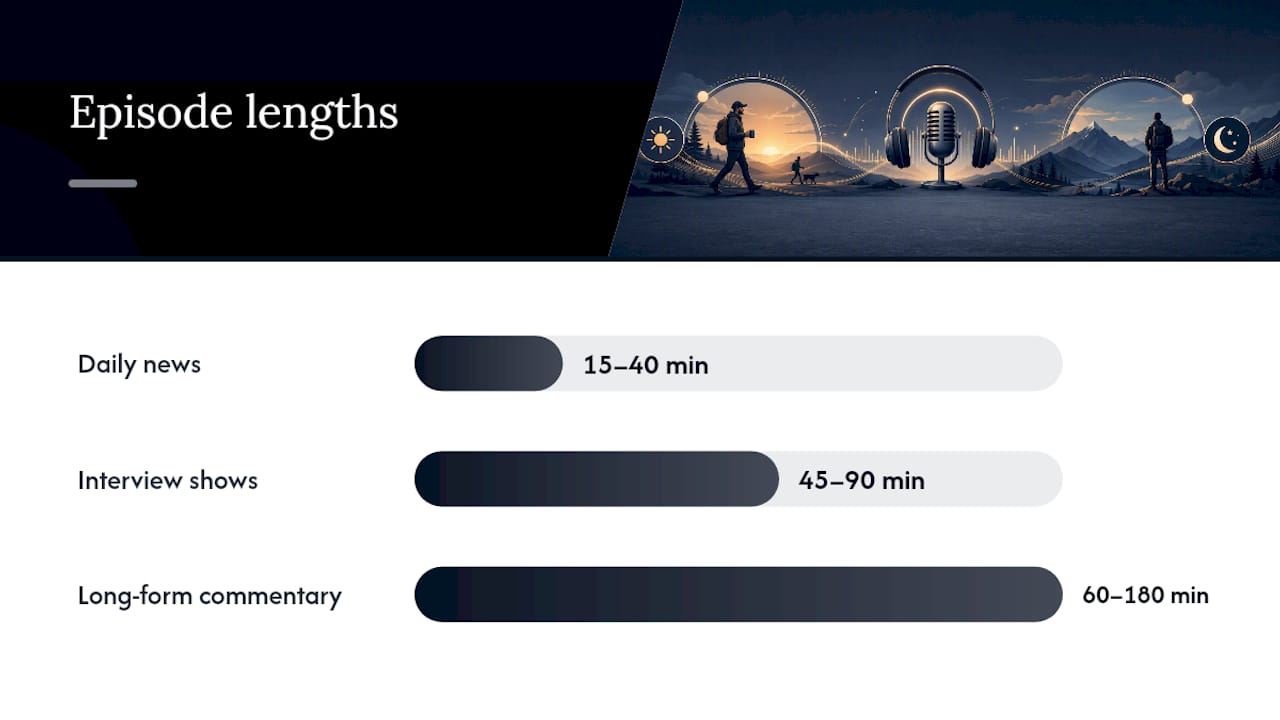
Daily news shows run 15 to 40 minutes and publish Monday through Friday, sometimes with weekend recap episodes. They’re built for commuters and anyone who wants a fast rundown of what happened overnight. Tone tends to be brisk, headline-driven, and light on tangents.
Long-form commentary shows run 60 to 180 minutes and lean into deep dives on a handful of stories rather than skimming the whole news cycle. These suit weekend listeners or anyone doing chores, driving long distances, or working out. The tone is conversational, often opinionated, and closer to a friend talking through the news than an anchor reading a script.
Interview shows mix host commentary with guest conversations, usually 45 to 90 minutes, published a few times a week. They suit listeners who want more than one voice in the room and enjoy hearing pushback or debate.
Activist and issue-focused shows zero in on a specific lane, constitutional law, free markets, media criticism, and publish on a lighter schedule, often weekly. These fit listeners who already know the daily headlines and want depth on one topic.
Once you know which category fits your day, subscribing takes about two minutes:
- Open Apple Podcasts, Spotify, YouTube, or the GOPcast hub and search the show name.
- Tap “Follow” or “Subscribe” so new episodes download automatically.
- Turn on notifications for shows you don’t want to miss the day they drop.
- Build a playlist that mixes one short daily show with one long-form show, so your queue never runs dry.
- Save or bookmark episodes you want to revisit, especially interviews that reference specific data or legislation.
Pro Tip: For long-form shows over 90 minutes, follow the host’s clip channel or highlight reel first. Most personality-led programs, including several available through Glenn Beck’s show page, post 3 to 10 minute cuts of the best segments, which makes it easier to decide which full episode is worth your commute time.
Why Do Conservative Listeners Stick With These Shows?
Trust and identity drive most of it. Listeners aren’t just checking headlines. They’re choosing a voice they already agree with and sticking with that voice over time.
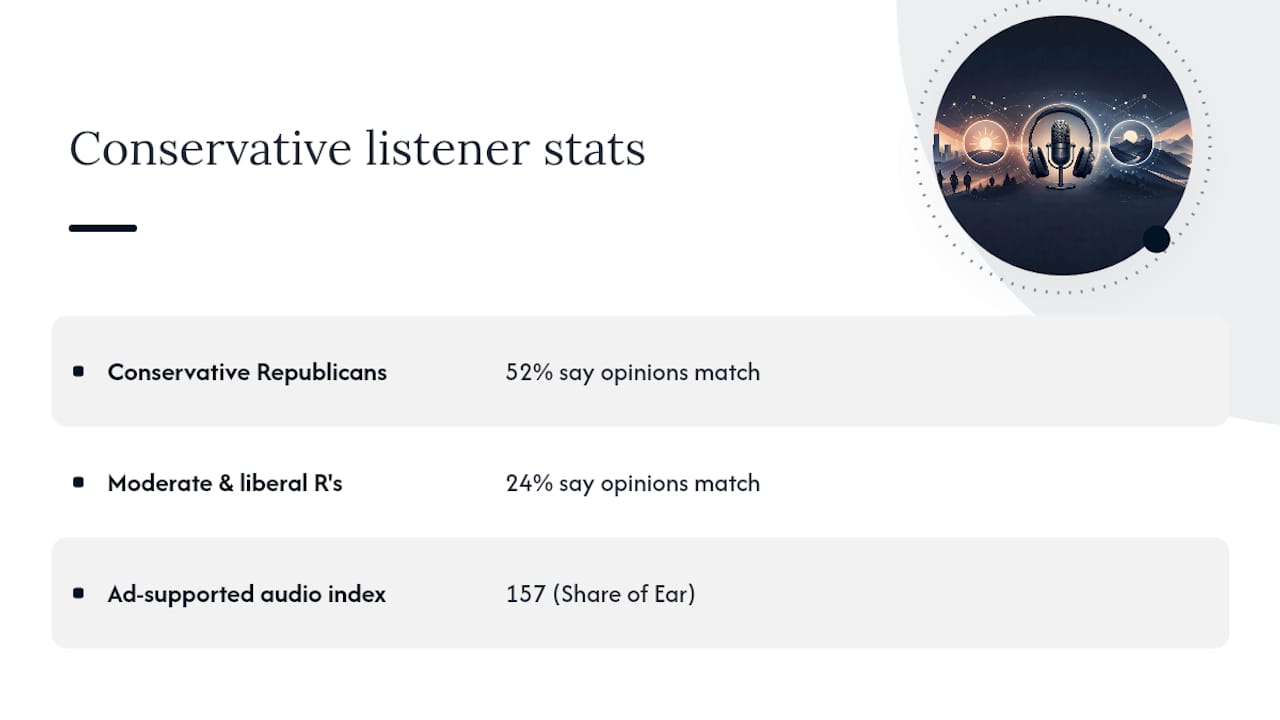
Pew Research found that self-described conservative Republicans are far more likely than moderate or liberal Republicans to say the political opinions they hear on podcasts match their own, 52% versus 24%. That gap explains a lot of the loyalty you see toward hosts like those featured on Clay and Buck’s show: when a host’s take consistently lines up with a listener’s own read on events, the relationship becomes less like reading a newspaper and more like checking in with a trusted source.
Part of that comes down to a documented effect called parasociality, a one-sided but very real sense of intimacy that builds between a listener and a host over hundreds of hours of audio. Academic research on podcast trust describes how this mediated closeness builds confidence in a host even when the content is heavily opinionated rather than strictly reported.
Listeners in conservative podcast communities frequently describe hosts as “telling it like it is,” a framing that research on podcast reviews ties directly to identity and shared values rather than traditional journalistic credibility.
That framing, documented in ISOJ research on podcast reviews, helps explain why conservative audiences often treat their favorite shows as an alternative to what they see as an unsympathetic mainstream press.
Republican listeners also over-index heavily on ad-supported spoken-word audio. Edison Research’s Share of Ear data puts Republican listeners at an index of 157 for ad-supported spoken-word platforms like SiriusXM’s talk channels, well above the general population average.
How Do You Choose a Reliable Patriot Podcast?
Picking a show that fits your politics is easy. Picking one that’s also worth your time takes a few extra minutes of vetting.
Run new shows through this checklist before committing:
- Topical fit. Does the show cover what you actually care about (policy, culture, elections) rather than padding episodes with unrelated filler?
- Host credibility. Does the host cite sources, name specific bills or rulings, or just assert claims without backup?
- Production quality. Clean audio, consistent episode length, and a real release schedule signal a serious operation.
- Cadence. A show that posts twice a month won’t keep you current; match frequency to your news appetite.
- Opinion versus reporting balance. Know whether you’re getting analysis on top of facts or mostly commentary dressed up as news.
Watch for a few red flags too: repeated claims that never get sourced, a pattern of predicting scandals that never materialize, or framing that treats every disagreement as a conspiracy. A single strong opinion isn’t a problem. A pattern of unverifiable claims is.
Subscribing is nearly identical across platforms:
- Apple Podcasts: search the show, tap the show name, then tap “Follow.”
- Spotify: search the title, open the show page, tap “Follow,” and it lands in your library automatically.
- YouTube: search the channel, hit “Subscribe,” and click the bell for notifications.
- GOPcast hub: browse by category, click into a show page, and stream directly with no separate app required.
Pro Tip: Use “Follow” for your daily must-listens and a separate saved playlist for long-form shows you plan to binge on weekends. Mixing the two into one feed usually buries the shorter episodes under hours-long conversations.
Where Is Podcast Listening Actually Headed?
Podcasting isn’t a niche habit anymore. The Infinite Dial 2026 study found that 80% of Americans age 12 and up have listened to a podcast at some point, and 58% listened within the past month. That’s a mainstream audience, not a fringe one.
The bigger shift is video. The same Infinite Dial data shows 57% of listeners have both listened to and watched a podcast, and reporting from TV Technology confirms most podcast audiences now expect a YouTube option alongside the audio feed. The Reuters Institute documents the same trend from the publisher side: creators are moving away from short segmented updates toward personality-led, long-form shows distributed across audio, video, and social clips at once.
That convergence matters for your listening habits, not just for producers:
- Shows that publish on smart TVs as well as audio apps give you more flexibility for how and where you watch.
- Long-form interviews, the kind that ran hours during the 2024 to 2025 election cycle, tend to hold attention better than clipped TV segments, which is part of why they became a major campaign tool.
- Video-first shows are easier to clip and share, which is how a lot of listeners discover new hosts in the first place.
If you want a show that’s easy to find on multiple screens, prioritize one that publishes video versions alongside the audio feed.
What to Do When a Show Won’t Play or Load
Playback problems are almost always a settings issue, not a broken episode. Before assuming a show pulled its content, run through the basics.
Check your app’s connection first. A stalled download or a spinning wheel usually means a weak Wi-Fi or cell signal, not a missing episode. Switch networks or wait a minute before retrying.
Confirm the subscription actually took. Apple Podcasts and Spotify occasionally fail to register a “Follow” tap if the app was mid-update. Search the show again and check whether the follow button still says “Follow” instead of showing as active.
Clear the app’s cache for stuck downloads. On Apple Podcasts, go to settings and adjust the “Limit episode storage” setting, then re-download the episode. On Spotify, removing a downloaded episode and redownloading it usually fixes corrupted files.
Check your notification settings separately from your subscription settings. You can be fully subscribed to a show and still miss new episodes if notifications are toggled off at the app or phone level.
Update the app itself. Podcast apps push frequent updates, and an outdated version is one of the more common causes of episodes failing to load or shows disappearing from your library.
Try the browser version as a backup. If an app is glitching, streaming directly through a hub like GOPcast in a browser sidesteps app-specific bugs entirely and gets you listening again in seconds.
How Do You Know a Conservative Host Is Actually Credible?
Credibility isn’t about whether a host agrees with you. It’s about whether you can verify what they’re telling you.
Start with sourcing habits. A credible host names the bill, the court case, the study, or the original reporting behind a claim, so you can go check it yourself. A host who only says “reports are saying” or “everyone knows” without ever naming a source is asking for trust without earning it.
Track record matters more than any single episode. Has the host made specific predictions before, and did those predictions hold up? One wrong call isn’t disqualifying, but a pattern of confident claims that consistently don’t pan out is worth noticing.
Watch how a host handles being wrong. Reliable hosts correct themselves on air when new information surfaces. Hosts who never once acknowledge an error, across years of episodes, are usually more invested in being right than being accurate.
Finally, separate opinion from reporting in your own head as you listen. A host can be sharply opinionated and still be trustworthy, as long as they’re clear about where the facts end and the take begins. The ISOJ research on conservative podcast audiences found that listeners often reward hosts most for feeling authentic and consistent, which is exactly why it pays to check that authenticity against something more concrete than vibes.
Why GOPcast Built a Home for Patriot Podcasts
We built GOPcast because finding reliable conservative voices across a scattered media landscape shouldn’t take twenty tabs and a dozen app downloads. Our approach is simple: organize shows by topic, keep the selection focused on established conservative voices, and make them available across platforms without friction. We’re not chasing every trend, just curating what already works for listeners who want alignment with their values. Follow the shows that fit you, and check back as our lineup grows.
— GOPcast
Start Listening to Patriot Podcasts on GOPcast
You can find many conservative shows aggregated in one place, making it easier for listeners to access a variety of hosts without needing separate logins for every platform.

A few shows worth starting with right now: the Brian Kilmeade Show for daily news with a conversational edge, The Dan Bongino Show for sharp opinion-driven commentary, Ringside Politics for debate-style discussion, and the long-running No Agenda Show if you want extended, unscripted conversation. Each show page streams free, no separate app download required.
Pick one daily show and one long-form show, hit play on GOPcast, and build your rotation from there.
Sources
- Pew Research Center — How Republicans and Democrats engage with podcasts
- Reuters Institute — The changing shape and new economics of news podcasting
- SSRS/Edison — The Infinite Dial 2026