
Media literacy for conservatives means one thing in practice: knowing how to find and vet conservative news, commentary, and podcasts before you trust or share what they say. The fastest path is a five-point checklist applied at the episode level, backed by transcript tools like Podlens and bias charts like Ad Fontes Media’s. Pair that with a curated hub like Gopcast, and you cut your verification time down to minutes instead of hours.
TL;DR:
- Most episodes should be evaluated with a five-point checklist focusing on sourcing, transparency, factual density, tone, and accountability to ensure reliability.
- Using tools like Podlens, bias charts, and outlet checks helps identify bias patterns, source diversity, and omissions, but manual verification remains essential.
- Building a trusted podcast feed requires active management, including tiering shows by scrutiny level, regularly re-evaluating hosts, and cross-referencing claims.
- Cross-referencing claims with primary documents or diverse outlets is crucial for accuracy, especially when a host makes a sensational claim at the start of an episode.
- Curated hubs like Gopcast streamline access to reliable shows and make verification easier, but consistent re-evaluation and note-taking are vital for maintaining trustworthiness.
Table of Contents
- How Do You Evaluate a Conservative Podcast for Reliability?
- What’s the Fastest Way to Fact-Check an Episode While Listening?
- Which Tools Help You Spot Bias and Credibility Fast?
- How Do You Build a Trusted Conservative Podcast Feed?
- How Should You Take Notes While Listening to Podcasts?
- What Are the Most Trusted Conservative Podcast Networks?
- Why Curated Discovery Matters More Than a Single Trusted Source
- Start Building Your Feed on Gopcast
- Sources
How Do You Evaluate a Conservative Podcast for Reliability?
Every episode you queue up deserves the same five checks, whether it’s a twenty-minute news brief or a two-hour interview. This is the rubric NewsGuard uses to rate podcasts, and it works just as well for a casual listener as it does for a media analyst.
- Factual reporting and sourcing. Does the host cite primary documents, court filings, or named officials, or is everything “sources tell me”?
- Editorial transparency. Can you tell news from opinion? Is sponsorship disclosed, and is there a visible correction policy?
- Factual density versus opinion. Roughly what share of claims tie back to a specific document or person, and how often does a guest make an assertion that goes unchallenged?
- Tone and sensationalism. Fear language, “everyone knows,” and repeated absolutes are red flags regardless of the politics behind them.
- Accountability. Reliable shows publish corrections and explain when they got something wrong instead of quietly editing it out.
Rating projects that track outlet credibility consistently recommend scoring factual rigor and ideological perspective as two separate axes rather than one blended score, since a strongly conservative outlet can still meet a high sourcing standard. A show can be unapologetically right-leaning and still be rigorous. Those are different questions, and conflating them is the single most common mistake conservative listeners make when picking shows.
Pro Tip: Keep a simple three-column note (claim, source cited, verified yes/no) for the first ten minutes of any new show you try. If column three stays mostly blank after three episodes, that show goes in your “caution” tier.
What’s the Fastest Way to Fact-Check an Episode While Listening?
You don’t need a research degree to run a solid check between commutes. Here’s a workflow that takes five to ten minutes per episode once you’ve done it a few times:
- Scan the episode notes or transcript first. Look for timestamps, linked documents, or named sources before you press play. If there’s nothing there, treat every claim as unverified until proven otherwise.
- Flag language, not just facts. Note exact wording when a host uses absolutes (“always,” “never,” “everyone knows”) or fear-based framing. Write the quote down so you can check it later without re-listening.
- Verify one thing. Pick the single most consequential claim in the episode and trace it to a primary document, a government record, or an independent outlet. One check per episode is enough to build a track record on a host.
- Tier the show. Based on what you find, label it core (trust and subscribe), supplementary (follow, but double-check), or caution (listen critically, don’t share unverified).
- Batch your triage weekly. Set aside fifteen minutes on a Sunday to run new episodes through steps one through four instead of doing it reactively every day.
This matters more than it sounds like it should. Transcript-based research on political podcasts found that roughly 1 in 20 episodes in a large studied sample contained at least one unsubstantiated or false claim, and conservative podcasters appeared frequently in that data. That’s not a reason to abandon conservative media. It’s a reason to verify before you repeat.
Pro Tip: If a host makes a big claim right at the top of the show to hook you, that’s exactly the claim worth checking first. Cold opens are where sensational, unverified statements tend to hide.
Which Tools Help You Spot Bias and Credibility Fast?
You don’t have to build a fact-checking process from scratch. A handful of tools now do the heavy lifting on the first pass.
- Podlens runs transcripts through a six-dimension framework that scores political lean, factual density, host trust, framing, source diversity, and omission risk. It also flags echo chamber and omission risk patterns, which is useful if your whole feed leans one direction and you want to know what you’re missing.
- Ad Fontes Media’s Podcast/Audio Media Bias Chart plots shows on bias and reliability separately, and its own analysts warn that shows from the same network can land in very different boxes. One good episode from a host doesn’t guarantee the next one meets the same bar.
- AllSides and NewsGuard-style outlet checks work at the publisher level: funding transparency, correction history, and whether news and opinion are clearly separated on the page.
None of these tools should be your final word. They’re a triage layer, not a verdict. A six-dimension transcript score or a bias chart placement tells you where to look closer, not whether to trust or dismiss a show outright. Treat every automated score as a prompt to go check the primary document yourself, especially since manual coding studies show automated keyword matching alone misses subtle or novel false claims that context reading would catch.
How Do You Build a Trusted Conservative Podcast Feed?
A reliable feed isn’t a fixed list. It’s a tiered system you actively manage, and it starts with sorting shows by how much scrutiny they’ve earned.
- Core tier: shows that consistently link sources, publish transcripts, and correct errors publicly. Subscribe and trust these by default.
- Supplementary tier: shows worth following for commentary or entertainment value, but where you still spot-check specific claims before repeating them.
- Caution tier: shows you listen to critically, often for the sake of knowing what the other side of the conservative conversation is saying, without treating claims as settled.
Mix your formats deliberately. A five-minute news brief catches you up fast but lacks depth; an investigative long-form episode digs deeper but takes longer to verify; interview shows reveal how a host handles pushback, which tells you a lot about editorial discipline. Rotating all three catches blind spots that any single format leaves.
Run a monthly audit. Pull up your feed, drop shows that repeat the same unverified claims, add anything new that’s passed your five-point check, and log recurring issues by host so patterns become visible over time. Curated hubs help here because they centralize episode metadata, transcripts, and category browsing in one place, which cuts the friction of finding shows that actually disclose their sourcing instead of hiding it.
How Should You Take Notes While Listening to Podcasts?
Cross-referencing while you listen turns passive consumption into an actual literacy practice. The habit itself matters more than the tool.
Keep a running log, even a basic notes app entry, with three columns: the claim, the source cited (if any), and whether you’ve verified it. Over a few weeks, patterns emerge fast. You’ll notice which hosts consistently name their sources and which ones lean on vague appeals to authority.
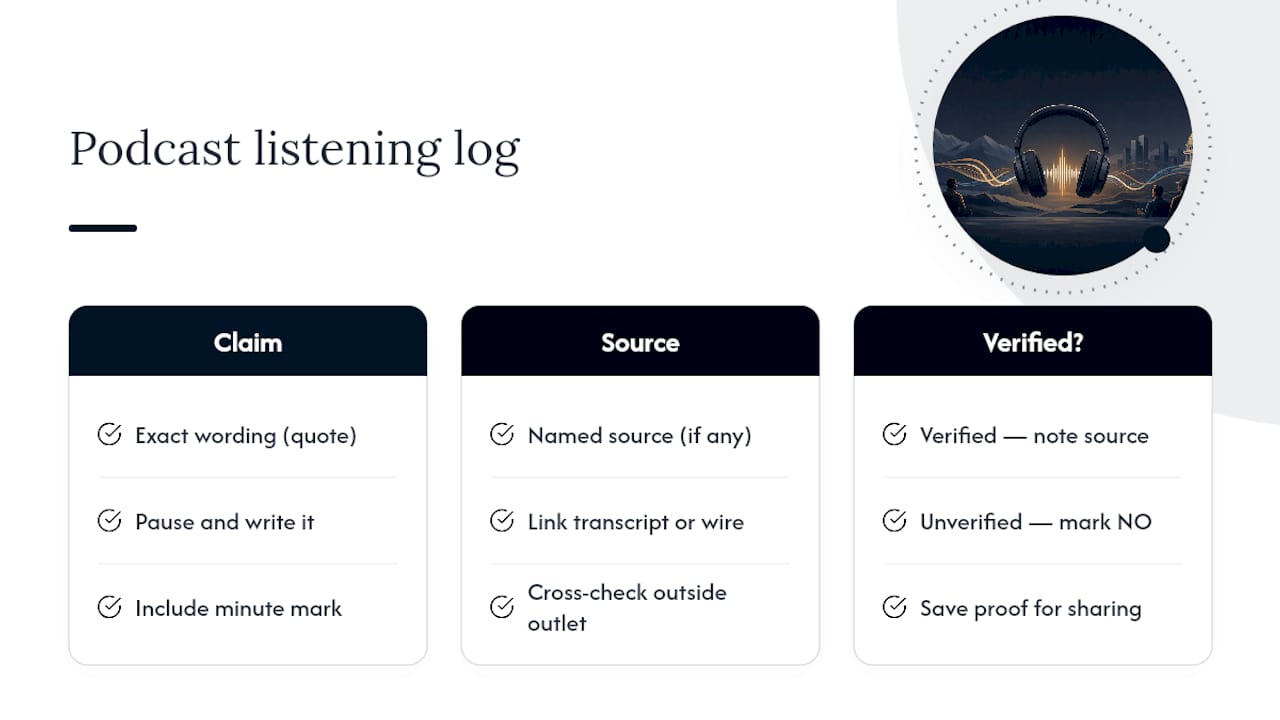
When an episode makes a claim that sounds significant, pause and write down the exact wording before you keep listening. Memory drifts, and paraphrasing a claim from memory an hour later almost always softens or distorts it. The exact quote is what you check against a transcript or a news wire, not your recollection of the gist.
Cross-reference claims across at least one outlet outside your regular feed, ideally one with a different institutional model. The Dispatch, for instance, built its reputation on subscription-funded reporting and recently strengthened its court coverage by acquiring SCOTUSblog, which gives it a sourcing bar worth checking your other shows against. You don’t need to agree with every outlet you cross-reference. You need one that forces your primary source to hold up outside the echo of your usual feed.
Save transcripts or timestamps for anything you plan to share. If you can’t point to the minute mark where a host said it, don’t repeat it as fact.
What Are the Most Trusted Conservative Podcast Networks?
No single hub covers every conservative voice, and you shouldn’t rely on just one. Beyond aggregators, a handful of networks and outlets have built track records worth knowing.
The Dispatch runs subscription-funded, fact-focused shows including Advisory Opinions, and its institutional coverage (including the SCOTUSblog acquisition mentioned above) gives it unusual depth on legal and court reporting for a conservative-leaning outlet.
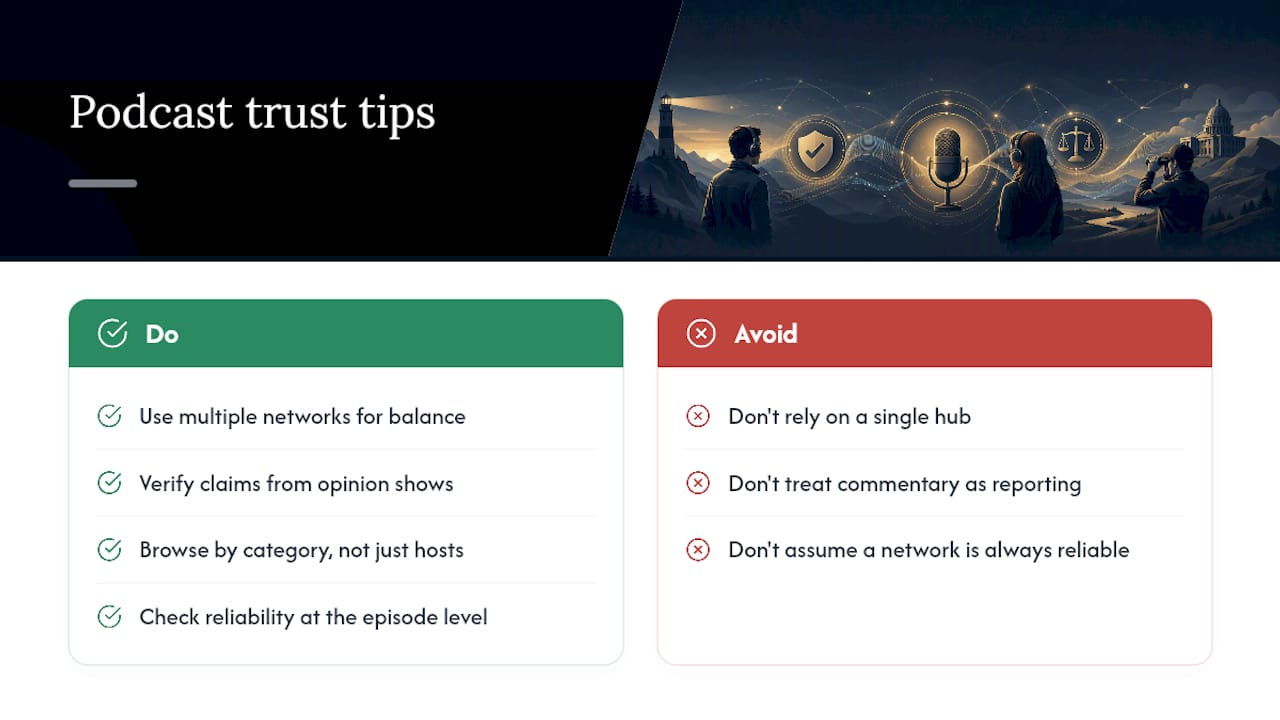
Independent commentary shows with large audiences, think Ben Shapiro’s and Matt Walsh’s programs, sit in a different category: strong on argument and framing, but you should treat them as opinion-first and verify factual claims independently rather than treating commentary as reporting. Gopcast’s Ben Shapiro and Matt Walsh pages are useful starting points precisely because they surface episode notes alongside the audio.
Longer-form interview and investigative networks round out a healthy feed, catching nuance that five-minute briefs skip. If you’re building from scratch, browsing by category rather than by a single favorite host tends to surface a wider range of formats faster. Gopcast’s conservative news podcast list is organized that way for exactly this reason.
No network is uniformly reliable across every show or every episode. That’s the whole point of checking at the episode level instead of trusting a brand name.
Why Curated Discovery Matters More Than a Single Trusted Source
Gopcast exists because no single podcast, however good, should be your entire information diet. The platform hosts shows from Bannon’s War Room to The Dan Bongino Show, but the real value is the curation layer sitting on top: categories, episode metadata, and a structure that makes it easy to apply the checks covered above instead of guessing which of a thousand shows deserves your time.
Curation doesn’t replace verification. It shortens it. When a hub surfaces shows that already publish transcripts and clear sourcing, you spend less time hunting for the primary document and more time actually listening. That’s also what builds a real community around shared values instead of a scattered, one-off relationship with whatever show an algorithm happened to push this week.
A quick, honest example: shows that link episode notes with named sources and timestamps make your five-minute triage workflow actually work. Shows that don’t should sit in your caution tier regardless of how popular the host is.
— GOPcast
Start Building Your Feed on Gopcast
Gopcast is the practical shortcut for the checklist you just read: instead of hunting across a dozen apps and websites to find conservative shows worth your time, you get aggregated shows, curated categories, and free listening in one place. That’s the real advantage over piecing together a feed manually, one show at a time, with no shared sourcing standards between them.

Start with a category built around media accuracy itself. Media Exposed with Adam Weiss applies exactly the kind of scrutiny this article recommends, aimed at the media landscape rather than politics alone. If you want a heavier news and commentary mix, sample The Dan Bongino Show or browse Gopcast’s workout and lifestyle conservative podcasts if you want something for the gym instead of the news desk.
Pick one show from each tier this week, run the five-point check on the first episode, and see how your feed holds up. That’s the fastest way to know which hosts have earned a permanent spot and which ones need a second look.
Sources
Shows change. Hosts change networks, editorial standards slip or improve, and a program you trusted a year ago might not deserve that trust today. Treat your feed as a living document, not a fixed list you set once.
Re-run your five-point checklist on core-tier shows quarterly, not just when you first add them. A host who used to cite primary documents consistently can drift toward unsourced commentary without you noticing, especially if you’ve stopped scrutinizing a show simply because you trusted it in the past.
Watch for pattern shifts rather than single bad episodes. One unverified claim doesn’t sink a show; a host who increasingly skips sourcing or stops correcting errors over several months is a real signal to downgrade from core to supplementary.
Cross-check against outlet-level bias and reliability charts periodically, since placements shift as shows change staff, ownership, or editorial direction. A network’s overall rating from a year ago isn’t a guarantee about this month’s episodes.
Log what changed and why when you move a show between tiers. That record is what turns re-evaluation into an actual habit instead of a vague sense that “something feels off” about a host you used to trust without question.