
For conservative listeners chasing election controversies and legal disputes, there are platforms that pull together shows like Ringside Politics, the Brian Kilmeade Show, and the Dan Bongino Show under one roof. Each covers ballot fights, court rulings, and election integrity questions from a right-leaning lens, mixing hard news with unapologetic commentary. Start there before scattering your attention across a dozen apps.
TL;DR:
- GOPcast consolidates conservative podcasts covering election law debates, legal fights, and election integrity from various formats like debate, investigation, and news briefs.
- Most shows cite specific court rulings and legal sources more often than they rely on vague claims or unverified assertions, aiding critical evaluation.
- Listener loyalty is fluid, and engaging with multiple formats, such as daily commentary and in-depth investigations, provides broader perspectives.
- Choosing hosts based on their expertise, credible guests, and transparency about political bias enhances the reliability of election-law insights.
- Using platform features like following, notifications, and episode note checks ensures timely access to primary sources and legal updates.
Table of Contents
- Which GOPcast shows cover election law and voting controversies?
- How do these podcasts shape conservative views on election controversies in 2026?
- How do you subscribe and find election-law episodes fast?
- Who gets the most out of election-law podcasts?
- Who’s behind GOPcast’s show lineup?
- How should you pick which shows to follow?
- How do these shows differ in depth, frequency, and engagement?
- What biases should you expect from each show?
- How do you critically evaluate what these podcasts tell you?
- GOPcast’s take: curation over chaos
- Start listening to election-law coverage today
- Sources
Which GOPcast shows cover election law and voting controversies?
Not every conservative podcast touches election law with the same depth or tone. Some go deep on court filings and legislative text. Others treat it as one more front in the broader culture fight, wrapped in monologue and callers. Both approaches have value, but knowing which is which saves you from expecting a legal breakdown and getting a rant instead.
Here’s a working shortlist from GOPcast’s lineup, built specifically around election and legal-controversy coverage:
- Ringside Politics — Covers election-cycle sparring and legislative fights with a debate format. Best for listeners who want opposing conservative takes argued out loud rather than delivered as settled fact. Sample segment: dueling analysis of a state’s voter ID law days after a court ruling.
- Brian Kilmeade Show — Blends mainstream conservative news framing with interviews of lawmakers and campaign figures. Best for listeners who want daily context without heavy legal jargon. Sample theme: interview with a state legislator defending a new election integrity bill.
- The Dan Bongino Show — High-energy commentary from a former Secret Service agent turned media figure, frequently tackling ballot security and DOJ decisions. Best for listeners who want a combative, opinionated read on breaking legal news. Sample segment: a monologue dissecting a federal court’s election-related injunction.
- The Sentinel Report — Leans investigative, tracking election administration stories over multiple episodes. Best for listeners who want follow-through on a story instead of a one-off take. Sample theme: a multi-part look at a contested county recount.
- National Update — A tighter news-brief format covering legal and political headlines nationally. Best for listeners short on time who still want the legal angle flagged. Sample segment: a rundown of pending Supreme Court election cases.
- The Hope Report — Faith-inflected commentary that ties election controversies to broader cultural stakes. Best for listeners who want values-driven framing alongside the news. Sample theme: a discussion of ballot measures affecting religious liberty.
Pro Tip: Rotate at least two shows with different formats, one debate style and one investigative, so you’re not hearing the same conclusion restated in six different voices. Pure agreement across every feed is a sign you’ve built an echo chamber, not a briefing.
How do these podcasts shape conservative views on election controversies in 2026?
Podcasts aren’t a side channel anymore. Research on strategic communication finds conservative political podcasts function as a primary source for right-leaning voters trying to understand election controversies, frequently framing topics like the SAVE Act and nomination fights in ways that reinforce listener identity alongside candidate preference.
That influence isn’t static. SSRS reporting on right-wing podcast audiences documents sharp swings between 2024 and 2026, with some shows posting audience growth near 100% while others lost ground fast, often tied directly to whether a host went on break or a new competitor launched. Podcast loyalty in this space is fluid, not fixed.
Media analyst A.J. Bauer has studied why listeners stay locked into specific hosts even when the facts get shaky:
Listeners seek the feeling of “critical engagement” with trusted hosts, wanting to feel like they’re getting the real story mainstream outlets are perceived to withhold, even when the narratives offered include dubious facts.
That single dynamic explains a lot about why a host’s tone matters as much as their sourcing. The rapid rise of figures like Candace Owens shows how quickly a personality can build a community around shared distrust of institutional messaging, turning a podcast feed into something closer to a political identity than a news habit. That’s not automatically a bad thing. But it does mean the shows you follow will shape how you interpret the next contested election, not just report on it.
How do you subscribe and find election-law episodes fast?
Getting set up takes minutes, and most of the friction disappears once you know where to look.
- Search GOPcast directly for the show you want, then open its dedicated show page for episode lists and show notes.
- Follow the show so new episodes land automatically instead of relying on memory to check back.
- Scan episode titles and timestamps on the show page to jump straight to a legal-controversy segment instead of sitting through a full episode.
- Add shows to a listening queue or playlist if you’re tracking multiple hosts on the same story, so episodes stack in release order.
- Turn on notifications in whatever app you’re using, whether that’s a native GOPcast follow or a third-party client, so breaking legal news doesn’t sit unheard for days.
Most shows also distribute through standard channels like RSS feeds, Apple Podcasts, and Spotify, and some GOPcast programs surface on Rumble as well, so you’re not locked into one app if you already have a preferred player.
Pro Tip: Check the show notes before you hit play on a legal-controversy episode. The best shows link the actual court filing or statute they’re discussing, which lets you read the primary source yourself instead of taking the host’s summary on faith.
Who gets the most out of election-law podcasts?
Not every listener wants the same thing from this category, and matching your goal to the right show archetype saves you a lot of wasted listening time.
- Activists who want ammunition for arguments tend to gravitate toward combative commentary shows like Dan Bongino, where the host’s conclusion is the point.
- Legal-detail watchers do better with investigative formats like The Sentinel Report, which follow a story across multiple episodes instead of wrapping it in one segment.
- Casual opinion listeners who want context without commitment fit best with brief-format shows like National Update.
- Red flags worth noting: heavy reliance on unverified claims repeated without new evidence, and conspiratorial framing that never engages a counterargument.
- Reliability cues to look for: hosts who cite specific court rulings, name dates, and bring on guest experts rather than just other commentators.
A simple rotation, one commentary show for daily framing and one investigative or interview program for depth, tends to serve most listeners better than betting everything on a single host’s take. Genre-wide audience research also shows political talk podcasts overall skew far less monolithic than any single show’s audience does, so don’t assume your favorite host represents conservative opinion broadly.
Who’s behind GOPcast’s show lineup?
Some platforms operate as aggregators, not producers of original content, pulling established conservative shows, from major syndicated programs to smaller independent commentary feeds, into a single browsable hub organized by category: news, commentary, interviews, activism, and investigative coverage.
The shows themselves carry their own editorial credentials. Brian Kilmeade brings a background as a longtime Fox News host. Dan Bongino draws on his experience as a former Secret Service agent and NYPD officer. Ringside Politics runs a debate format with multiple recurring conservative commentators rather than a single host’s voice. These platforms typically do not edit or fact-check the programs; they curate access to them, giving listeners a single destination instead of forcing them to track down a dozen separate apps and RSS feeds.
That aggregation model matters more than it sounds. Individual podcast audiences shift fast, as the SSRS audience data referenced earlier shows, with shows gaining or losing significant reach within a single year depending on host availability and new competitors entering the space. A hub that keeps adding and organizing shows gives listeners a stable home base even as individual programs rise and fall in prominence.
How should you pick which shows to follow?
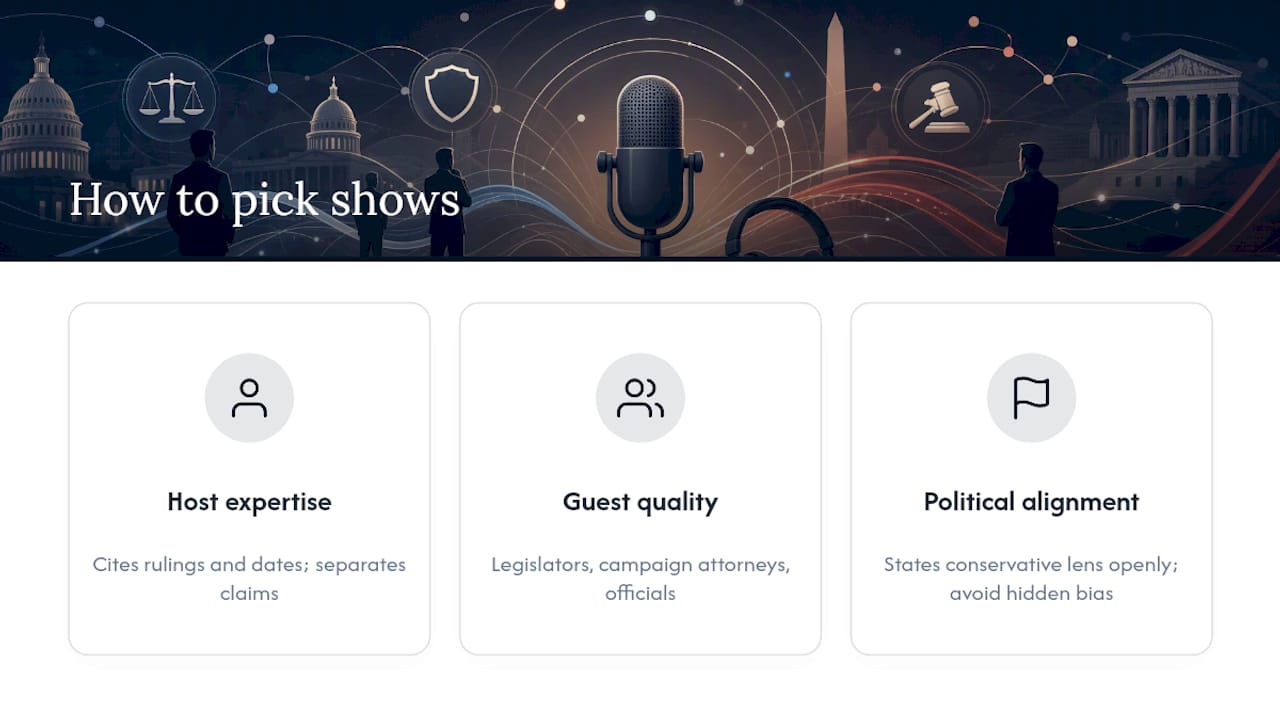
Three criteria matter more than any star rating or download count: host expertise, guest quality, and how openly a show states its political alignment.
Host expertise doesn’t require a law degree. A host who consistently cites specific rulings, names dates, and distinguishes between a lawsuit’s claims and its actual outcome is doing real work, even in a commentary format. A host who treats every controversy as proof of a predetermined conclusion, without engaging what the other side actually argued, is offering entertainment dressed as analysis.
Guest speakers are a strong signal too. Shows that bring on state legislators, campaign attorneys, or election officials, even ones you’d expect to disagree with, tend to offer more texture than shows that only interview other commentators who already agree with the host. Reporting on high-profile political podcasts, including politician-hosted programs like Senator Ted Cruz’s Verdict, suggests audiences reward hosts who mix legal specifics with a clear, consistent voice over hosts who rotate every guest and angle.
Political alignment should be obvious, not hidden. A show that’s upfront about its conservative lens lets you calibrate your trust accordingly. One that pretends to neutrality while pushing a hard angle is the bigger risk, because you’ll take its framing at face value.
How do these shows differ in depth, frequency, and engagement?
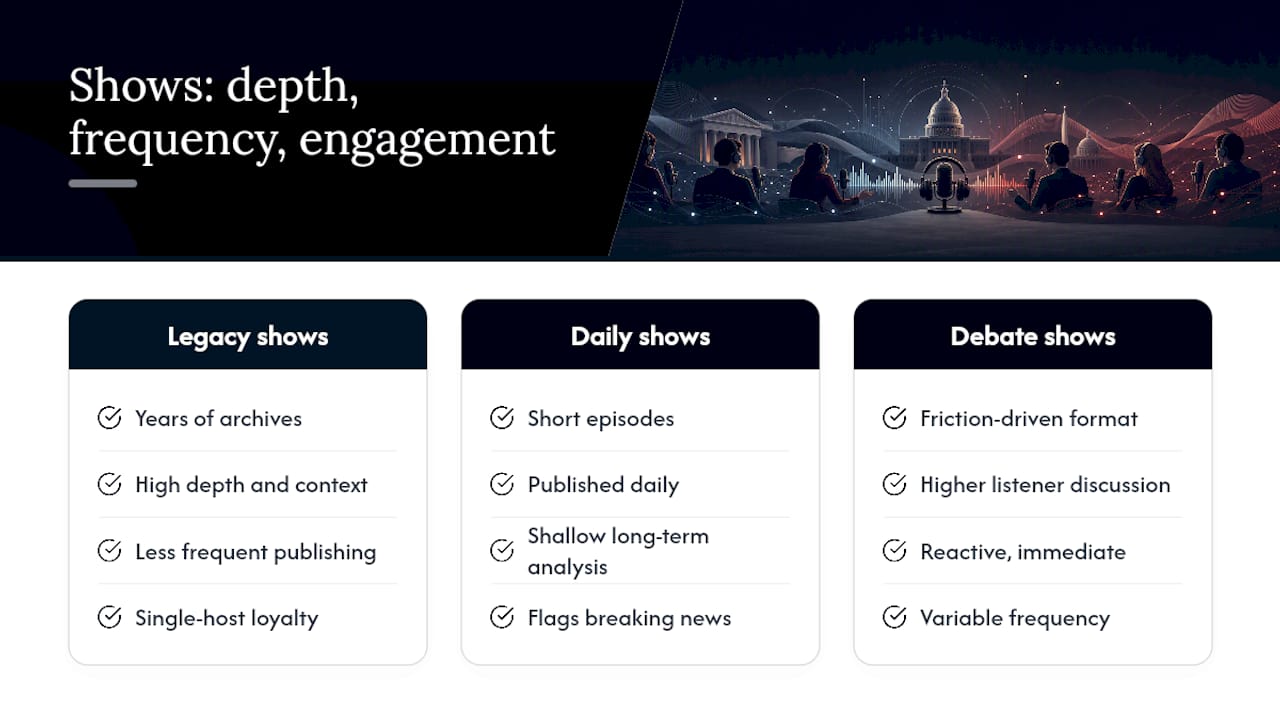
Depth and frequency usually trade off against each other, and it helps to know which side of that trade each show sits on before you commit your listening time.
Legacy shows with years of archives, like the Brian Kilmeade Show, tend to offer depth built on accumulated context: the host has covered a decade of election cycles and can place a new controversy against past patterns. Newer or smaller shows trade that archive for immediacy, often reacting faster to breaking news even if their long-term analysis is thinner.
Frequency varies widely too. Daily shows like National Update prioritize staying current, publishing short episodes that flag developments without deep dives. Shows like The Sentinel Report publish less often but dedicate more runtime per episode to a single story, following it across a court case’s full arc rather than one news cycle.
Engagement patterns track with format. Debate-style shows like Ringside Politics tend to generate more listener discussion because they present friction rather than consensus. Single-host commentary shows build tighter, more loyal followings, often reflected in the audience swings documented across the right-wing podcast landscape, where individual hosts can see rapid gains or losses tied directly to their own output schedule rather than any external event.
What biases should you expect from each show?
Every show on this list has a point of view, and pretending otherwise does listeners no favors. Commentary-heavy programs like the Dan Bongino Show lead with conclusions and build the case backward, which makes for compelling listening but means dissenting evidence gets less airtime than confirming evidence. Debate-format shows like Ringside Politics reduce that risk somewhat by putting competing conservative views in direct conflict, though the range still runs right of center by design.
Interview-driven shows carry a subtler bias: guest selection. A show that only books officials and attorneys who already agree with its editorial stance will sound more authoritative than its actual balance of evidence supports. That’s worth watching for even on shows you trust.
None of this means the coverage is worthless, and it doesn’t mean you should expect false neutrality either. GOPcast doesn’t market these shows as unbiased sources of election law reporting. It markets them as conservative commentary and news, and that framing is accurate. The responsible move is treating each show as an advocate’s take on the facts, not a court transcript, and cross-checking a big legal claim before repeating it as settled.
How do you critically evaluate what these podcasts tell you?
A few habits separate a sharp listener from one who just absorbs whatever a favorite host says. Check whether the host cites a specific ruling, statute, or filing by name, versus gesturing vaguely at “the courts” or “the law.” Specificity is checkable; vagueness isn’t. Look for episode notes that link primary sources like court documents, since the strongest shows include them and the weakest rarely bother.
Watch for repetition of a claim without new evidence behind it. A host who states the same allegation across five episodes without adding a new fact each time is reinforcing a narrative, not reporting new information. Compare across at least two shows with different formats before treating a legal claim as confirmed, since the SSRS audience data shows how much individual show loyalty can distort perception of what’s actually contested versus settled.
Finally, separate the host’s opinion from the underlying fact pattern. A host can accurately describe a court’s ruling and still draw a conclusion about it that goes well beyond what the ruling itself established. Both things can be true at once, and noticing the gap between them is what makes a listener informed instead of just entertained.
GOPcast’s take: curation over chaos
Some platforms have been built to address the challenge of finding reliable conservative voices amid an increasingly fragmented media landscape. Their curation principle is to aggregate shows conservative listeners already trust, organize them by category, and stay out of the way of the content itself. These platforms typically do not edit the programs or soften their edges but aim to make them easier to find in one place instead of a dozen.
{{BRAND_SIGNAL_1}} {{BRAND_SIGNAL_2}} {{BRAND_SIGNAL_3}}
{{AUTHOR_CREDENTIALS_PLACEHOLDER}} {{PROPRIETARY_METRICS_PLACEHOLDER}}
— GOPcast
Start listening to election-law coverage today
Chasing conservative election coverage across five different apps wastes time you could spend actually listening. GOPcast solves that by putting the shows already covering election controversies and legal fights, from debate formats to hard commentary, in one place you can browse instead of hunt for.

If you want combative daily takes on ballot security and DOJ decisions, start with the Dan Bongino Show. If you’d rather hear conservative voices argue out the legislative fights themselves, Ringside Politics runs that debate format episode after episode. And for a steadier, mainstream-adjacent read on the news alongside lawmaker interviews, the Brian Kilmeade Show fits that role well. Pick one, hit follow, and let the next episode land in your queue automatically.
Sources
- Code-switching candidates: strategic communication, podcasts, and cultural and racial politics (2026)
- Right Wing Podcast Power Shift - SSRS
- The 19th — ‘These women don’t trust politicians. They do trust Candace Owens.’ (2026)