The fastest way to find conservative podcasts on Rumble is to start with GOPcast, which aggregates the biggest right-leaning shows into one hub instead of making you search Rumble show by show. From there, you can jump straight to a show’s Rumble channel or stream it through GOPcast’s own show pages.
To get listening in the next five minutes:
- Open GOPcast’s home page and browse by show or category.
- Search Rumble directly for a specific host’s channel name if you already know who you want.
- Bookmark two or three shows now so you’re not starting from scratch every time.
Good starting points: Bannon’s War Room for daily political strategy, The Dan Bongino Show for law-enforcement-informed commentary, and America’s Voice Live for a livestream discussion format.
Key Takeaways
GOPcast works as a starting point because it centralizes video-first, community-driven conservative shows that are otherwise scattered across dozens of individual Rumble channels.
| Point | Details |
|---|---|
| Start with a hub, not a search | Searching Rumble channel by channel wastes time; a curated portal gets you to verified shows faster. |
| Verify before you follow | Check upload history and consistency to avoid impersonator or fan-run channels posing as the real host. |
| Match format to habit | Pick livestreams for active engagement and recorded episodes for commutes or background listening. |
| Rumble policy shapes tone | Looser political-content moderation means longer, less-cut segments than on mainstream video platforms. |
| GOPcast simplifies discovery | GOPcast aggregates shows like Bannon’s War Room and The Dan Bongino Show into one browsable catalog, free to stream. |
Table of Contents
- Why Conservative Podcasters Choose Rumble
- How to Find and Follow Conservative Podcasts on Rumble
- Which GOPcast Shows Should You Start With?
- Why GOPcast Is a Reliable Starting Point
- How Rumble’s Content Policies Shape What You’ll See
- How Rumble Content Compares to Other Platforms
- How to Judge Whether a Conservative Podcast on Rumble Is Worth Your Time
- What Actually Matters When Choosing a Show
- Start Listening on GOPcast Today
- Sources
Why Conservative Podcasters Choose Rumble
Rumble built its reputation on being video-first, and that changes what a “podcast” actually feels like once you watch instead of just listen. A host holding up a document during a monologue, cutting to a guest’s facial reaction during a heated exchange, or pulling up a graphic mid-segment adds context that audio alone can’t deliver.
The comment sections and live chat features matter more than people expect. During a livestream, you’re watching a host react to the chat in real time, which turns a monologue into something closer to a town hall. That’s a different experience than downloading an episode and listening on a commute with no interaction at all.

A pattern worth knowing before you dive in: a lot of “video podcasts” on Rumble are simulcasts. The host is often running the same show they’d run on talk radio, complete with commercial-style breaks and call-in references, just filmed live for a video audience. Feedspot’s directory notes that shows like Triggered With Don Jr. publish full video versions on Rumble specifically for this reason.
What that means for you:
- If you want a traditional radio feel with visuals attached, simulcasts are your best bet.
- If you want a show built for video from the ground up, look for programs that lean on live chat and on-screen graphics as part of the format itself.
How to Find and Follow Conservative Podcasts on Rumble
Finding the right channel on Rumble is easy once you know what to search for and what to avoid. Follow these steps:
- Search the exact show or host name. Typing “Charlie Kirk” or “Dan Bongino” directly into Rumble’s search bar gets you closer to the verified channel than a generic term like “conservative podcast.”
- Check for a verified badge and consistent upload history. Charlie Kirk’s official Rumble channel publishes long-form episodes and livestreams on a predictable schedule, which is a good baseline for what a legitimate channel looks like.
- Use channel pages and playlists to separate formats. Most active hosts organize full episodes, livestreams, and short clips into separate playlists, so you’re not scrolling past thirty-second highlight reels to find the full show.
- Follow the channel and turn on notifications. This step is easy to skip and it’s the one that actually keeps you from missing episodes, especially for shows that livestream at irregular times.
- Compare app and web behavior. Notifications on Rumble’s mobile app tend to be more reliable than browser alerts, so if you’re a daily listener, the app is worth installing.
Pro Tip: Before you follow a channel, scroll back to its earliest uploads. Impersonator and fan-run channels usually have a thin upload history or reused thumbnails from the real host’s other platforms. A genuine channel almost always has years of consistent content behind it.
If you’d rather skip the manual search entirely, GOPcast’s curated show pages organize this discovery work by topic, so you land on the right show without guessing which of five similarly named channels is the real one.
Which GOPcast Shows Should You Start With?
GOPcast hosts a wide roster of conservative programs, and picking where to start depends on what you actually want out of a podcast, daily news, deep interviews, legal analysis, or something lighter.
For daily news and commentary:
- Bannon’s War Room — Multiple segments a day covering political strategy and grassroots organizing.
- The Dan Bongino Show — A former Secret Service agent’s take on law enforcement, politics, and media bias, streamed on Dan Bongino’s GOPcast show page.
- National Update — A tighter, headline-driven format for listeners short on time.
- My Mornings — Built around the early news cycle before the workday starts.
For interviews and long-form conversation:
- The Trey Gowdy Podcast — The former congressman’s legal background shapes sharper questioning than most political interview shows.
- Hang Out with Sean Hannity — A more relaxed, conversational format than his cable programming.
- The Secretary Kennedy Podcast — Policy-focused discussions from a former cabinet-level perspective.
For legal and investigative depth:
- The Sentinel Report — Leans into investigative stories mainstream outlets tend to underreport.
- Stinchfield Tonight — Fast-paced commentary with a sharper opinion edge.
For culture and lighter takes:
- Louder with Crowder — Comedy mixed with political commentary, aimed at listeners who want some humor with their news.
- The Hope Report and The Brian Kilmeade Show round out the roster with a mix of interviews and daily analysis, giving you more options once you know your preferred format.
For livestream community energy:
- America’s Voice Live — Built around live audience interaction rather than a pre-recorded monologue.
Why GOPcast Is a Reliable Starting Point
GOPcast hosts and aggregates a roster that includes Bannon’s War Room, The Dan Bongino Show, and more than a dozen other named conservative programs, which means you’re not piecing together a listening habit from a dozen different bookmarks. The GOPcast blog on conservative news podcasts breaks the catalog down by category, from daily news to interviews to culture commentary, so browsing feels closer to flipping through a curated channel guide than searching cold.
Aggregators reduce discovery friction by centralizing show pages and providing curated categories, according to GOPcast’s own analysis of the conservative podcast landscape, which matters most when the shows you want are scattered across five or six different platforms to begin with.
How Rumble’s Content Policies Shape What You’ll See
Rumble markets itself as a platform with a lighter content-moderation touch than mainstream video sites, and that positioning is exactly why many conservative hosts moved their video presence there in the first place. Shows that faced demonetization or removal pressure elsewhere often describe Rumble as a place where political commentary, including sharp criticism of media and government figures, doesn’t trigger the same automatic flags.
That doesn’t mean the platform has no rules. Rumble still enforces terms of service around copyright, harassment, and illegal content, and channels can be suspended for violations just like anywhere else. What’s different is the threshold for political opinion and commentary, which tends to run looser than on platforms built around advertiser-friendly content guidelines.
For listeners, this shows up in small but noticeable ways: hosts speak more freely, segments run longer without ad-driven cuts, and livestreams often include unscripted tangents that a more heavily moderated platform might trim or flag. If you’ve felt like conservative commentary elsewhere gets sanitized or cut short, this is likely the biggest practical difference you’ll notice on Rumble.
It’s worth remembering that content policy differences are platform-level, not host-level. The same host may sound sharper on their Rumble channel than on a network broadcast simply because the guardrails are different, not because the underlying opinions changed.
How Rumble Content Compares to Other Platforms
The same host often sounds different depending on where you find them, and that gap is usually about platform incentives, not personality. A show clipped for a mainstream video platform tends to get trimmed for length and softened at the edges; the same episode on Rumble often runs uncut, with the tangents, ad reads, and unscripted moments left in.
Audio-only platforms have their own tradeoff. You lose the visual context, the guest reactions, the on-screen graphics, but you often gain portability for a commute or workout. Industry rankings show hosts like Ben Shapiro, Mark Levin, and Dan Bongino now distributing across both formats simultaneously, which tells you the audience itself is split between wanting video and wanting audio depending on the moment.
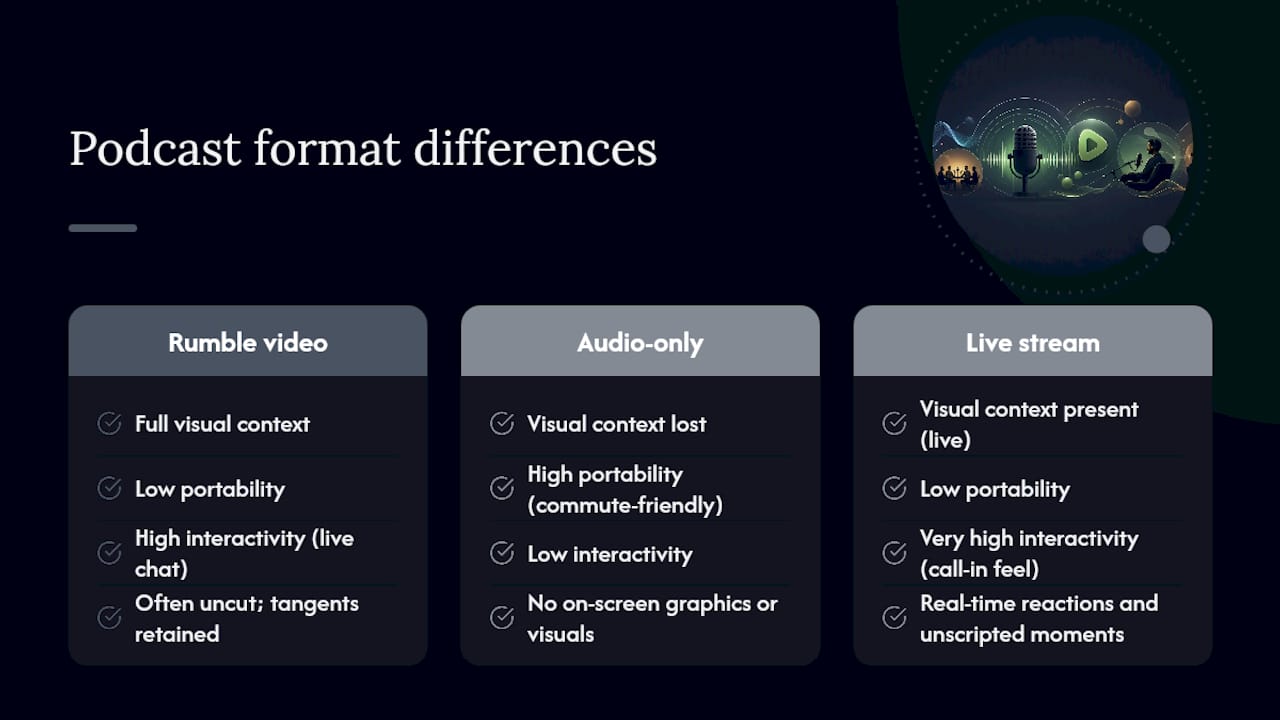
Where Rumble pulls ahead is the live layer. A recorded episode on a traditional podcast app is a one-way conversation. A livestream on Rumble, with active chat running alongside the host, turns the same content into something closer to a call-in radio show updated for video. That’s not a small difference if you’ve ever wanted to react to a segment in real time instead of just absorbing it.
The tradeoff is discovery. Scattered across dozens of individual host channels, finding the right show on Rumble takes more digging than opening a single directory. That’s the gap a curated hub is built to close.
How to Judge Whether a Conservative Podcast on Rumble Is Worth Your Time
Not every channel calling itself a conservative news show is run by someone with real reporting or policy background, so a little vetting goes a long way before you make a show part of your routine.
Start with the host’s track record outside Rumble. A host with a documented history in journalism, law, government, or media, like a former prosecutor, a syndicated radio veteran, or a former administration official, brings a different level of credibility than an anonymous commentary channel with no public background.
Check upload consistency and production quality next. Shows that have run for years with a steady schedule and clear production value have generally built and kept an audience for a reason. A channel with sporadic uploads and low view counts isn’t automatically wrong, but it deserves more scrutiny before you treat it as a primary news source.
Cross-reference big claims. If a host makes a specific factual claim, especially about a breaking story, see whether other outlets or directories are covering the same angle. Editorial directories like Feedspot and industry rankings can help you sanity-check whether a show is part of the broader conservative media conversation or an outlier making claims nobody else is reporting.
Finally, watch how a host handles being wrong. Anyone can make a bad prediction. Hosts who acknowledge it openly tend to be more reliable long-term than ones who quietly scrub the record.
What Actually Matters When Choosing a Show
The advice you’ll find elsewhere tends to focus on subscriber counts and production budgets, and honestly, that’s the wrong starting point. A show with a smaller audience but a host who actually has the background to speak on a topic, legal experience, government service, investigative reporting, is worth more than a slickly produced channel repeating headlines with more energy.
The bigger mistake listeners make is treating Rumble as one undifferentiated feed of “conservative content” instead of a collection of genuinely different shows built for different needs. A daily news update and a long-form interview show solve different problems, and trying to get both from the same program usually leaves you disappointed in one direction or the other.
If there’s one thing worth prioritizing first, it’s matching the show’s format to your actual listening habit. Commuters want tight, headline-driven episodes. People who watch while working from home can handle livestreams with tangents. Figure out which one you are before you start following ten channels you’ll never actually watch.
Start Listening on GOPcast Today
Instead of hopping between a dozen individual Rumble channels to find the shows you actually want, GOPcast puts the biggest conservative programs in one place, organized so you can browse by topic instead of guessing at search terms.

- Curated catalog: Every major show, from Bannon’s War Room to Stinchfield Tonight, sits in one browsable hub instead of scattered channels.
- Live access: Stream shows like America’s Voice Live as they happen, not just after the fact.
Listening is free, no account or subscription required to start. Head to The Dan Bongino Show’s page on GOPcast right now and press play on today’s episode, or browse the full catalog from the home page to find your next daily listen.
Sources
- 100 Best Conservative Podcasts to Listen to in 2026
- Best Conservative Podcasts in 2026 (Top 20, Ranked)
- The Charlie Kirk Show