
Yes, clean political podcasts exist, and you don’t have to dig through hours of yelling to find them. Shows like Left, Right & Center from KCRW, the NPR Politics Podcast, and The Rest Is Politics prove that political talk can be substantive without profanity, ad hominem attacks, or one-sided cheerleading. The common thread: hosts who argue in good faith, cite sources, and treat disagreement as the point rather than a problem.
TL;DR:
- Most clean political shows avoid profanity but still maintain respectful disagreement and source claims openly; avoid hosts who mock or attack opponents personally.
- Listening to a mix of newsroom updates, cross-aisle debates, and long-form interviews ensures a balanced and informative rotation that reduces bias.
- Check episodes for consistent language policies, respectful guest treatment, clear sourcing, and evidence of on-air corrections before fully subscribing.
- Sample episodes within the first 10 to 20 minutes to gauge tone, argument quality, source use, and suitability for shared listening environments like family or car.
- Shows that focus on explaining policy mechanics and presenting opposing views fairly tend to foster civility and are more trustworthy than sensationalist or token-participant formats.
Table of Contents
- What Makes a Political Podcast “Clean”?
- The Best Clean Political Podcasts to Start Listening to This Week
- How Do You Tell If a Show Is Really Clean?
- How to Sample and Build a Balanced Political Podcast Rotation
- How These Shows Get Chosen for a Clean List
- Who Curates This List and Why It’s Worth Trusting
- How the Podcasts Maintain Neutrality and Avoid Political Bias
- What to Know About the Hosts Behind These Shows
- What Listeners Actually Say About the Tone of These Shows
- Clean Political Podcasts vs. the Loudest Shows in the Category
- Why Civil Political Listening Actually Matters
- Start Listening to Clean, Civil Political Shows Today
- Sources
What Makes a Political Podcast “Clean”?
“Clean” doesn’t mean bland or apolitical. It means the show argues its politics without the verbal trash that makes so much political media unlistenable around family or coworkers. That distinction matters more than most “best of” lists acknowledge, because plenty of popular shows are technically profanity-free yet still spend half their runtime mocking the other side instead of engaging with it.
The shows on this list share three traits. First, hosts disagree with each other’s ideas, not their character. Second, claims come with sources you could actually check, not vague appeals to “everyone knows.” Third, episodes run without gratuitous language, which makes them safe to play in a car with teenagers or during a family dinner without a scramble for the skip button.
The Best Clean Political Podcasts to Start Listening to This Week
This shortlist mixes newsroom-style updates, cross-aisle debate shows, and long-form interview formats so you can build a rotation instead of relying on a single voice. Each entry tells you what the show is best for, its tone, and how long you’re committing to before you hit play.
-
Left, Right & Center (KCRW): Best for structured debate between people who actually disagree. The show pairs commentators from across the political spectrum and pushes them to unpack their differences instead of smoothing them over. Episodes run around 30 to 40 minutes weekly. Sample the segment where panelists react to a breaking news story rather than the interview episodes, since that’s where the format shows its strength.
-
NPR Politics Podcast (NPR): Best for a fast, reporter-led catch-up on what happened and why it matters. NPR’s political correspondents explain the mechanics of a story rather than perform outrage about it, which makes this the closest thing to a daily briefing in podcast form. New episodes drop most weekdays and run 20 to 30 minutes. Start with any “Weekly Roundup” episode to get a feel for the group dynamic.
-
The Rest Is Politics: Best for insider political analysis delivered as a genuine argument between two people who used to be political rivals. Hosts Alastair Campbell and Rory Stewart built the show around modeling disagreement between people from opposite ends of the spectrum, and it plays out weekly in episodes that typically run 45 to 60 minutes. Sample an episode tagged “Question Time,” where listener questions force both hosts off their talking points.
-
A civics-and-context newsroom show: Best for listeners who want depth without a daily time commitment. Look for a weekly format (60 to 90 minutes) that spends more time explaining policy mechanics than predicting political winners. These shows tend to run lighter on speculation and heavier on primary documents.
-
A cross-aisle interview series: Best for hearing a single guest challenged from multiple ideological angles in one sitting. Episode length varies, usually 40 to 70 minutes, and frequency is often biweekly. Sample an episode where the guest is interviewed by two hosts who disagree with each other, not just with the guest.
-
A local or regional politics roundtable: Best for listeners who want political discussion grounded in specific policy outcomes rather than national horse-race coverage. These shows run shorter, often 25 to 35 minutes, and appear weekly. They tend to skip the shouting because the stakes are concrete (a school board vote, a zoning fight) rather than abstract tribal wins.
-
A historian-hosted context show: Best for understanding how current events fit into longer patterns. Episode length runs long, often over an hour, with a monthly or biweekly release schedule. Sample the episode that covers a topic you already know something about, so you can judge whether the historical framing holds up.
-
A explainer-format policy podcast: Best for listeners who want the “how it actually works” version of a political story rather than the “who’s winning” version. These run 20 to 45 minutes, usually weekly, and skew toward primary sources like bill text and agency reports rather than pundit reaction.
Build your rotation from at least three of these categories: one newsroom update, one cross-aisle debate, and one long-form interview. That mix keeps you informed without leaving you stuck in a single tone or a single set of assumptions, and it lines up with how Pew Research Center tracks shifting podcast listening habits.
How Do You Tell If a Show Is Really Clean?
Run any show through a short checklist before you commit to a season’s worth of episodes.
- Language policy. Does the show avoid profanity as a rule, or only when it happens to slip the host’s mind? Consistency matters more than a single clean episode.
- Guest civility. Are guests interrupted mid-sentence, or given room to finish an argument before the host pushes back? Shows that cut off opposing views usually aren’t interested in the view, just the applause line.
- Sourcing. Does the host cite a study, a transcript, or a government report, or just assert something as fact? A show worth your time names its sources out loud.
- Corrections policy. Has the show ever walked back a claim on air? Shows that never correct themselves are either flawless or not paying attention.
Red flags: regular profanity, recurring personal attacks instead of argument, conspiracy framing presented without evidence, and a total absence of named sources.
Positive signals: a guest slate that includes people who disagree with the host, occasional on-air fact-checking, content warnings before intense episodes, and published transcripts you can skim before committing 40 minutes.
Pro Tip: Skim the last three episode descriptions on a show’s homepage before subscribing. If every title reads like a headline built to provoke outrage, the audio will match.
How to Sample and Build a Balanced Political Podcast Rotation
You don’t need to finish a full episode to know if a show fits. Listen to the first 10 to 20 minutes and pay attention to host tone, how guests are introduced, and whether the episode leans on sourced claims or just opinion. That window is usually enough to catch ad hominem patterns or an absence of evidence.
Once you’ve sampled a few shows, build a weekly rotation instead of binging one voice:
- Pick one newsroom-style update for daily or near-daily news catch-up.
- Add one cross-aisle debate show weekly to hear both sides argue directly with each other.
- Include one long-form interview show, biweekly or monthly, for depth on a single topic.
- Check episode descriptions and content warnings before playing anything in front of kids or in a shared car.
- Use playlist features, 1.5x speed, and bookmarks to fit episodes into commutes without falling behind.
This three-part mix keeps any single host’s blind spots from becoming your only lens on the news.
How These Shows Get Chosen for a Clean List
Vetting starts with sampling recent episodes, not just relying on a show’s reputation or its “about” page. That means checking transcripts or episode descriptions for language and tone, and confirming the show has published new episodes within the last six months. A podcast with a devoted following but no new content in over a year doesn’t belong on an active listening list, however good its archive is.
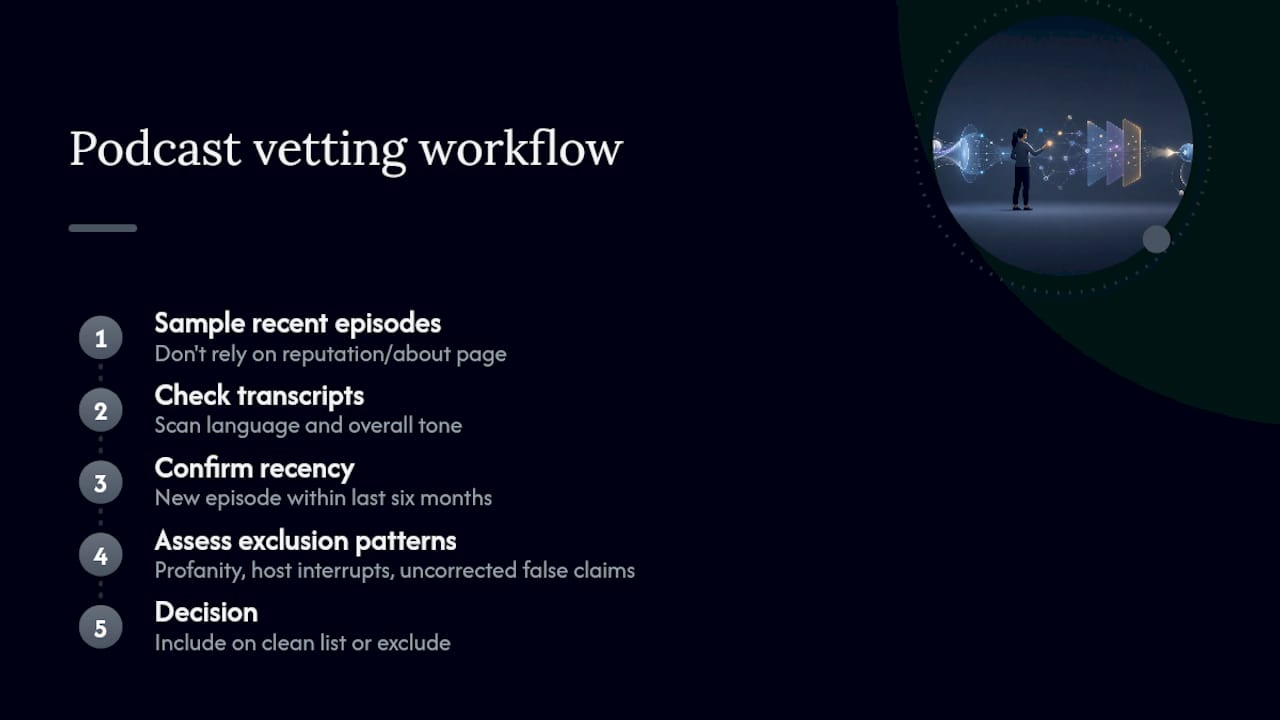
Shows get excluded for predictable reasons: a pattern of profanity despite an otherwise clean format, a host who consistently talks over guests instead of engaging their argument, or a claim later shown false with no on-air correction. None of that means a show is bad entertainment. It just means it isn’t “clean” by the standard this list uses.
Who Curates This List and Why It’s Worth Trusting
Gopcast built its reputation aggregating conservative political shows in one place, from Bannon’s War Room to workout-friendly conservative programs listeners can queue up during a commute. That curation work means sifting through a lot of political audio to figure out what’s substantive and what’s just noise, and it’s the same skill applied here to civil, cross-spectrum shows.
A show earns a spot on a clean list by demonstrating it, episode after episode, not by claiming it in a tagline. Consistency is the actual test.
Show descriptions and episode lengths change, so verify current details on each show’s own homepage, including pages Gopcast curates directly, before you build a permanent rotation around any single title.
How the Podcasts Maintain Neutrality and Avoid Political Bias
None of these shows claim to be free of a point of view, and that’s a feature, not a flaw. Genuine neutrality in political media is close to impossible; hosts have opinions, and pretending otherwise usually just hides bias instead of removing it. What these shows do instead is structural: they build disagreement into the format itself.
Left, Right & Center does this literally, pairing commentators from different ideological camps and asking them to argue the case rather than perform consensus. KCRW’s own framing pushes listeners to “look more closely” and challenge their assumptions rather than simply agree with whichever panelist sounds most confident. The Rest Is Politics uses a similar mechanic with two hosts instead of a rotating panel, which means every episode has a built-in check on any single narrative taking over.
Newsroom shows like the NPR Politics Podcast take a different route: they focus on explaining mechanics (how a bill moves, what a ruling actually changes) rather than predicting winners and losers, which naturally lowers the temperature. The balance isn’t the absence of opinion. It’s the presence of a counterargument in the same episode, every time.
What to Know About the Hosts Behind These Shows
A host’s background tells you a lot about what kind of political show you’re getting, so it’s worth a quick check before you commit. Journalists tend to produce shows built around reporting and sourcing. Former political operatives tend to produce shows built around strategy and insider read. Neither is automatically better, but they’re different products.
The Rest Is Politics pairs Alastair Campbell, a former UK government communications director, with Rory Stewart, a former UK cabinet minister and Conservative Party member. Both have direct experience inside the politics they now discuss, which gives their disagreements a specificity that pure commentary shows often lack. Their opposing party backgrounds are exactly why the format works as a check on either host dominating the conversation.
The NPR Politics Podcast rotates NPR’s own political correspondents and editors, journalists whose job is reporting rather than persuasion. That newsroom structure, with editors reviewing claims before air, is part of why the show reads as lower-heat than talk-radio-style formats.
Before committing to any show long-term, search the host’s name alongside their previous employer. A host who spent a decade in campaign strategy will frame stories differently than one who spent it in a newsroom, and knowing which lens you’re getting helps you calibrate what you hear.
What Listeners Actually Say About the Tone of These Shows
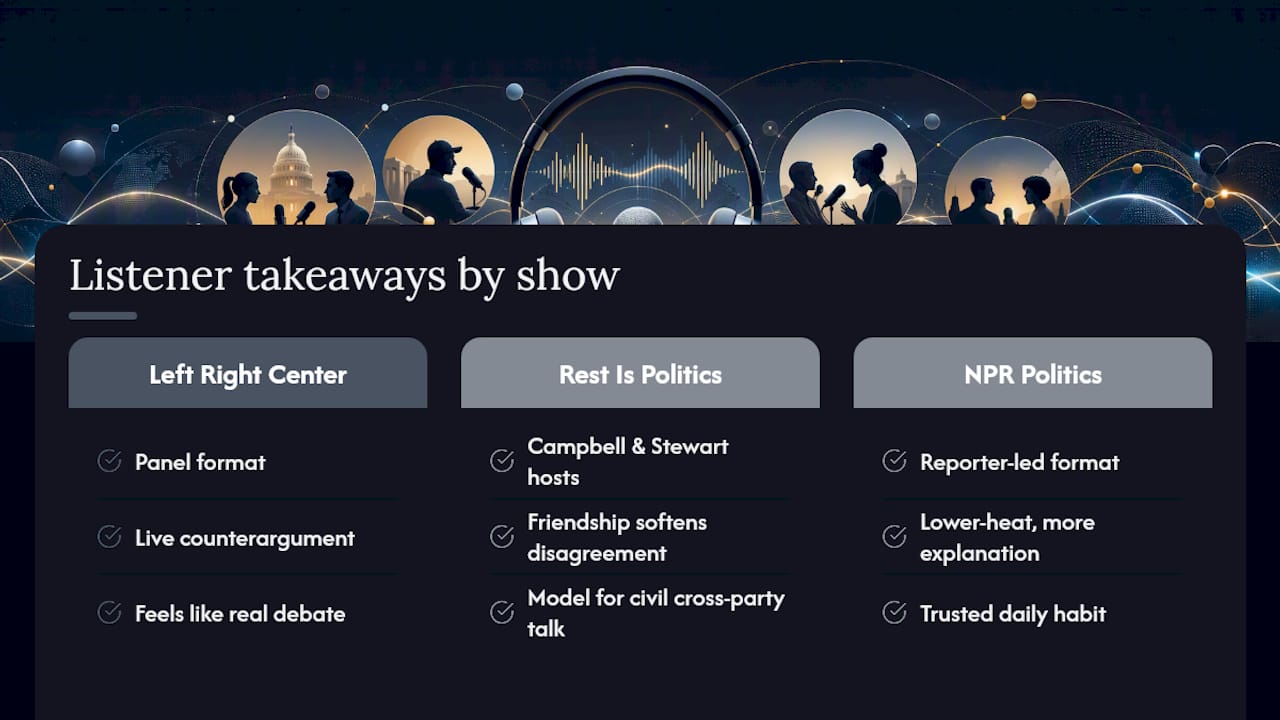
Listener reaction to Left, Right & Center consistently centers on one thing: the show doesn’t let anyone win too easily. Because the panel format forces commentators to respond to a live counterargument instead of a friendly moderator’s softball, feedback often praises the show for feeling like an actual debate rather than a monologue with commercial breaks. That structural tension is precisely what KCRW designed the format around.
Feedback on The Rest Is Politics tends to note the friendship between hosts Campbell and Stewart despite their opposing party backgrounds, and how that relationship changes the tone of disagreement. Listeners often describe the show as a model for what political conversation between opposing sides could sound like away from cable news, where hosts stay focused on the argument instead of scoring points off each other personally.
The NPR Politics Podcast draws a different kind of response, usually centered on efficiency and trust rather than tone. Listeners citing it as a daily habit tend to mention the reporter-led format as the reason: less performance, more explanation. That’s consistent with newsroom podcasts generally, which tend to run lower-heat than opinion-driven formats because the goal is comprehension, not persuasion.
Across all three, the pattern in listener response is the same: respect for hosts who let an opposing argument breathe instead of cutting it off.
Clean Political Podcasts vs. the Loudest Shows in the Category
Plenty of political podcasts with huge audiences are technically profanity-light and still fail the “clean” test this list applies. The difference usually isn’t language. It’s structure and intent.
A popular monologue-format show might avoid swearing entirely and still spend most of its runtime characterizing the opposing side through their worst examples rather than their actual arguments. That’s a rhetorical strategy, not a civility failure in the profanity sense, but it produces the same outcome: listeners leave more entrenched than informed. Compare that to Left, Right & Center, where the opposing view isn’t a punchline; it’s a co-host with airtime and the ability to push back in real time.
Debate-format shows also differ from panel shows that only look balanced. Some programs book a token guest from “the other side” for five minutes of a sixty-minute show, which creates an illusion of balance without the substance. The Rest Is Politics avoids this because both hosts carry equal airtime throughout, not just during a token segment.
The practical test: does disagreement shape the whole episode, or does it show up for a few minutes before the show returns to preaching to its existing audience? Shows that pass that test earn a spot on a clean list. Shows that don’t might still be entertaining, just not what this guide is built to recommend.
Why Civil Political Listening Actually Matters
Political media rewards outrage because outrage is cheap to produce and easy to sell. That’s the uncomfortable truth behind why so much of the category sounds the way it does. The shows on this list prove there’s a real audience for the harder version: hosts who argue their case and let someone push back without the segment collapsing into insults.
We built this list because curiosity about the other side’s reasoning shouldn’t feel like a compromise or a betrayal of your own views. Sample one show outside your comfort zone this week. Subscribe to the ones that hold up after a few episodes, and share them with someone who’s tired of yelling matches disguised as news.
Know a clean show that belongs on a future update? We’re always looking.
— GOPcast
Start Listening to Clean, Civil Political Shows Today
Finding shows that argue in good faith is only half the battle; actually getting them into your regular rotation without hunting across five different apps is the other half. Gopcast solves that by putting conservative and cross-spectrum political programming in one player, so you can sample a show, bookmark it, and come back without losing your place.

If you want a starting point that pairs well with the debate-format shows covered above, Ringside Politics delivers sharp political discussion without the filler. Prefer a talk-format show with a strong point of view balanced by real reporting instincts? The Brian Kilmeade Show fits that slot in a weekly rotation, and The Dan Bongino Show offers a heavier commentary format for listeners who want deeper dives into current events. Each show page streams free, with no separate app download required.
Open any of these three pages now, hit play on the most recent episode, and judge for yourself inside the first 20 minutes whether the tone fits your rotation.
Sources
- Left, Right & Center | Political Discussion & News | KCRW
- The NPR Politics Podcast : NPR
- Pew Research Center — Audio and podcasting fact sheet