
GOPcast is the curated hub built for finding conservative podcast channels without wading through algorithm-driven noise. It aggregates the biggest names in right-leaning talk radio and commentary, from breaking news to long-form interviews, into one browsable destination. Listeners can stream content online; advertisers can inquire about media kits for advertising opportunities. Explore shows on GOPcast and see the lineup for yourself.
TL;DR:
- GOPcast filters out irrelevant or outdated shows, providing a curated platform that groups conservative podcasts by theme and format for easier discovery.
- Sampling multiple episodes over two weeks helps listeners assess host chemistry and pacing to find the best fit for their routine or preferences.
- Advertisers should focus on engagement metrics like listen-through rates and demographic data to ensure ad effectiveness rather than relying solely on download counts.
- Host-read ads typically outperform produced spots because audiences trust the host’s voice, making them a worthwhile investment despite higher costs.
- Conservative podcast audiences tend to be adults aged 35 and older, with a growing younger segment, primarily listening during commutes or workouts in geographically diverse areas.
Table of Contents
- The Best Conservative Podcast Channels on GOPcast Right Now
- How Do You Pick the Right Conservative Podcast Channel?
- What Should Advertisers Look for Before Buying Podcast Ads?
- How Big Is the Audience for Conservative Podcasts?
- What Content Themes Show Up Most in Conservative Podcasts?
- What Do Conservative Podcast Ads Typically Cost?
- Do Ads on Conservative Podcasts Actually Work?
- Why Editorial Curation Matters More Than Raw Search
- Ready to Start Listening or Booking Ad Space?
- Sources
- FAQ
The Best Conservative Podcast Channels on GOPcast Right Now
Conservative podcasts run the gamut from five-minute news hits to ninety-minute deep dives on culture and policy, and that range is exactly what makes a curated hub useful instead of overwhelming. Editorial roundups of top conservative shows consistently point to the same pattern: audiences want both fast takes and slower, argument-driven conversation, often from the same rotation of hosts. GOPcast organizes its lineup around that split, with dedicated show pages for each program.
Here’s a working shortlist of standout programs available through the hub, with what each one actually does best:
- The Dan Bongino Show — Daily news commentary with a law-enforcement lens, built for listeners who want quick, opinionated breakdowns of the day’s biggest political stories.
- Ringside Politics — A sharper, debate-style format for listeners who want two sides argued out loud rather than a single host’s monologue.
- Brian Kilmeade Show — Weekday commentary blending history, current events, and interviews, best for commute-length listening.
- No Agenda Show — A long-running, media-criticism format for listeners who want media literacy alongside political analysis.
- The Sentinel Report — Investigative-leaning coverage for people who want depth over speed.
- Louder with Crowder — Long-form commentary with a comedic edge, popular with younger conservative audiences who want opinion delivered with personality.
- Benny Johnson Show — Fast-moving, social-media-savvy commentary aimed at listeners already plugged into daily political cycles.
- Perino on Politics — A more measured, policy-focused format for listeners who want less shouting and more analysis.
- Diamond and Silk — Conversational, personality-driven commentary that leans heavily on audience connection over formal structure.
Each show lives on its own page inside the hub, where you can stream episodes, browse back catalogs, and see release schedules. Daily shows like Bongino’s tend to run around an hour; weekly or interview-format programs often stretch past an hour. That format variety is deliberate; research on top conservative and liberal podcast audiences shows daily news formats and weekly deep-dive formats both hold loyal, distinct listener bases rather than competing for the same attention.
How Do You Pick the Right Conservative Podcast Channel?
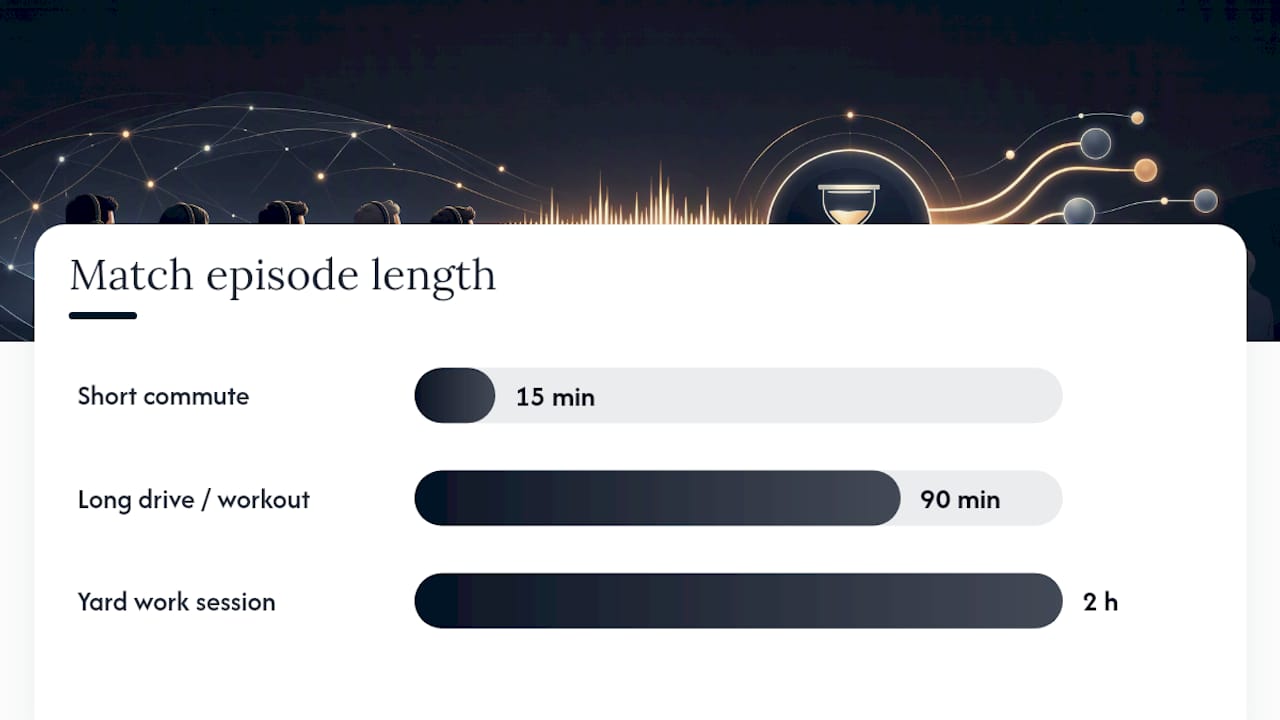
Choosing a show isn’t about finding “the best” one. It’s about matching tone and format to how you actually listen. Someone commuting short durations needs a different rhythm than someone doing yard work for two hours on a Saturday.
Start with these steps:
- Sort by tone first. Decide if you want fast news reaction, culture commentary, or investigative depth. GOPcast’s category browsing makes this the first filter, not an afterthought.
- Check episode length against your routine. A 15-minute daily hit fits a short commute; a 90-minute interview show fits a long drive or a workout.
- Run a two-week sample. Pick two or three shows, listen to several recent episodes of each, and pay attention to which one you actually finish. Editorial guides across the podcast industry repeatedly recommend this exact sampling window before committing to a regular follow, because host chemistry and pacing take a few episodes to reveal themselves.
- Build a playlist once you know your favorites. GOPcast’s multi-format listening options let you mix audio and video shows into one rotation.
Pro Tip: Don’t judge a show by its first episode alone. Hosts warm up over a series, and a slow opener sometimes turns into your favorite weekly listen by episode four.
If you gravitate toward breaking-news formats specifically, GOPcast’s conservative news category groups those shows together so you’re not hunting across the whole platform.
What Should Advertisers Look for Before Buying Podcast Ads?
Advertisers evaluating conservative podcast inventory need more than download counts. Media-buying guidance for conservative-audience podcasts stresses that audience alignment and engagement metrics matter more than raw reach when it comes to actual conversion.
Before committing budget, request:
- Downloads per episode and average unique listeners over a trailing 30-day window.
- Completion or listen-through rate. Podcast advertising standards treat completion rate as a stronger predictor of ad retention than total downloads, since a listener who finishes an episode is far more likely to hear the ad read inside it.
- Audience demographics by age, region, and household income where available.
- Engagement signals, like comment activity, social shares, or repeat-listen rates.
On format, host-read ads generally outperform produced spots on podcasts like these because the audience trusts the host’s voice more than a polished commercial. Pre-roll works for brand awareness; mid-roll tends to drive direct response better since listeners are already engaged by that point; bumpers work best as reinforcement in a multi-spot campaign rather than a standalone play.
A practical campaign sequence looks like this: request a media kit, run a short trial flight with measurable promo code or tracking link, measure response over a few weeks, then scale spend toward whichever show or format converted best. Watch for lift in direct-response actions (code redemptions, click-throughs) as your clearest early success signal, alongside any measurable shift in brand recall if you’re running a longer flight.
How Big Is the Audience for Conservative Podcasts?
Conservative talk audiences skew toward adults 35 and older, with a meaningful and growing share of listeners in their 20s and 30s drawn to faster-paced, personality-driven shows. Listening habits split fairly evenly between commute-time consumption and dedicated at-home or gym listening, which is part of why daily and weekly formats both thrive rather than one crowding out the other.
Geographically, conservative podcast audiences tend to concentrate in suburban and exurban markets, though national shows with major hosts pull listeners from every region. Gender skew varies by show. Debate and news-analysis formats often draw a more even male/female split than combat-style commentary shows, which tend to run more male-heavy.
What ties these audiences together isn’t demographics so much as intent: listeners actively seek out these shows rather than stumbling into them, which is a meaningfully different behavior than passive terrestrial radio listening. That intentionality is exactly why advertisers see stronger response from host-read, native-sounding ads than from generic spots dropped into unrelated content.
What Content Themes Show Up Most in Conservative Podcasts?
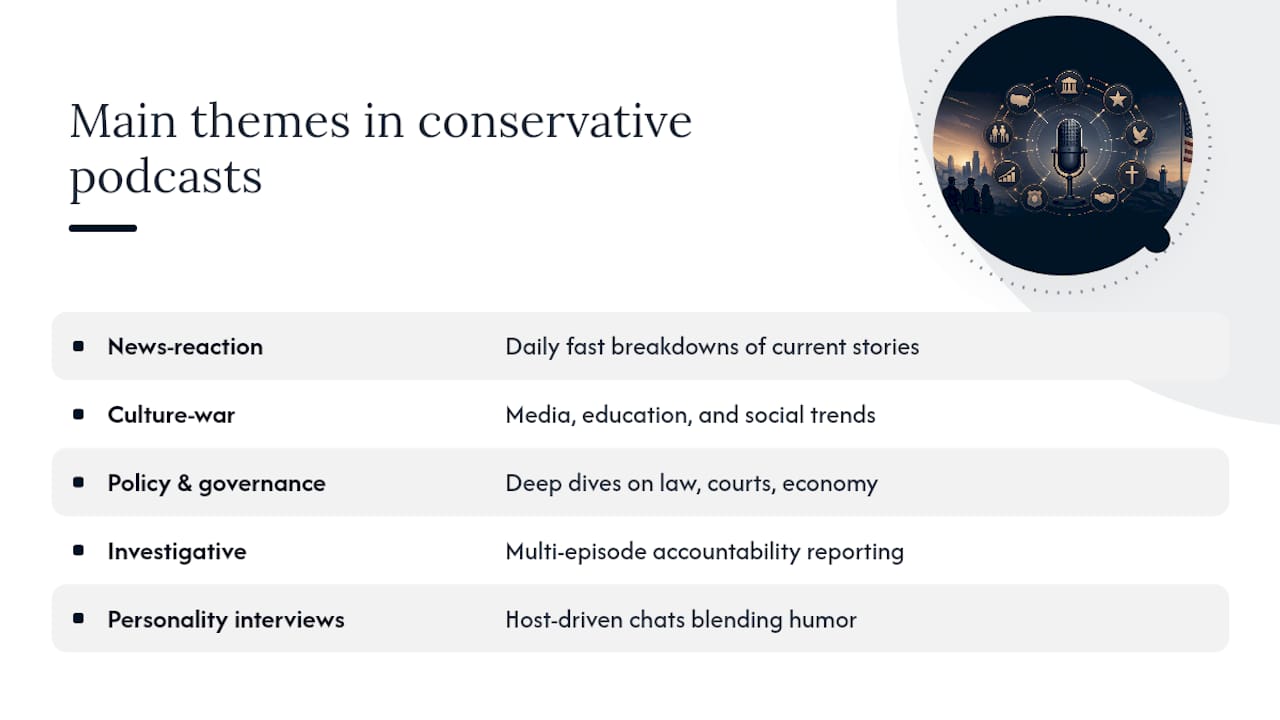
Conservative podcasts cluster around a handful of recurring themes, and knowing them helps you pick shows that actually match your interests instead of guessing from a title alone.
News-reaction shows dominate the daily format, breaking down the day’s political stories fast, usually within hours of them happening. Culture-war commentary covers media bias, education fights, and social trends, often with a sharper, more opinionated tone. Policy-and-governance shows go deeper on legislation, court decisions, and economic policy, appealing to listeners who want substance over reaction speed. Investigative and accountability-focused shows dig into specific stories over multiple episodes rather than covering everything briefly.
A fourth lane worth knowing: personality-driven interview shows, where the draw is less the topic and more the host’s rapport with guests. These often blend humor with political commentary and tend to build the most loyal, parasocial-feeling audiences.
None of these lanes are mutually exclusive. Most shows blend two or three, which is why sampling multiple episodes matters more than reading a one-line description before deciding whether a show fits your taste.
What Do Conservative Podcast Ads Typically Cost?
Podcast advertising pricing generally follows a CPM model, cost per thousand downloads or listens, though many shows also sell flat-rate sponsorship packages for a set number of episodes. Host-read ads command a premium overproduced spots because they require the host’s time and carry more perceived trust, and mid-roll placements typically cost more than pre-roll or bumper spots since they reach listeners deeper into the episode.
Pricing varies widely by show size and format, so rather than anchoring to one number, advertisers should request a full media kit with current rates for each ad position. What matters more than the sticker price is testing before scaling. Podcast advertising best practices recommend running a short trial flight with trackable codes before committing to a longer buy, since actual conversion often differs from what raw audience size would predict.
Bundled buys across multiple shows on one platform can also improve efficiency versus negotiating separately with each host, since a single media kit request covers several inventory options at once instead of five separate outreach emails.
Do Ads on Conservative Podcasts Actually Work?
The strongest signal advertisers should chase isn’t reach, it’s response. Guidance for media buyers targeting conservative audiences points to campaigns that pair host-read messaging with a trackable offer, a promo code, a dedicated landing page, or a unique link, as the ones that produce measurable direct response instead of vague brand-awareness claims.
The pattern that separates a working campaign from a wasted budget is simple: match the message to the host’s actual voice and the show’s actual audience, rather than dropping a generic script into any available slot. A financial services ad read by a policy-focused host lands differently than the same script read by a comedy-leaning personality show, even if both shows have similar download numbers. Completion rate matters here too. A show with fewer total downloads but a high completion rate can outperform a bigger show where most listeners drop off before the mid-roll slot.
The takeaway for anyone buying podcast ads for the first time: test small, measure the direct-response signal, and let the data decide which show or format earns the bigger budget next quarter.
Why Editorial Curation Matters More Than Raw Search
Search results for political podcasts are a mess of algorithm noise, outdated lists, and shows that stopped publishing years ago. Content aggregators that add real editorial curation solve that by grouping shows thematically and filtering out the dead weight, which is the entire premise behind GOPcast’s approach to conservative podcasting.
GOPcast curates prominent conservative shows into one platform, providing listeners with centralized access instead of using multiple apps or bookmarked feeds. That curation isn’t neutral. It’s a deliberate editorial choice to surface voices that resonate with a right-leaning audience and skip the filler.
For listeners, that means less time hunting and more time actually listening. For advertisers, it means a single point of contact for inventory across a lineup of politically aligned shows instead of negotiating separately with every host. Browse the curated categories, sample a few shows, and reach out to ad sales when you’re ready to talk placements.
— GOPcast
Ready to Start Listening or Booking Ad Space?
There’s no shortage of ways to find political commentary online, scattered YouTube channels, individual podcast apps, cable replays. GOPcast’s advantage is that it removes the hunting entirely: one platform, curated conservative shows, free streaming, and a direct path to ad inventory without chasing down five separate media kits.

If you’re a listener, start with a flagship show and branch out from there. The Dan Bongino Show is a solid entry point for daily news commentary, while Ringside Politics works well if you want two-sided debate instead of a single host’s take. Follow show pages, build a playlist, and switch between audio and video formats depending on where you’re listening.
If you’re an advertiser, the process is just as direct. Request a media kit through GOPcast, review the audience metrics and available ad formats for shows that match your brand, and set up a short trial flight with a trackable code before scaling spend. Visit GOPcast to explore shows and request advertising information and get your first campaign moving this quarter.
Sources
- The Best Conservative Podcasts to Know Right Now - Top Entrepreneurs Podcast | Enterprise Podcast Network
- Harnessing the Power of Conservative Podcasts in 2025: A Strategic Guide for Media Buyers - Access To Media
- Podcast Advertising: The Complete Guide for Brands | Starke
FAQ
What Is the Best Way to Find Conservative Podcast Channels?
A curated hub like GOPcast is the most direct route since it groups conservative shows by theme and format instead of relying on generic app-store search results.
How Long Should I Sample a Show Before Subscribing?
Listen to several recent episodes over roughly two weeks; that’s usually enough to judge host chemistry, pacing, and whether the format fits your routine.
What Metrics Should Advertisers Request Before Buying Ads?
Ask for downloads per episode, completion or listen-through rate, audience demographics, and unique listener counts, since completion rate predicts ad retention better than raw downloads.
Are Host-Read Ads Worth the Higher Cost?
Generally yes. Host-read spots tend to convert better than produced ads because listeners already trust the host’s voice, which is why they typically carry a pricing premium.
Can I Listen to Conservative Podcasts for Free on GOPcast?
Yes, GOPcast offers free streaming access to its full lineup of conservative shows, including flagship programs, with no subscription required to start listening.