Start with the Originalism Seminar Podcast from Georgetown’s Constitution Center, the We the People episodes from the National Constitution Center featuring guests like Randy Barnett, and the Chicago Unbound Deep Dive series on the emergence of originalism. Each pulls from law-school faculty or named constitutional scholars rather than talking-head commentary, and each posts transcripts or show notes you can actually cite.
TL;DR:
- The Georgetown Originalism Seminar Podcast features panel discussions with scholars debating methodology, making it ideal for those wanting internal disagreements among originalists.
- The “We the People” podcast, especially episodes with Randy Barnett, offers deep dives into originalism’s evolution and how scholarly debates shape contemporary understanding.
- Chicago Unbound and similar law-review episodes focus on academic debates over originalist theories, suitable for listeners already familiar with the basics and seeking nuanced arguments.
- Reliable episodes cite primary sources, include transcripts, and feature credible scholars, while red flags include vague credentials and unreferenced claims.
- For more substantial discussion, law-school media and transcripts provide detailed background to supplement podcast insights.
Table of Contents
- The Best Originalism Podcasts to Start With
- Episodes Worth Queuing Up First
- How These Podcasts Actually Talk About Originalism
- How to Tell a Scholarly Episode From Noise
- Tracking Down Transcripts and Follow-Up Reading
- Why Scholar-Led Beats Pop-Legal Every Time
- Follow These Shows Directly on GOPcast
- Sources
The Best Originalism Podcasts to Start With
If you want originalism explained by the people who built the theory, not by pundits repeating it secondhand, four feeds do the heaviest lifting.
Originalism Seminar Podcast (Georgetown Center for the Constitution). This series comes out of Georgetown’s summer seminar program, and it shows: episodes run as panel discussions rather than single-guest interviews, with multiple scholars sparring over methodology in the same recording. That format makes it the strongest option if you want to hear internal disagreement among originalists, not just a lecture defending the theory. The seminar’s panel bibliographies double as reading lists.

We the People (National Constitution Center). Host Jeffrey Rosen runs single-guest deep dives, and his episode with Randy Barnett on the evolution of originalism is a good example of the format at its best. Rosen frames originalism as a living scholarly project with a documented history, not a fixed talking point, and his episodes tend to link out to the books and cases discussed on air.
Chicago Unbound / Deep Dive. These law-review-affiliated episodes, including entries examining the emergence of originalism, lean theory-heavy. Expect discussion of academic debates over methodology rather than case outcomes. If you already know the basics and want the second-wave arguments, this is where you go.
Fund for American Studies interviews and law-school media. These tend to be more accessible than the Chicago Unbound material while still bringing in real scholars, Barnett among them, and they often attach annotated reading lists to the episode page. Good entry point if the seminar panels feel too dense on a first listen.
Episodes Worth Queuing Up First
- Randy Barnett on the evolution of originalism (We the People). This conversation with Jeffrey Rosen is one of the more concentrated discussions available on how originalist argument has shifted since the 1980s, and it doubles as a preview of Barnett’s own scholarship on the subject.
- Barnett on the Ninth Amendment. Look for episodes where Barnett applies originalist reasoning to unenumerated rights. His academic work on this question, documented in law review archives, gives useful backup reading.
- William Baude and colleagues on the “new originalism.” Panel recordings that trace how originalism moved from an intent-based theory to a public-meaning one are some of the clearest entry points into the internal history of the movement.
- Georgetown’s summer seminar panels. Certain sessions include sitting judges alongside academic scholars, which is rare. Check the episode descriptions for panelist lists before committing your listening time.
How These Podcasts Actually Talk About Originalism
Two terms come up constantly, and knowing them in advance saves you from getting lost in the first ten minutes. The fixation thesis holds that a constitutional provision’s meaning was locked in at the moment it was ratified. The contribution thesis goes further, arguing that this fixed original meaning should substantially govern how courts decide cases today. These aren’t interchangeable, and scholars on these podcast panels debate the gap between them regularly.
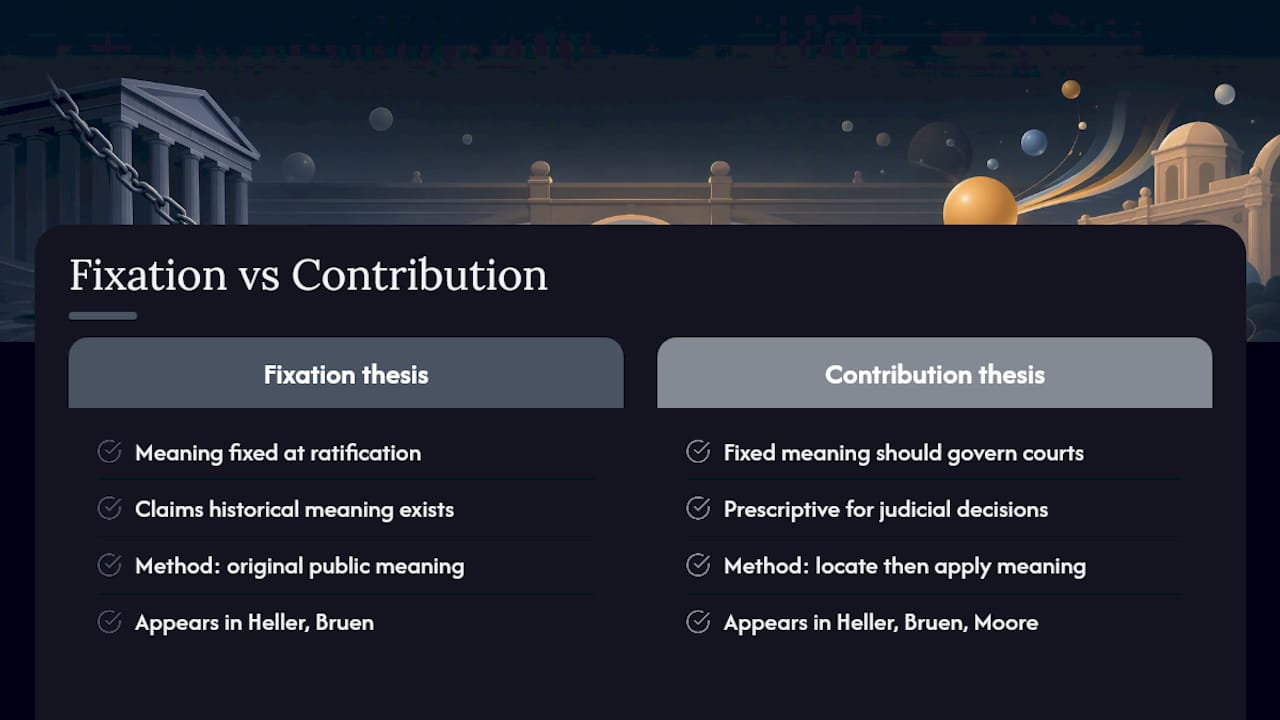
You’ll also hear a running distinction between original public meaning, the approach Justice Antonin Scalia championed by focusing on how ratifying-era readers would have understood the text, and original intent, an older framework centered on what the drafters personally meant to say. Most episodes ground these abstractions in specific cases: Heller, Bruen, and Moore v. Harper show up often because they let scholars argue methodology through a concrete fact pattern instead of pure theory. Expect a fairly consistent structure: a normative case for why original meaning should matter, a methodological argument about how to find it, then application to a real dispute.
How to Tell a Scholarly Episode From Noise
Not every podcast claiming to discuss originalism is worth your time, and the tells are easy to spot once you know what to check.
- Confirm the host or the show has a university or constitutional-institution affiliation, not just a law degree mentioned in a bio.
- Prefer episodes with transcripts or show notes that link back to primary sources, as many Constitution Center episodes do.
- Watch for named guests with visible academic credentials on the episode page, not vague “constitutional expert” labels.
- Treat purely rhetorical framing, strong claims with zero citations, as a red flag rather than a feature.
Pro Tip: Before you commit to an hour-long episode, search the guest’s name alongside “SSRN” or their law school faculty page. If the paper referenced on the show is publicly posted, you’ll get more out of the conversation by skimming the abstract first.
Tracking Down Transcripts and Follow-Up Reading
Start with the episode’s own institutional page. Constitution Center episodes and law-school media pages routinely post full transcripts, guest bios, and lists of cases referenced during the discussion. If a transcript isn’t posted, search the guest’s name plus “transcript” or the exact episode title. Academic repositories often host the underlying papers a guest discusses on air. Once you’ve pulled the cited cases and law-review articles from the show notes, you have a self-built reading list that goes well beyond what the episode itself covered.
Why Scholar-Led Beats Pop-Legal Every Time
The gap between a five-minute cable-news explainer on originalism and an hour with Randy Barnett or a Georgetown seminar panel isn’t subtle. Pop-legal commentary tends to flatten originalism into a slogan, “judges should follow the text,” and skip the part where scholars have spent forty years arguing about what that even means in practice. The fixation thesis versus contribution thesis debate alone would confuse most cable panels, yet it’s the actual fault line inside the movement.
GOPcast exists because politically engaged listeners deserve better than being handed one talking point and told it’s the whole theory. Curating access to substantive political and legal programming, the kind that respects your intelligence enough to bring in named scholars instead of paraphrasing them, is worth doing well. The conservative news podcast roundup on GOPcast reflects that same instinct: point listeners toward shows that actually engage with ideas rather than just reacting to headlines.
— GOPcast
Follow These Shows Directly on GOPcast
GOPcast gives you one place to find the political and legal commentary that actually matches your interests, without digging through five different podcast apps to piece together a listening list. If constitutional debate and judicial philosophy are what pulled you into this article, you’ll likely want the same depth applied to current political coverage, and that’s exactly what GOPcast aggregates.

Search for a show by name on the GOPcast landing page, follow the ones that match your interests, and turn on notifications so new episodes don’t slip past you. A few shows worth following if legal and constitutional commentary caught your attention here: The Trey Gowdy Podcast for a former prosecutor’s take on legal news, The Dan Bongino Show for daily political analysis, and Hang Out with Sean Hannity for broader conservative commentary. Head to GOPcast’s show directory and start following the ones that fit how you already listen.
Sources
- Originalism — Legal Information Institute (LII)
- The Evolution of Originalism — We the People (podcast episode)