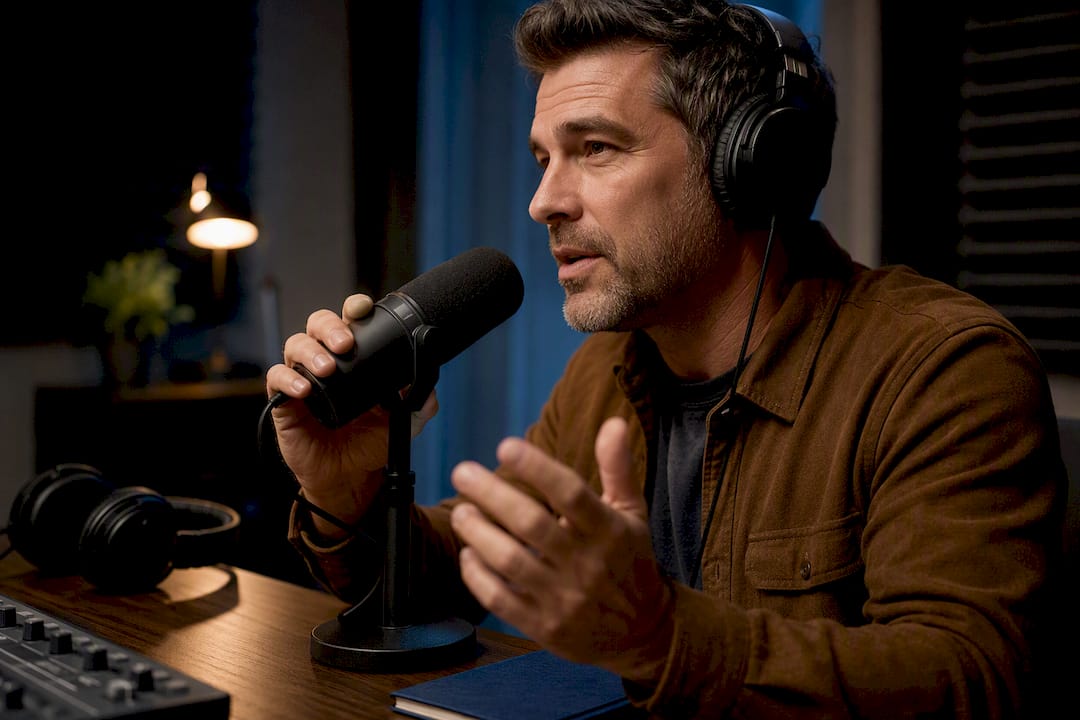
Start with a curated shortlist rather than a general search, and you save yourself hours of sampling shows that turn out to be reruns of cable news talking points. GOPcast works as a practical discovery hub for this exact problem, grouping shows by live schedule, platform, and editorial tone rather than by download charts alone. The list below covers roughly a dozen shows worth your first hour of listening this week.
TL;DR:
- Most uncensored conservative podcasts use provocative branding to signal candid commentary, but they still operate within legal and platform moderation limits.
- Shows differ in format, with live call-in, opinion monologue, and news hybrid options catering to diverse listener preferences and engagement styles.
- Platform choice influences tone and discoverability, as many hosts distribute on alternative sites like Rumble and Gettr to avoid mainstream restrictions.
- Listening habits should include sampling episodes with both guest and call-in segments to better assess a host’s authentic tone and expertise.
- GOPcast centralizes these shows for easier access, providing schedules, format information, and direct streaming options to streamline listener experience.
Table of Contents
- The Best Uncensored Conservative Podcasts to Start With
- How Do You Choose the Right Uncensored Podcast for You?
- What Does “Uncensored” Actually Mean for These Shows?
- Why Trust This Curated List of Conservative Shows?
- How Should Uncensored Podcasts Handle Sensitive Topics?
- What Legal and Ethical Lines Do These Shows Walk?
- How Do Hosts’ Backgrounds Shape What You Hear?
- Listening Responsibly Without Falling Into an Echo Chamber
- Stream These Shows in One Place With GOPcast
- Sources
- FAQ
The Best Uncensored Conservative Podcasts to Start With
Not every show branded “uncensored” delivers the same thing. Some lean on live call-ins and raw reaction, others read more like long-form monologues with a producer and a script. Sorting them by format, rather than by fame, gets you to the right show faster.
Live call-in and audience-driven shows
- Ringside Politics — Built for listeners who want to weigh in, not just tune in. The format leans on real-time reaction to breaking news, and you can stream it directly on GOPcast to catch it live or on demand.
- UNGOVERNED — Runs a daily live show at 10 a.m. ET on weekdays, a scheduling pattern that rewards habitual listeners who tune in at the same time every day. That predictability is part of the appeal: you know exactly when to show up.
- After Hours with Alex Stein — A looser, comedy-forward format that mixes political commentary with sketch-style bits. Best for listeners who want their politics with an edge of absurdity, available to stream on GOPcast.
Opinion-driven monologue shows
- Benny Johnson Show — Fast-paced and social-media literate, aimed at a younger audience that follows political fights across platforms in real time. Find it on GOPcast.
- The Case for America — A more argument-driven format, structured like a debate case being built episode by episode rather than a running reaction to news. Stream it on GOPcast.
News and commentary hybrids
- Brian Kilmeade Show — Blends historical framing with current commentary, useful if you want political analysis with more context than hot takes. Listen on GOPcast.
- National Update — A tighter, headline-driven format for listeners who want the day’s political news compressed into a focused rundown rather than an hour of monologue. Available on GOPcast.
- The Sentinel Report — Positions itself around watchdog-style reporting on government and media, aimed at listeners suspicious of official narratives. Stream on GOPcast.
Culture and lifestyle-adjacent commentary
- Diamond and Silk — Known for a conversational, unscripted style that blends politics with personal commentary and cultural observation. Find it on GOPcast.
- Louder with Crowder — Combines comedy sketches, interviews, and commentary segments, appealing to listeners who want entertainment alongside political content. Listen free on GOPcast.
- Media Exposed with Adam Weiss — Focused specifically on media criticism, aimed at listeners who want a running critique of how mainstream outlets cover conservative politics. Stream on GOPcast.
Shows that market themselves as “uncensored” tend to share a provocative, unapologetic tone built around hot takes, and that branding choice tells you something about what to expect before you press play.
How Do You Choose the Right Uncensored Podcast for You?
Picking a show isn’t about finding the loudest voice. It’s about matching format to how you actually listen. Run through these criteria before committing to a regular subscription:
- Ideological sub-focus. Some shows are populist and culture-war focused; others lean toward constitutional originalism or foreign policy. Know which lane you want.
- Host tone. Combative and confrontational, or measured and analytical? Sample a clip before assuming.
- Live versus recorded. Live shows offer real-time reaction and audience interaction; recorded shows tend to be tighter and more edited.
- Frequency. Daily shows build habit but demand more of your time. Weekly shows work better for casual listeners.
- Platform moderation policy. Shows hosted on alternative platforms like Rumble or Gettr often market themselves as free from mainstream content restrictions, which shapes both tone and audience.
- Production polish. A single-mic monologue feels different from a fully produced show with sound design and multiple segments.
Pro Tip: Sample any new show by listening to a stretch that includes both a guest segment and a listener call-in or comment reaction. That combination tells you more about a host’s real tone, under pressure and off-script, than a solo monologue ever will.
What Does “Uncensored” Actually Mean for These Shows?
“Uncensored” is a branding signal, not a literal claim about zero moderation. It typically promises candid, provocative commentary and an unapologetic point of view rather than a guarantee that nothing is ever edited or filtered. Read it as editorial voice, not a legal status.
That branding shapes where shows choose to live. Some hosts distribute on platforms like Rumble and Gettr specifically to sidestep perceived restrictions on mainstream apps, while others stay on standard podcast platforms and simply lean into a sharper tone there. Platform choice affects discoverability, too: shows on alternative platforms often show up less in mainstream charts but circulate heavily inside conservative social networks and direct distribution channels.
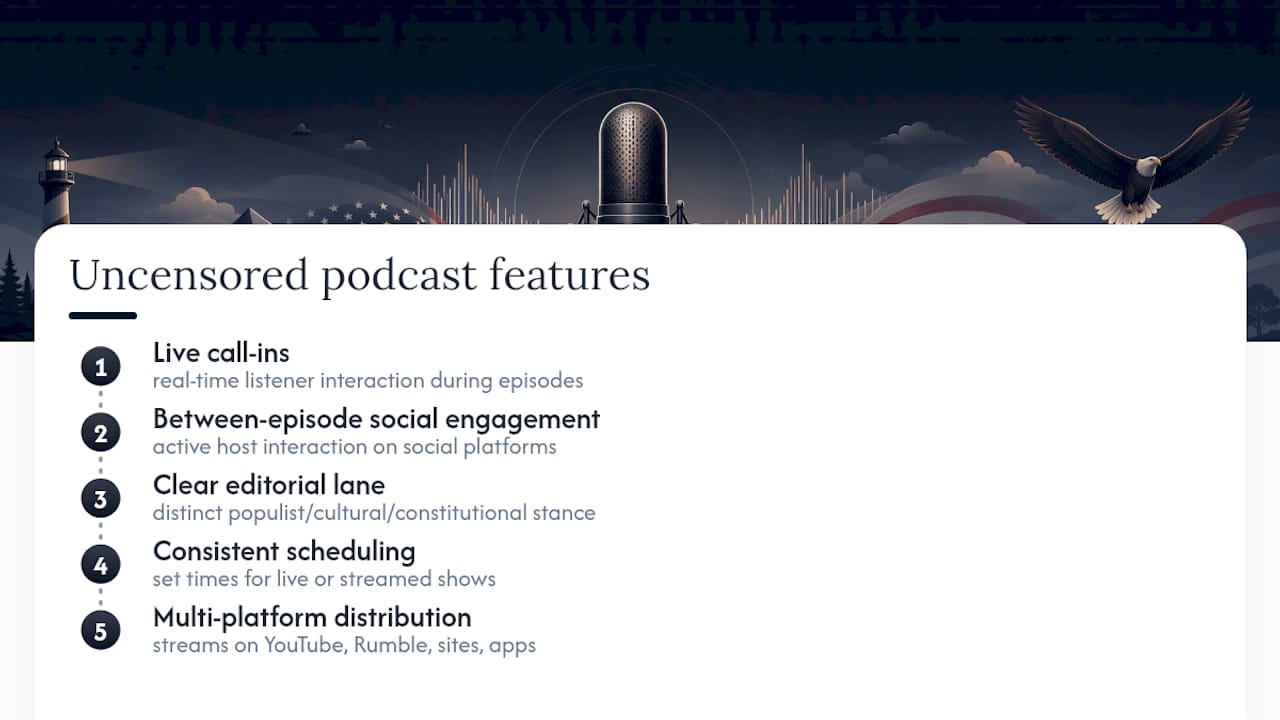
In practice, “uncensored” shows tend to share a few recurring features: live call-ins, active social media engagement between episodes, and a clear editorial lane, whether that’s populist commentary, cultural critique, or constitutional debate. Cross-platform hosts like Will Cain, who streams live on both YouTube and FoxNews.com at set times, show how even mainstream-adjacent hosts borrow the same playbook: consistent scheduling plus multiple distribution points.
Why Trust This Curated List of Conservative Shows?
GOPcast built its conservative podcast curation around a simple filter: public availability, a consistent broadcast schedule, a clear editorial identity, and real listener engagement. Shows that meet all four earn a spot; shows that don’t get skipped, no matter how loud their marketing.
That filter matters because the conservative podcast field is crowded and uneven in quality. Curation reduces the guesswork of sampling ten shows to find one that fits.
- Editorial categories (live call-in, opinion monologue, news hybrid) group shows by format, not just popularity.
- Live schedule visibility means you know when a show airs before you commit to it.
- A single hub for streaming removes the friction of hunting across five different apps.
How Should Uncensored Podcasts Handle Sensitive Topics?
Shows that brand themselves as unfiltered often cover material that mainstream outlets soften or skip entirely: crime statistics, immigration enforcement, contested elections, or graphic news events. That’s part of the draw for listeners tired of hedged language.
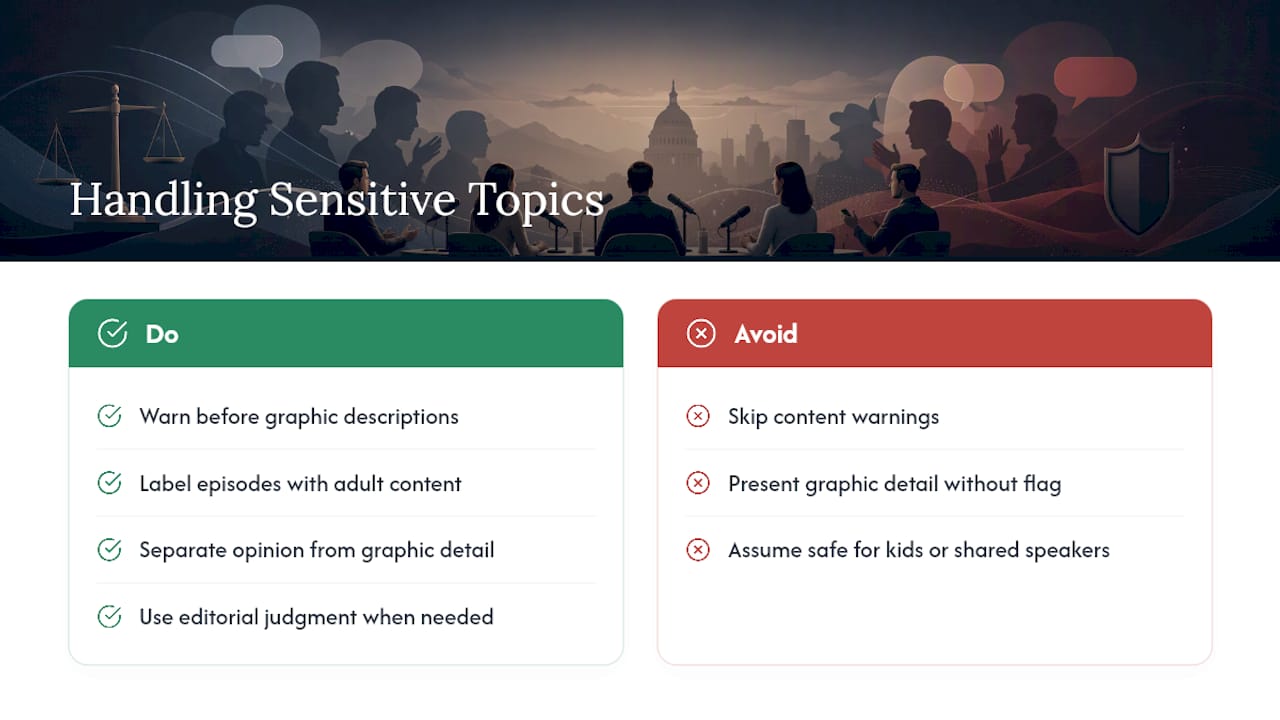
The tradeoff is real, though. A show that skips content warnings on genuinely disturbing material, say, detailed violent crime, isn’t being braver. It’s being careless. The strongest “uncensored” shows draw a line between blunt political opinion, which they deliver freely, and graphic descriptive content, which they still flag before diving in. Listen for hosts who tell you what’s coming (“this next story involves graphic detail”) even when they refuse to soften the political take that follows. That’s a sign of editorial judgment, not censorship.
Parents and workplace listeners should also note that many of these shows use blunt language and dark humor that isn’t safe for shared speakers or younger listeners, regardless of the political content itself.
What Legal and Ethical Lines Do These Shows Walk?
“Uncensored” branding butts up against real legal boundaries every host has to respect regardless of platform: defamation law, incitement standards, and platform terms of service that even Rumble and Gettr enforce, just with a lighter touch than mainstream apps.
The ethical questions run deeper than legality. A host who states an unpopular opinion is doing commentary. A host who states a false factual claim about a specific person is exposed to a defamation claim, uncensored branding or not. Listeners should also weigh how a show handles corrections. Shows built around rapid, unscripted reaction sometimes get facts wrong in the moment; the ones worth trusting acknowledge it on a later episode rather than letting the error stand. Fundraising asks tucked into episodes deserve scrutiny too. A show that regularly solicits listener money should be transparent about what that funding supports.
How Do Hosts’ Backgrounds Shape What You Hear?
A host’s professional history shapes the show more than most listeners realize. A former law enforcement officer hosting a politics show, for instance, brings a different lens to crime coverage than a media critic or a career broadcaster does. Recognizing that background helps you calibrate what you’re hearing rather than mistaking one host’s expertise for universal authority on every topic they cover.
This cuts both ways. A host’s real-world experience in a field lends specific credibility on that subject, and genuine blind spots on everything outside it. The most useful uncensored shows lean into their host’s actual expertise, whether that’s a legal background, a military record, or years in broadcast news, rather than treating every host as an equally reliable authority on every subject from foreign policy to public health. Checking a host’s background before you commit to a show tells you where their strongest material will land, and where you should cross-check harder.
Listening Responsibly Without Falling Into an Echo Chamber
Candid commentary works best paired with a habit of checking claims against original sources, not just trusting a host’s read on them. When an episode cites a study, a leaked document, or a court filing, look it up yourself before repeating it. Live shows make this easier: join the call-in segments or comment sections and ask hosts directly where a claim came from.
Uncensored political podcasts fill a real gap in civic conversation, offering perspectives mainstream coverage often trims down. That value holds up best when listeners treat strong opinions as a starting point for their own research, not a substitute for it.
— GOPcast
Stream These Shows in One Place With GOPcast
Finding a handful of uncensored conservative shows is easy. Keeping track of ten across five different apps, each with its own login and release schedule, is the actual headache. GOPcast solves that by putting curated shows, live schedules, and direct streaming into a single hub, so you stop juggling apps and start listening.

Every show landing page on GOPcast tells you the format, the schedule, and gives you a direct play button, no digging through app store descriptions to guess what a show actually sounds like. If you want a strong daily starting point, The Dan Bongino Show delivers direct commentary on a predictable schedule, and Ringside Politics offers the live, audience-driven format many uncensored listeners want most. Pick one, press play, and see how it fits your day before adding a second show to your rotation.
Sources
- UNGOVERNED - Podcast profile on PodStatus
- Triggered UNCENSORED — Townhall podcasts
- Top Podcasts with Conservative or Liberal Content — SSRS
- The Will Cain Show — Fox News
FAQ
Who are the top conservative podcasts right now?
Rankings vary by source, but SSRS lists The Ben Shapiro Show, The Dan Bongino Show, and The Tucker Carlson Show among the most-listened conservative shows, alongside newer live-format shows like UNGOVERNED.
What makes a podcast “controversial” rather than just opinionated?
A show crosses into controversial territory when it makes contested factual claims, uses deliberately provocative framing, or covers graphic material without warning, not simply when it states a strong political opinion.
Who are some well-known conservative podcast hosts?
Dan Bongino, Brian Kilmeade, and Benny Johnson are among the recognizable names in the space, each running shows with a distinct format you can stream directly on GOPcast.
Are uncensored conservative podcasts actually free from moderation?
Not literally. “Uncensored” is branding that signals candid tone and platform choice, and shows still operate within defamation law and each platform’s terms of service.
Where can I listen to these shows live?
Most of the shows on this list stream live on their host platform, whether that’s Rumble, Gettr, or a mainstream podcast app, and GOPcast aggregates schedules so you know when to tune in without checking five separate sites.