
Start with cross-aisle “bridge” podcasts that host both left and right voices, then sample one or two conservative shows from different subgenres once you’ve got your bearings. GOPcast works well as a discovery hub for the second step, since it groups shows by category instead of dropping you into the deep end. Go in curious, not combative, and expect to disagree plenty while still learning something real.
TL;DR:
- Starting with cross-aisle podcasts helps liberals understand conservative arguments in context and reduces reliance on caricatures.
- Focus on shows that prioritize explanation and mutual respect rather than outrage, especially from subgenres like legal reasoning or free-market policy.
- Use a five-step listening approach: separate facts from values, identify recurring frames, fact-check later, watch for concessions, and distinguish argument from performative content.
- Sampling episodes that explicitly explain issues or feature deliberate disagreement enhances understanding better than reactionary or monologue shows.
- Curated hubs group shows by category, making it easier to find content that matches your tolerance for tone and format without trial-and-error.
Table of Contents
- Which conservative podcasts should liberals start with?
- How should liberals listen to conservative podcasts?
- What are the main conservative podcast subgenres?
- Which specific episodes should you start with?
- How does a curated hub make discovery easier?
- Why publish a listening guide for conservative podcasts?
- Try These Shows on GOPcast
- Sources
Which conservative podcasts should liberals start with?
Skip the shows built for maximum outrage and start with the ones built for translation. That’s the whole logic behind bridge podcasts: they put a liberal and a conservative in the same room, on the same question, and force both to make their case to someone who isn’t already nodding along.
Start here: cross-aisle and bridge shows
- Left, Right & Center (KCRW) pairs commentators from across the spectrum on the same news cycle, and the format itself pushes toward unpacking ideological differences instead of talking past each other.
- Elevated Thoughts brands itself explicitly as a show where left meets right, built around the idea that conservative and liberal guests can break down an issue with actual mutual respect rather than performance.
- What If You’re Wrong? brings on a deliberately mixed guest list and structures episodes around challenging the host’s own assumptions, which makes it a good gut check before you dive into single-perspective shows.
Once those feel familiar, branch into shows that represent a specific conservative lane rather than a debate format. Here’s where the subgenre matters more than the host’s name recognition.
Then branch out by subgenre
A populist or activist-style show will hit differently than an intellectual one, and both hit differently than a straight interview program. If you want the news-cycle, opinion-heavy end of the spectrum, look at daily political roundups that track the same stories your usual feeds cover, just from the other side of the room. If you want something closer to legal or constitutional reasoning than punditry, originalism-focused shows walk through how conservatives read the Constitution rather than just reacting to headlines.
For free-market and economic conservatism specifically, shows centered on market-based policy tend to argue from cost-benefit and incentive structures rather than culture-war framing, which can be an easier entry point if you find the culture-war stuff exhausting. If institutional and legal explainers interest you more than opinion shows, election-law and legal-process podcasts spend more time on how systems work than on who’s winning the news cycle that week.
For a lower-conflict on-ramp
If your first instinct is that all of this sounds like a headache, you’re not wrong to want a softer entry point. Lower-conflict, civil-audience shows exist specifically for listeners who want conservative perspective without the shouting match. These tend to run longer, calmer segments and skip the rapid-fire outrage cycle entirely.
One thing worth saying plainly: this list deliberately skips the loudest, most combative shows in the conservative media ecosystem. That’s not because they’re unimportant. It’s because a first-time liberal listener gets more out of a show built to explain a position than a show built to win an argument. You can always work up to the sharper-elbowed programs once you’ve built some fluency in how conservative arguments are actually structured, rather than how they get caricatured.
How should liberals listen to conservative podcasts?
Treat the first few episodes like fieldwork, not combat. Your job isn’t to win the argument in your head. It’s to figure out what the host actually believes and why, which is a different skill than finding the weakest point in their logic.
Psychology Today’s rundown on liberal and conservative “essential truths” makes a useful point here: liberalism tends to organize around reducing harm, while conservatism tends to organize around defending freedom and tradition. Once you map an argument to that underlying value instead of judging the policy conclusion cold, a lot of positions that sounded bizarre start making internal sense, even if you still disagree with them.
Here’s a five-step approach that works for most episodes:
- Separate the fact claim from the value claim. A host saying crime is up is a factual claim you can check. A host saying that means we need harsher sentencing is a values claim about deterrence versus rehabilitation.
- Note the recurring frame. Conservative commentary leans hard on a handful of recurring frames, like freedom versus safety or tradition versus progress, and once you can spot them, half the episode gets easier to parse.
- Flag anything that needs fact-checking, and actually check it later. Don’t derail your listening to Google mid-episode; jot it down and follow up afterward.
- Watch for concessions. A host admitting a policy failed on their own side, or praising an opponent’s point, is a strong signal you’re listening to something more honest than performative.
- Decide whether the episode is arguing or performing. If a host is working through a genuine tension, keep listening. If it’s a monologue built purely to rile up the audience, you can bail without missing much.
A simple listening log helps more than you’d think. Keep three columns: the timestamp and claim, the underlying value or frame behind it, and any fact worth verifying later. This turns a passive scroll-and-listen session into something closer to actual analysis, and it’s the same basic method behind Elevated Thoughts’ approach to tracking cross-ideological claims.
Pro Tip: Keep a running note of moments where a host concedes a point or criticizes their own side. Those moments are gold for gauging whether a show argues in good faith, and they make great conversation starters if you ever discuss the episode with someone who disagrees with you.
What are the main conservative podcast subgenres?
The right isn’t one voice. Treating “conservative podcast” as a single genre is a bit like treating “rock music” as a single genre, and it leads to the same mistake: judging the whole category by whichever example happened to cross your feed first.
- Bridge and cross-aisle shows put both sides in conversation directly, which makes them the gentlest entry point and the best format for spotting genuine concessions.
- Intellectual and establishment shows lean on policy history, legal reasoning, and economic argument, closer to a seminar than a rally.
- Populist and activist shows run hot, move fast, and prioritize energizing an already-sympathetic audience over persuading outsiders.
- Faith and cultural conservatism shows center religious tradition and social conservatism, often with a slower, more reflective tone than the political news shows.
- Interview and long-form shows dig into a single guest’s background and reasoning for an hour or more, which tends to produce more nuance than a rapid-response news show.
Discourse analysts studying conservative and liberal argument note that the right’s media landscape spans everything from faith-based programming to intellectual long-form interviews, which is exactly why sampling one show and generalizing to “conservatives” is a mistake. If you want nuanced understanding, stick to intellectual and interview formats first. If you’re curious what the loudest wing of the movement actually sounds like, save the populist shows for once you’ve built some context.
Which specific episodes should you start with?
Pick episodes that explain rather than perform. A good starter episode gives you context on how the host thinks, not just what they’re mad about this week.
- What If You’re Wrong? — Start with an early episode featuring a guest whose politics visibly differ from the host’s. The format is built to surface disagreement productively, so pay attention to where the host actually updates their view versus where they just restate it louder.
- Left, Right & Center — Any recent weekly episode works, since the format repeats: same news cycle, three or four commentators, and a moderator forcing them to respond to each other directly rather than monologue past one another.
- Elevated Thoughts — Look for an episode tagged around a hot-button issue like immigration or gun policy. These tend to produce the clearest side-by-side value comparison, since the bipartisan format is designed around that exact contrast.
- A single-subgenre show of your choice — If you branch into an originalism or free-market show, start with an episode that features a guest explainer walking through a specific case or policy rather than a solo opinion monologue. Guest-explainer episodes tend to teach more than solo rants, simply because the host has to slow down and justify each step.
Pacing tip: sample the first 10 to 15 minutes of a bridge episode to get the setup, then jump to wherever the guests start actually disagreeing. For single-host interview shows, listen sequentially. Context builds fast in those formats, and skipping ahead usually means missing the premise that makes the back half make sense.
How does a curated hub make discovery easier?
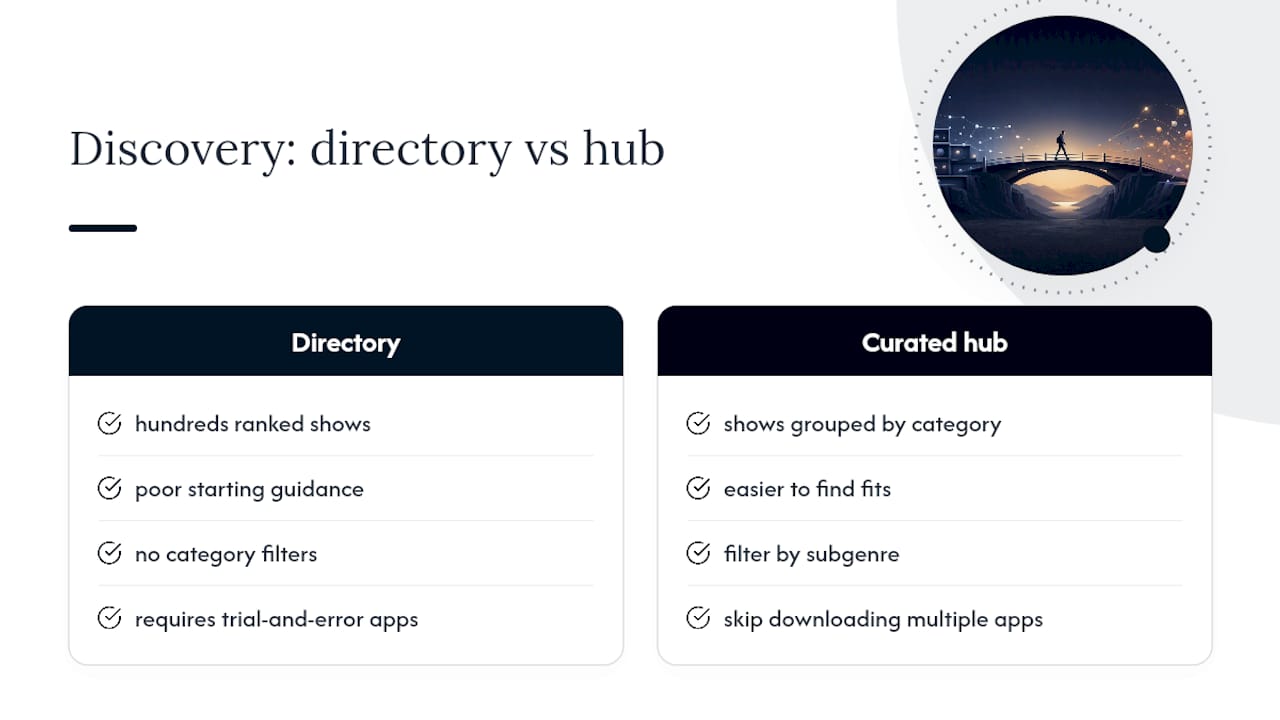
Scrolling through Feedspot’s directory of hundreds of ranked conservative podcasts is useful if you want a sense of how big this media landscape actually is. It’s a terrible way to figure out where to start, since raw size tells you nothing about tone, format, or fit.
There are curated hubs that aggregate conservative shows, grouping them by category instead of dumping every show into one undifferentiated feed. A new listener can filter by subgenre, land on a show that matches their tolerance for a given day, and skip the trial-and-error of downloading five apps to find one show worth a second episode.
One honest caveat: curation tells you what a show generally is, not whether a specific claim in a specific episode holds up. GOPcast can point you to the right shelf. Fact-checking the argument you just heard is still on you.
Why publish a listening guide for conservative podcasts?
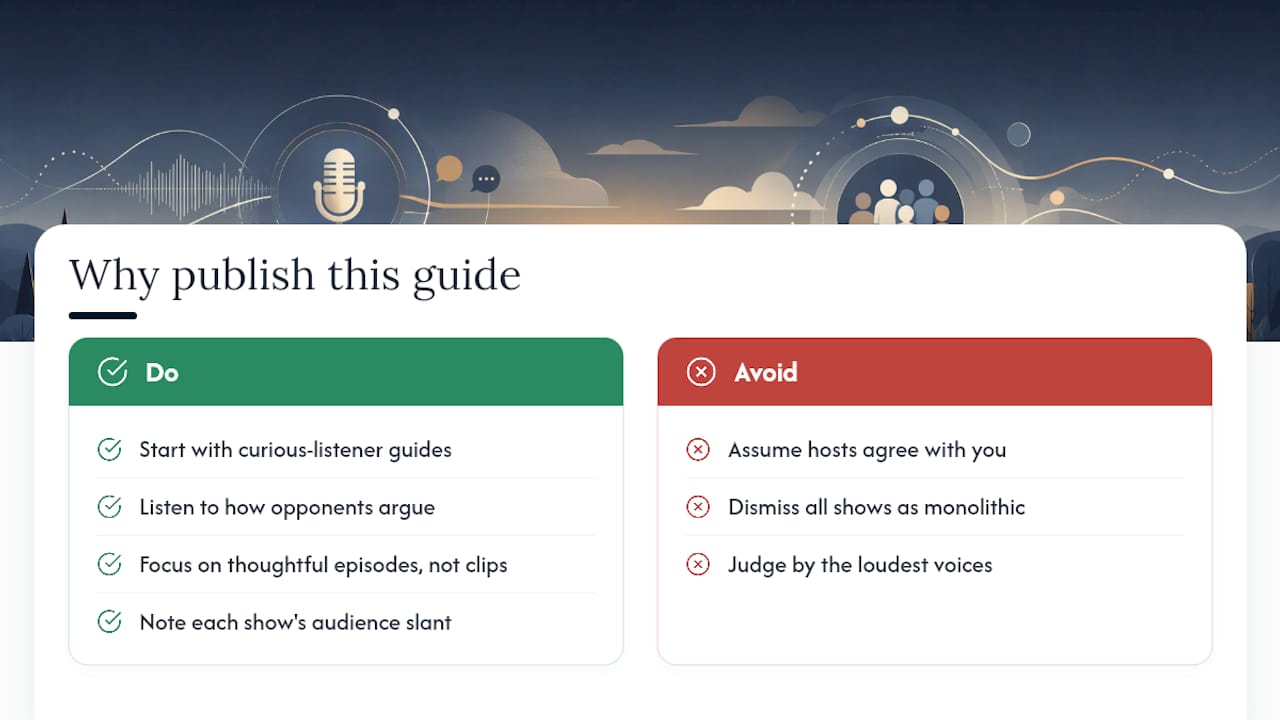
We built this guide because most “conservative podcasts” lists either assume the reader already agrees with the hosts, or treat the whole category as a monolith worth avoiding entirely. Neither framing helps a curious liberal listener figure out where to actually start.
GOPcast’s audience skews conservative, and we’re upfront about that. But understanding how the other side argues, at its best and not just its loudest, makes you sharper regardless of where you land politically. That’s the goal of this guide: fewer strawmen, more actual listening.
— GOPcast
Try These Shows on GOPcast
There are free, curated hubs built specifically to solve the problem this guide just walked through: finding a conservative show worth your first hour without wading through hundreds of undifferentiated feed results.

If you want to start with the news-cycle, roundup-style format mentioned above, Ringside Politics is a solid daily entry point that tracks the same stories your usual feeds cover, just from the other side. Prefer a single-host interview format instead? The Brian Kilmeade Show leans more conversational and less combative than the average cable-adjacent program. Everything streams free, browsable by category, so you can sample a few minutes of one show and jump to another without committing to a download or a subscription. Pick one show from this guide, find it on GOPcast, and give the first fifteen minutes a real shot.