
If you want history told through a conservative lens, the fastest path is a curated hub like GOPcast, which surfaces historian-hosted and guest-driven shows in one place. A conservative history podcast typically re-centers narratives its hosts believe academia downplays, often backed by think-tank fellows or published historians as guests. Start by sampling a show or browsing the history category directly.
TL;DR:
- Conservative history podcasts often feature expert guests affiliated with research institutes or published authors, emphasizing credibility through sourcing.
- Many shows use strategies like reclamation to challenge mainstream narratives, tying past events directly to current political debates or misconceptions.
- Episode formats vary from long-form analyses with primary sources to brief commentaries linking history to current events, so matching your schedule and interest is key.
- Show notes that include citations or recommended readings indicate a host committed to transparency and verifying claims, enhancing reliability.
- Regular episode releases and consistent content archives suggest a show built for long-term engagement, regardless of production quality.
Table of Contents
- Types of Conservative History Shows to Look For
- What to Check Before You Commit: Selection Criteria
- How Conservative History Podcasts Use History in Service of Present-Day Discussion
- Where to Find Curated Conservative History Shows
- What Each Episode Actually Covers
- Beginner-Friendly Shows Worth Starting With
- Comparing Conservative and Non-Conservative History Podcasts
- Production Quality and How Often New Episodes Drop
- Why This Genre Matters, and How to Listen to It Well
- Start Listening: Your Next Conservative History Podcast Is One Click Away
- Sources
- FAQ
Types of Conservative History Shows to Look For
Not every conservative history podcast sounds the same, and the differences matter more than most listeners realize before they hit play. Some shows run 90 minutes with footnotes you could cite in a term paper. Others deliver a five-minute historical parallel to whatever happened in Washington that morning. Knowing which format you’re getting saves you from abandoning a show after one mismatched episode.
The genre breaks down into a few recognizable formats:
- Long-form historian-hosted analysis: These episodes run long, feature academic guests, and dig into primary sources rather than headlines.
- Interview shows built around think-tank fellows and authors: The host asks questions; the guest’s credentials carry the episode’s authority.
- Short daily or weekly commentaries: These link a historical event to a current news cycle in ten minutes or less.
- Multi-episode narrative arcs: A single topic, like a war or a founding-era debate, gets three or four dedicated episodes instead of one.
The Sons of History illustrate that narrative format well, publishing focused episode series with named historian guests rather than one-off chats. Victor Davis Hanson’s show leans toward the short-commentary model, pairing historian-led analysis with frequent weekly episodes and shorter segments tied to current events.
The “reclamation” framing shows up across nearly all four formats. Listen for language about correcting a narrative, restoring a forgotten founder’s reputation, or pushing back on what a host frames as a distorted textbook version of events. That framing is the throughline of the genre, whether it arrives in a 90 minute deep dive or a five minute aside.
What to Check Before You Commit: Selection Criteria
Picking a conservative history podcast without a checklist means you’ll churn through three shows before finding one that fits. A few minutes of vetting up front beats a month of half finished episodes in your queue.
- Check host credentials and guest affiliations. Look for named fellows at research institutes, published historians, or authors with an actual bibliography, not just an opinionated voice.
- Match episode length and cadence to your schedule. Some shows publish multiple long-form episodes per week; others run shorter daily or weekly segments built for a commute rather than a road trip.
- Look for source transparency. Show notes with citations or a recommended-reading list signal a host who wants you to verify claims, not just accept them.
- Decide on tone intentionally. Some programs sit closer to academic rigor; others lean populist and argumentative, and neither is wrong, but you should choose on purpose.
- Confirm platform availability and subscription model. Check whether episodes are free, gated behind a premium feed, or split between the two.
Pro Tip: If a show’s episode description mentions a guest’s institute or fellowship by name, that’s usually a faster credibility check than reading five reviews.
Guest credentials often carry more weight in this genre than production polish. A show recorded in someone’s home office with a historian who wrote the book on the subject beats a slick studio production with no named sources.
How Conservative History Podcasts Use History in Service of Present-Day Discussion
Most conservative history shows aren’t just cataloging the past. They’re using it to argue about the present, and understanding that intent helps you judge what you’re actually listening to.
The dominant strategy is reclamation: producers select episodes and guests to directly rebut or reframe topics they see as misrepresented in mainstream academic narratives. A second strategy, applied history, treats a past event, say a founding-era debate over federal power, as a direct analogy for a current policy fight. Both strategies lean heavily on guest-driven credibility: a claim lands harder coming from a fellow at a research institute than from the host alone.
Watch for signals that a show has drifted from historiography into persuasion. If every guest agrees, if counterarguments never get airtime, and if primary sources rarely get cited by name, you’re listening to commentary wearing history’s clothes. That’s not automatically bad, but it’s worth knowing which one you signed up for.
Where to Find Curated Conservative History Shows
Discovery friction is the real barrier in this genre. Conservative history content is scattered across networks, apps, and platforms, which makes a lesser-known historian-hosted series easy to miss entirely.
Some curated platforms aggregate conservative political and history programming into one browsable hub, surfacing historian-hosted shows alongside commentary and interview programs listeners already know. A few things worth using once you’re there:
- Browse the history category directly instead of relying on generic podcast-app search, which tends to surface only the biggest names.
- Check GOPcast’s blog resources for context on guest backgrounds and episode angles before you commit 40 minutes to a show.
- Use media literacy guidance to sharpen how you evaluate any host’s sourcing, not just the ones featured on the platform.

What Each Episode Actually Covers
Episode structure varies more than the marketing copy suggests. A typical long-form episode opens with a historical setup, ten or fifteen minutes establishing dates, figures, and context, before pivoting into the host’s or guest’s interpretation of what that history means today.
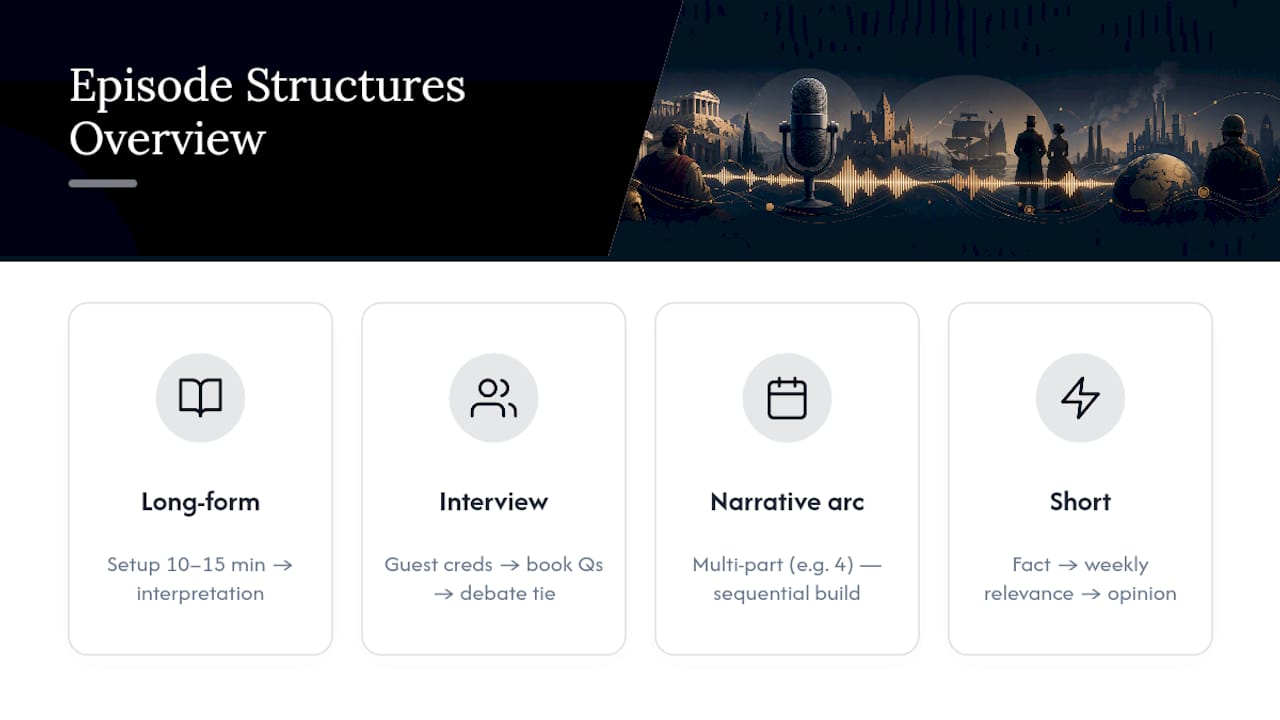
Interview-driven episodes usually follow a simpler arc: introduction of the guest’s credentials, a handful of questions about their book or research, then a closing segment connecting their findings to a live political debate. Conservative Historian structures its show notes this way across platforms, listing topic, guest, and takeaway for each episode so listeners can scan before committing.
Narrative-arc shows work differently. Instead of one self-contained episode, you get part one of four covering a single war, founding document, or movement, with each installment building on the last. That format rewards binge listening but punishes anyone who jumps in at episode three without context.
Short-commentary formats compress all of this into a single segment: a historical fact, why it’s relevant this week, and a closing opinion. There’s no guest, no show notes to speak of, and no pretense of neutrality. Knowing which structure a show uses before you press play sets your expectations correctly and saves you from bailing halfway through.
Beginner-Friendly Shows Worth Starting With
If you’re new to the genre, start with something guest-driven before committing to a dense academic feed. Interview shows front-load credentials, so you learn who you’re listening to within the first five minutes, which makes it easier to judge whether their expertise matches the claims that follow.
History-Reconsidered is a reasonable entry point precisely because its hosts state their mission plainly: keeping what they call “true and good history” alive outside the academy, positioning the show as a direct corrective rather than a subtle one. That clarity helps a new listener know exactly what lens they’re getting from episode one.
From there, short-commentary shows work well as a second step, since they’re low commitment and make the historical analogy explicit rather than buried in a 90-minute discussion. Once you’ve got a feel for tone and pacing, narrative-arc series are worth tackling, but they ask for more patience since dropping in mid-series without the earlier episodes leaves gaps in the argument. Save those for when you already trust the host’s approach to sourcing.
Comparing Conservative and Non-Conservative History Podcasts
The biggest difference isn’t factual accuracy on either side. It’s which facts get emphasized and which interpretive frame those facts get placed inside.
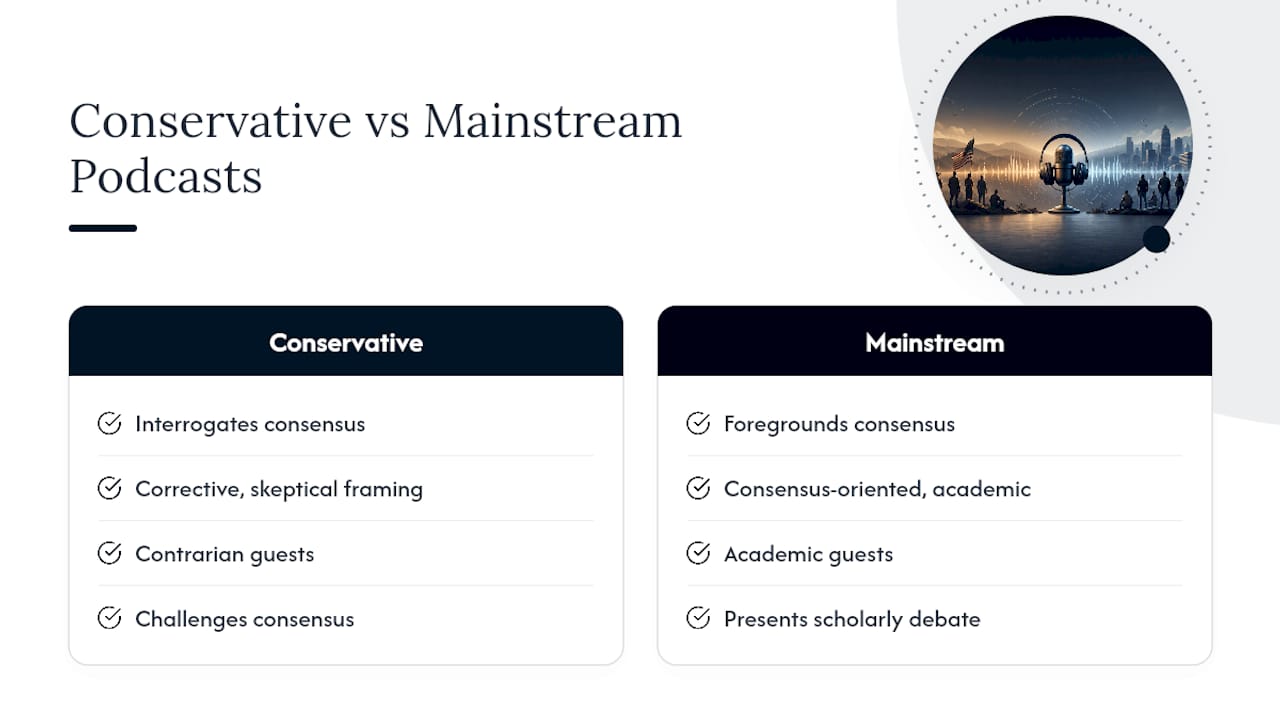
A mainstream academic history podcast will often foreground institutional consensus, citing peer-reviewed research and treating disagreement among historians as part of the story. A conservative history podcast is more likely to treat that same consensus as something to interrogate, framing itself explicitly as a corrective to what hosts describe as a skewed academic narrative. Neither approach is inherently more rigorous. The difference shows up in guest selection, framing language, and which questions get asked in the first place.
For a listener, the practical takeaway is this: if you only listen to one side, you’ll hear one set of questions asked and one set of counterarguments left unexamined. Pairing a conservative-framed show with a more academically mainstream one on the same topic, say the New Deal or the Cold War’s origins, gives you both the corrective lens and the consensus view side by side. That contrast tends to teach more than either show alone.
Production Quality and How Often New Episodes Drop
Production values across this genre vary widely, and that’s not necessarily a mark against a show. Episode cadence matters more than audio polish for most listeners.
Some programs, like Victor Davis Hanson’s show, publish multiple episodes weekly, mixing longer commentary with shorter segments to keep a steady release schedule. Others run on a strict weekly cadence with a single, longer episode, trading frequency for depth. Narrative-arc series often publish in bursts, several installments close together, followed by a gap before the next topic begins.
Check a show’s episode archive before subscribing. A feed with gaps of two or three months between episodes signals a side project rather than a consistent program, no matter how good the individual episodes are. Conservative Historian’s consistent episode listings across major platforms are a useful benchmark: regular uploads, clear show notes, and archive depth all point to a show built for the long haul rather than a handful of enthusiastic episodes that trail off.
Why This Genre Matters, and How to Listen to It Well
Conservative framing gives you a distinct interpretive lens, one that complements rather than replaces other historical sources. That’s the honest case for this genre: it strengthens civic literacy by handing you counterpoints that mainstream coverage often skips entirely.
The catch is that a lens is still a lens. Listen critically. When a host cites a source, look it up. When a show skips citations entirely, treat the claims as commentary, not settled history. The best conservative history podcasts make that distinction easy by publishing show notes and recommended reading. The weaker ones don’t, and that gap is the single clearest signal of quality in this space.
— GOPcast
Start Listening: Your Next Conservative History Podcast Is One Click Away
GOPcast exists so you don’t have to hunt across a dozen apps and networks to find historian-hosted and guest-driven shows worth your time. Instead of guessing which feed has staying power, you get a curated hub where conservative political and history programming lives in one browsable place.
A few entry points worth trying first: Ringside Politics pairs commentary with the kind of historical framing covered throughout this guide, while The Sentinel Report offers a steadier, news-adjacent cadence if you want shorter daily listening. If you’d rather start with a recognizable voice, The Brian Kilmeade Show is a solid first stop.
Many shows on curated conservative podcast platforms stream free through the web, no app download required, and listeners can often follow programs directly from their landing pages to keep new episodes easy to find. Pick one of the shows above, listen to a single episode, and decide from there whether its tone and cadence match what you’re after.
Sources
For deeper listening, History-Reconsidered lays out its editorial mission directly on its show page, useful for understanding host intent before you press play. Victor Davis Hanson’s show page lists episode cadence and format details worth checking against your own schedule. The Sons of History on EpochTV shows how the narrative-arc format looks in practice, guest by guest. For platform availability and full episode archives, Conservative Historian on Apple Podcasts is a reliable reference point for checking how consistently a show publishes over time.
- History-Reconsidered – Reconsider History with Dr. Sumantra Maitra & Jarrett Stepman
- Victor Davis Hanson: In His Own Words - The Daily Signal
- The Sons of History | Unveiling Profound Insights | EpochTV
FAQ
Who Are the Top Conservative Podcasts Right Now?
There’s no single official ranking, but recognizable names in political commentary include Bannon’s War Room and The Dan Bongino Show, both available through curated hubs like GOPcast, alongside historian-hosted shows like Victor Davis Hanson’s program and History-Reconsidered.
What Are the Best History Podcasts to Start With?
The strongest starting point depends on your preferred format: interview-driven shows front-load host and guest credentials, making them easier for new listeners to judge quickly, while narrative-arc series reward patience once you’ve found a host you trust.
Are There Any Politically Balanced History Podcasts?
Fully neutral political history podcasts are rare, since most hosts bring an interpretive framework whether they state it outright or not; the more reliable approach is pairing a conservative-framed show with a mainstream academic one on the same topic to see both angles.
What Makes a Podcast a Conservative History Podcast?
A conservative history podcast typically applies a reclamation framing, correcting or re-centering narratives hosts believe mainstream academia downplays, and often features guests tied to research institutes or published books rather than neutral historians alone.
How Can I Tell If a History Podcast Is Reliable?
Check for named host and guest credentials, published show notes with citations, and a consistent episode archive; shows that skip sourcing entirely lean closer to commentary than historiography.