Start with GOPcast’s curated America First collection, which sorts shows into two clear lanes: think-tank policy programs and independent nightly commentary. Policy shows like The Tank give you legislative depth with credentialed guests; commentary shows deliver fast, opinionated takes on the day’s news. Subscribe through podcast platforms or follow the same feeds on Apple Podcasts and Spotify.
TL;DR:
- Most podcasts in the America First space are either structured, sourced policy shows or reaction-based commentary programs, each serving different informational needs.
- Building a balanced feed involves selecting one daily commentary show, one weekly policy program, and rotating in cultural or satire shows to avoid burnout.
- When choosing shows, verify sourcing transparency, episode cadence, guest credentials, topical focus, and warning signs like vague claims or lack of notes.
- Distribution differences mean policy shows are usually on mainstream platforms with detailed notes, while commentary shows often stream live on decentralized hosts and clip afterward.
- Most engaged listeners are politically experienced, middle-aged or older, using podcasts during commutes, with some younger audiences attracted to live interaction and quick reaction content.
Table of Contents
- Curated GOPcast Picks for an America First Listening Feed
- Two Ecosystems: Policy Think Tanks vs. Independent Commentary
- How to Choose and Curate Your America First Feed
- Where These Shows Actually Publish and How to Follow Them
- Why Production Source Changes What You Can Trust
- The Hosts Driving the Movement’s Biggest Shows
- Who Actually Listens to These Shows
- Where “America First” Comes From and What It Means Today
- How to Judge a Show’s Credibility Before You Trust It
- How GOPcast Puts the Whole America First Lineup in One Place
- Author Perspective: Building a Media Diet That Actually Holds Up
- Sources
- FAQ
Curated GOPcast Picks for an America First Listening Feed
You don’t need twenty subscriptions to stay informed. You need the right handful, matched to what you actually want out of your listening time. Here’s a working lineup pulled from GOPcast’s show library, organized by what each one does best.
- Ringside Politics — Offers sharp, combative takes on the week’s biggest story. Weekly, roughly 45 to 60 minutes. Listen on a Friday commute to catch up before the weekend news cycle.
- The Dan Bongino Show — Covers national security and law enforcement angles most outlets skip. Daily, 60 to 90 minutes. Good for a morning routine since episodes drop early.
- Brian Kilmeade Show — Offers a more traditional, broadcast-style conservative take. Daily, around 40 minutes. Works well as a lunch-break listen.
- The Sentinel Report — Best for readers who want a watchdog lens on federal agencies. Weekly, 30 to 45 minutes. Pair it with a policy podcast for context.
- National Update — Best for a quick, no-frills news rundown without heavy commentary. Daily, under 30 minutes. A solid first listen if you’re new to the space.
- The Hope Report — Best for cultural commentary with a faith-and-family lens. Weekly, 30 to 40 minutes.
- After Hours with Alex Stein — Best for satire and comedic takes on political absurdity. Several times weekly, 60+ minutes.
- Media Exposed with Adam Weiss — Best for media criticism and fact-checking mainstream coverage. Weekly, 30 to 45 minutes.
- Stinchfield Tonight — Best for direct, unfiltered nightly reaction to breaking political news. Nightly, 30 to 45 minutes.
- Perino on Politics — Best for a calmer, interview-driven format if the shouting shows wear you out. Weekly, 45 minutes.
- The Case for America — Best for policy arguments framed for persuasion, useful if you debate politics with friends or family. Weekly, 40 to 50 minutes.
- Louder with Crowder — Best for long-form debate segments and audience call-ins. Several times weekly, 60 to 90 minutes.
Pro Tip: Don’t build your feed entirely out of nightly reaction shows. Mix one or two daily commentary programs with a single weekly policy show, so you’re getting both the pulse of the news cycle and the deeper “why” behind it.
Two Ecosystems: Policy Think Tanks vs. Independent Commentary
Every America First podcast falls into one of two production models, and knowing which one you’re listening to changes how you should treat what you hear.
Think-tank and policy podcasts are built around institutional research. They book former officials, cite legislation by name, and typically run as structured interviews rather than free-flowing reaction. Episodes tend to the formal side: 30 to 60 minutes, released weekly rather than daily, with show notes that list guest credentials and source material.
Independent commentary and satire shows run on a completely different clock. These are reaction-driven, often recorded and posted the same night as breaking news, and lean into personality and audience rapport more than sourced argument. Cadence is aggressive, sometimes multiple times a week or nightly, and episodes commonly run 60 to 90 minutes since hosts are covering more ground in real time.
The practical difference shows up in how you’d use each one:
- Prepping for a policy debate or writing on a specific bill? Reach for a think-tank show with named sources and expert guests.
- Want the fastest read on how the right is reacting to today’s headline? A nightly commentary show gets you there before the policy shows even finish recording.
- Building general cultural literacy on the movement? You need both, on rotation, not one or the other.
Neither format is inherently more trustworthy. They’re built for different jobs, and mistaking one for the other is where most listeners get burned on nuance.
How to Choose and Curate Your America First Feed
Building a reliable feed comes down to five checks before you hit subscribe:
- Cadence match. Does the release schedule fit how you actually consume podcasts? A daily show you never catch up on is worse than a weekly one you finish every time.
- Production source. Is this a think tank, an independent creator, or a hybrid? Know which one you’re listening to before you quote it.
- Guest expertise. Are guests named with actual titles and affiliations, or vague “insiders” and “sources”?
- Topical focus. Does the show stay in its lane (policy, culture, national security) or bounce around without depth?
- Sourcing transparency. Do episode notes cite where claims come from, or is it commentary presented as fact?
Once you’ve filtered for those, build a weekly rhythm instead of subscribing to everything at once:
- Pick one daily or nightly commentary show for your baseline news pulse.
- Add one weekly policy show for depth on a topic you actually care about, whether that’s immigration, trade, or judicial nominations.
- Rotate in a satire or cultural show for variety, since a steady diet of hard news burns people out fast.
- Reassess monthly. Drop anything you’re skipping more than you’re listening to.
Watch for red flags along the way: shows with no episode notes, guests introduced without last names or affiliations, and hosts who make specific factual claims with zero sourcing. GOPcast’s guide to building a conservative podcast lineup walks through this same filtering process in more detail if you want a deeper checklist.
Pro Tip: Keep one “audit” show in your rotation, something that fact-checks media coverage from the right. It keeps your other shows honest and gives you a sense of where the weak claims tend to come from.
Where These Shows Actually Publish and How to Follow Them
Distribution for America First podcasts splits across three patterns. Think-tank shows like The Tank publish through mainstream directories including Spotify, Apple, and Amazon Music, with full episode notes on the producer’s own site. Independent commentary shows often stream live first on decentralized hosts like Rumble or Cozy.tv, then get reposted as clipped audio archives on podcast directories afterward.
That gap between live and archived matters. If you only catch the clipped version, you’re getting yesterday’s reaction to today’s news.
- On podcast aggregation sites, browse by show, hit follow, and enable notifications for new episodes across both policy and commentary categories in one place.
- On Apple or Spotify: search the show name directly, but check upload timestamps since clipped shows can lag the live stream by hours.
- For live interaction: Telegram channels and in-stream chat let you catch Q&A segments that never make it into the podcast cut. GOPcast’s notes on streaming to a smart TV cover the setup if you’d rather watch than listen.
Why Production Source Changes What You Can Trust
The gap between a think-tank podcast and an independent commentary show isn’t about tone. It’s about sourcing.
The Tank, produced by the America First Policy Institute, interviews former officials such as former Director of National Intelligence John Ratcliffe, with episode notes that identify guests, their affiliations, and the policy area under discussion.
That level of transparency is the exception, not the rule, across the wider America First podcast space. Independent nightly shows built around cultural commentary and satire, including several titled simply “America First,” run on a completely different model: episodes post as clipped archives, typically 1 to 2 hours long, prioritizing speed and audience reaction over in-episode sourcing.
Neither approach is wrong for its purpose. But if you’re citing a claim in an argument or building a case for a policy position, a show with named guests and documented affiliations gives you something you can actually check. A nightly reaction show gives you the mood of the moment, which is valuable in its own right, just not the same kind of evidence.
The Hosts Driving the Movement’s Biggest Shows
The most influential voices in America First media split roughly along the same lines as the shows themselves. On the policy side, hosts and guest interviewers tend to come from government or think-tank backgrounds: former cabinet officials, ex-intelligence officers, and policy staffers who bring institutional credibility and a Rolodex of former colleagues willing to go on record.
On the commentary side, the biggest names built their audiences through raw volume and consistency rather than credentials. Hosts putting out nightly or near-nightly episodes tend to develop the most loyal followings, largely because frequency builds habit. Listeners tune in the same way they’d check a nightly news broadcast, and that repetition compounds into trust over time, even when the show is opinion-driven rather than reported.
A smaller tier of hosts straddles both worlds: broadcast veterans who moved into podcasting after careers in cable news or talk radio, bringing production polish and interview chops but leaning into commentary more than institutional sourcing. These hosts often draw the widest audiences precisely because they split the difference between the two ecosystems, giving listeners familiar voices with looser editorial constraints than a network job would allow.
Who Actually Listens to These Shows
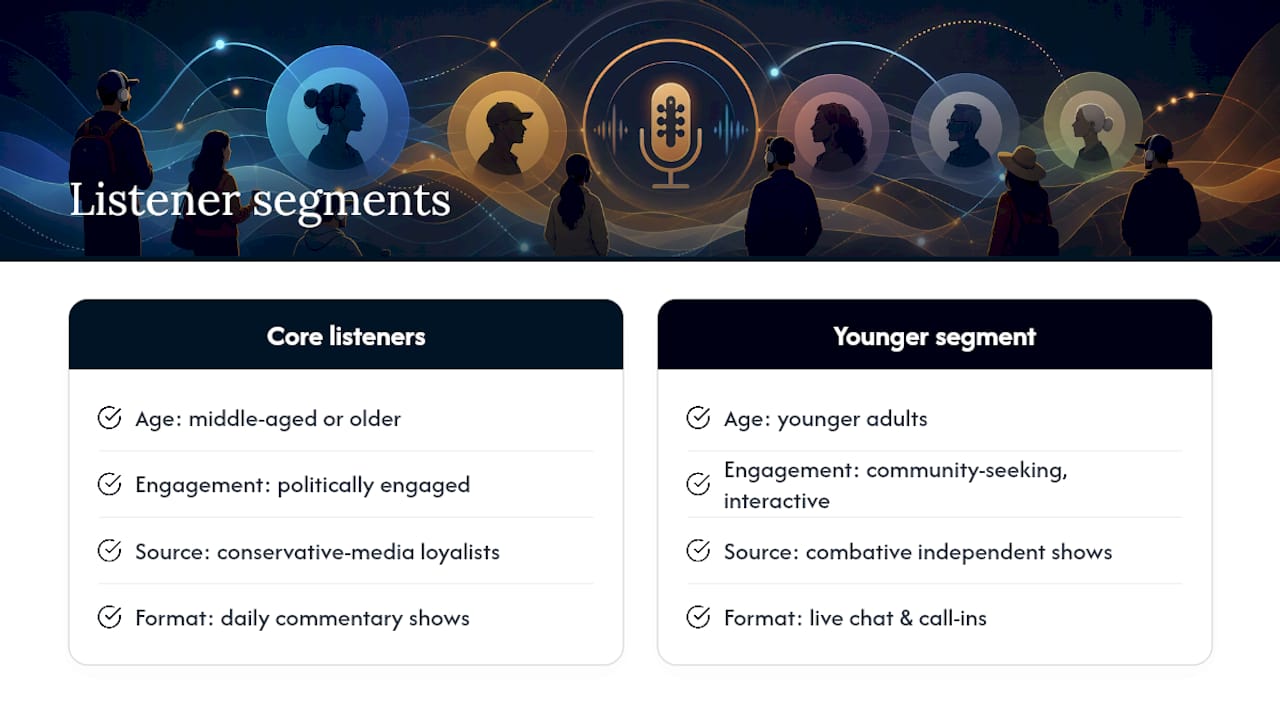
America First podcast audiences skew toward listeners already engaged with conservative media rather than casual news consumers dipping in for the first time. Rankings from industry trackers like Feedspot show that the highest-reach conservative shows draw large, consistent audiences, with top programs reporting sizable monthly listener bases and daily commentary formats like The Ben Shapiro Show ranking near the top of most lists.
The typical listener profile leans middle-aged and older, politically engaged enough to seek out commentary beyond mainstream cable news, and often listening during commutes or while doing other tasks rather than sitting down for a dedicated viewing session. That’s part of why podcast format itself has thrived in this space. It fits around a workday in a way that cable news segments scheduled at fixed times can’t match.
There’s also a growing younger segment drawn specifically to the faster, more combative independent shows, particularly ones that blend commentary with live audience interaction through chat and call-ins. That interactive layer, increasingly common across the format, pulls in listeners who want to feel part of a conversation rather than just receiving one, which is a meaningfully different draw than the policy-show audience tuning in for depth over community.
Where “America First” Comes From and What It Means Today
“America First” as a political phrase predates podcasting by roughly a century, first associated with isolationist sentiment before World War II and later revived as a governing slogan during the Trump administration. Today’s usage in podcast titles and branding draws almost entirely from that second wave: a framework built around trade protectionism, immigration restriction, and skepticism of multinational institutions and foreign entanglements.
That history matters for listeners because it explains why the podcast landscape splits the way it does. Institutional programs like The Tank descend more directly from the policy apparatus built around the movement, staffed by people who worked in or adjacent to the administration that popularized the phrase. Independent commentary shows draw more from the movement’s populist, anti-establishment energy, the strain that predates and outlasts any single administration and shows up as suspicion of media gatekeepers, academic institutions, and party leadership alike.
Understanding which strand a given show pulls from helps explain its tone before you’ve even hit play. A show rooted in the policy wing will sound more like a briefing. A show rooted in the populist wing will sound more like a rally.
How to Judge a Show’s Credibility Before You Trust It
Not every show wearing the America First label deserves the same level of trust on every claim, and treating them all identically is how misinformation spreads inside a media ecosystem that otherwise gets a lot right.
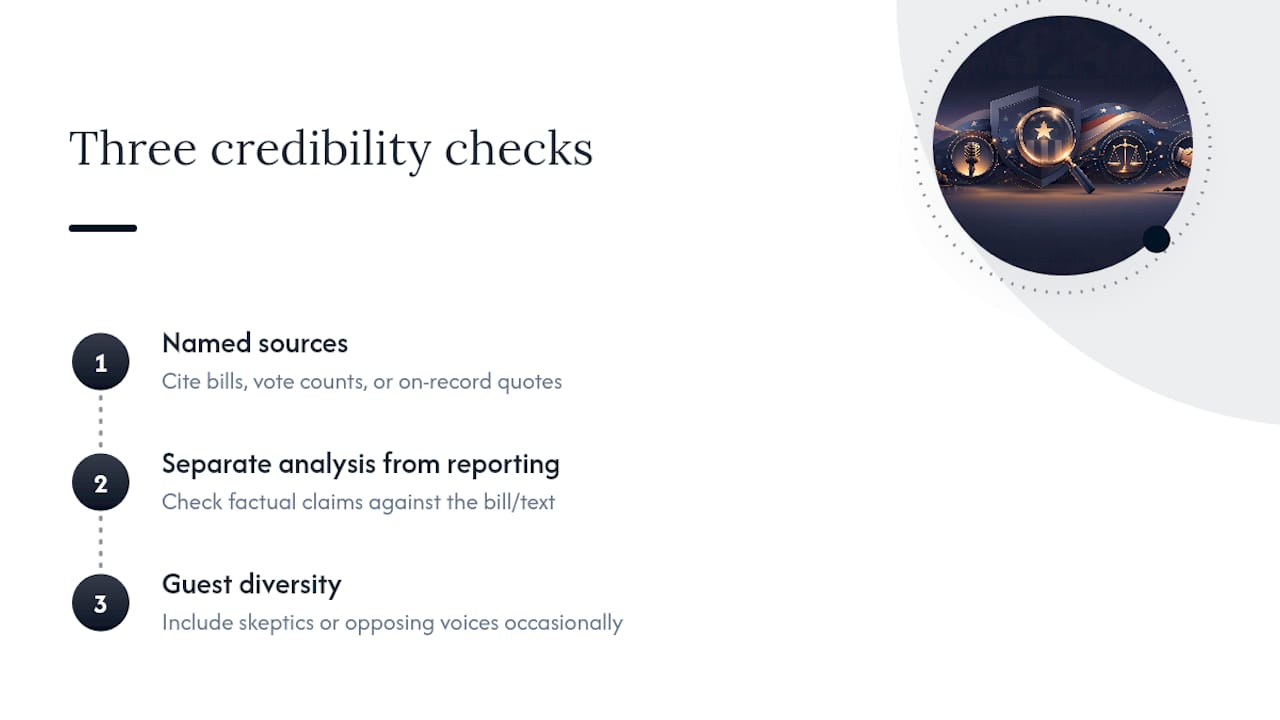
Start by checking whether a show names its sources. A think-tank program that cites a specific bill, a specific vote count, or a named official’s on-record statement gives you something verifiable. A commentary show that says “sources tell me” or “everyone knows” without elaboration is asking you to trust the host’s judgment alone, which might be fine for opinion but is a weak foundation for a factual claim.
Second, separate analysis from reporting. A host’s take on what a policy means for the country is opinion, even a well-informed one. A claim about what a bill actually says or what a vote actually did is a factual matter you can check against the text itself.
Third, watch for guest diversity. Shows that only ever host people who already agree with the host tend to drift further from center over time, since there’s no friction pushing back on weak arguments. A show willing to bring on skeptics or opposing voices, even occasionally, is doing more to earn your trust than one that never does.
How GOPcast Puts the Whole America First Lineup in One Place
GOPcast pulls every show above into one portal instead of making you hunt across five different apps and three streaming sites to build a decent feed. You get curated aggregation, live access when a show is broadcasting, and recorded episodes archived in one place, so switching between a nightly commentary show and a weekly policy program takes one tap, not a different login for each.

A few starting points if you’re not sure where to jump in: Ringside Politics for sharp weekly takes on the biggest story of the week, the Brian Kilmeade Show for a more traditional daily broadcast feel, No Agenda Show if you want a looser, listener-driven format, and The Dan Bongino Show for daily national security and law enforcement coverage. Each show page lists cadence and recent episodes upfront, so you can gauge fit before committing to a subscription.
Visit GOPcast, follow the shows that match your feed, and turn on notifications so new episodes land the moment they drop instead of getting buried in a crowded podcast app.
Author Perspective: Building a Media Diet That Actually Holds Up
Curation only works when it respects the difference between depth and speed instead of treating every show as interchangeable. GOPcast’s approach favors surfacing both think-tank programs and independent commentary side by side, because a media diet built on only one leaves gaps the other fills. [brand_signal] If you’ve found a show that deserves a spot on this list, we want to hear about it.
— GOPcast
Sources
- Making sense of the “America First” | Podcast |
- Nick Fuentes — Wikipedia
- The Tank | America First Policy Institute
FAQ
Who Has the #1 Podcast in America Right Now?
Rankings shift by category and tracker, but daily conservative commentary shows like The Ben Shapiro Show consistently rank among the highest-reach shows in the space, while overall chart leaders vary week to week across all genres combined.
What Is the Most Listened-to History Podcast?
History podcast rankings aren’t tracked within the America First political podcast space specifically, and no figure in the research behind this guide covers that category, so it falls outside what this article can confirm.
What Is the Best Podcast in America?
There’s no single “best” since it depends on what you want. For America First policy depth, think-tank programs like The Tank lead the pack; for daily commentary, high-frequency independent shows draw the largest and most engaged audiences.
What Is the Oldest Podcast Still Running?
Podcasting as a format dates back over two decades, but no source in this guide’s research confirms a specific oldest surviving show within the America First or conservative podcast category, so that claim can’t be verified here.
Should I Start With a Policy Show or a Commentary Show?
Start with a commentary show for the daily news pulse, then add one weekly policy program like The Tank for depth. Most experienced listeners run both simultaneously rather than choosing one over the other.