
If you want podcasts that critique or push back on Critical Race Theory from a conservative perspective, start with GOPcast. The platform hosts flagship shows like The Dan Bongino Show, Ringside Politics, and Media Exposed with Adam Weiss, three programs that pair sharp commentary with real policy substance. Each one treats CRT as a subject worth arguing about seriously, not a punchline, which is exactly what separates a useful listen from noise.
TL;DR:
- Most effective conservative CRT podcasts feature hosts who question premises, provide documented evidence, and engage in real-time pushback rather than reciting slogans.
- Show formats such as debates, panels, and investigative-style episodes tend to offer more depth and credibility than repetitive or outrage-driven content.
- Reliable sources include hosts with legal or policy backgrounds who cite specific studies, memos, or court cases, and guest lists that include diverse expert opinions.
- Avoid shows that rely on emotional appeals, unverified anecdotes, or lack transparent sourcing, especially if claims are repeated without new evidence.
- Platforms like GOPcast help users quickly find reputable critique shows, with curated variety and easy subscription options to streamline conservative CRT listening.
Table of Contents
- Where to Find Critical Race Theory Podcasts That Push Back
- 6 Podcasts That Take On Critical Race Theory Seriously
- How to Tell a Serious Anti-CRT Podcast From an Outrage Machine
- How to Start Listening on GOPcast
- Why These Critiques Resonate With Conservative Audiences
- The Editorial Case for Curated Conservative Listening
- Start Listening: Featured Shows on GOPcast
- Sources
Where to Find Critical Race Theory Podcasts That Push Back
Most searches for critical race theory podcasts turn up academic explainers or advocacy shows defending the framework. That’s not what conservative listeners are usually after. What you want is critical race theory audio built around counterargument: hosts who question CRT’s premises, examine how it shows up in school curricula and corporate training, and bring on guests who can back their claims with documents and named research rather than slogans.
The platform built its show lineup around that gap. Rather than making you hunt across many apps for the right conservative voice, it groups commentary, legal analysis, and policy debate shows in one place. That matters more than it sounds, because the CRT conversation moves fast, and a lot of shows recycle the same talking points without adding anything new. The ones worth your time actually do the work.
6 Podcasts That Take On Critical Race Theory Seriously
1. The Dan Bongino Show
Dan Bongino built his platform on a law enforcement and Secret Service background, and he brings that same combative, evidence-first style to CRT segments. He treats it as a policy fight, not an abstraction, tying it to school board battles and federal guidance. Start with any recent episode tagged education policy or federal overreach.
2. Ringside Politics
This show runs more like a debate than a monologue, with hosts sparring over the news of the day rather than preaching to an audience that already agrees. That format is useful for CRT coverage specifically because it forces claims to survive pushback in real time. Sample an episode where a guest defends a mainstream position. It’s the fastest way to judge how well the hosts handle a real disagreement.
3. Media Exposed with Adam Weiss
Adam Weiss focuses on media criticism and institutional accountability, which makes his CRT episodes different from pure commentary shows. He tends to walk through specific stories, memos, or training materials rather than talking in generalities. That evidentiary approach is closer to investigative journalism than punditry, and it’s worth your first listen if you want sourcing over sentiment.
4. Louder with Crowder
Crowder blends satire with longer-form commentary, and his CRT material usually shows up inside broader segments on education and campus culture. It’s a stylistic departure from the other shows on this list. If straight policy analysis starts to feel repetitive, an episode of Louder with Crowder is a good change of pace without abandoning the critique.
5. Panel and interview-format shows
Programs that repurpose scholarly panels into podcast audio, the way The Daily Signal did with its Heritage Foundation panel, give you a model worth seeking out generally: policy experts talking through CRT’s practical effects rather than trading one-liners. Look for similarly structured episodes when you’re evaluating shows for depth.
6. Legal and originalism-focused commentary shows
A smaller slice of the field approaches CRT through a constitutional lens, asking how it intersects with equal protection law and free speech doctrine. These episodes run drier than the flagship commentary shows, but they’re the ones most likely to cite actual court filings and legislative text instead of anecdotes.
Pro Tip: Sample the interview-format episode of a show before its solo commentary episodes. A host’s willingness to let a guest make a real counterargument tells you more about their standards than an hour of monologue ever will.
How to Tell a Serious Anti-CRT Podcast From an Outrage Machine
Not every show that criticizes Critical Race Theory does it well. Some rely on the same three anecdotes rotated across a dozen episodes, and some builds it’s entire premise on outrage instead of argument. Run a quick check before you commit real listening time.
- Check the host’s background. Legal training, policy experience, or education-sector work adds weight to a claim. Pure commentary experience isn’t disqualifying, but it means you should scrutinize sourcing more closely.
- Look at the guest list. A rotation of scholars, attorneys, and school board members mixed with pundits beats a guest list made up entirely of fellow commentators repeating each other.
- Listen for sourcing. Serious episodes name the study, the memo, or the court case. If a host can’t point to anything more specific than “everyone knows,” treat the claim skeptically.
Beyond that three-step scan, watch for a few consistent red flags: claims repeated episode after episode with no new documentation, guest lists that never include anyone who might disagree, and arguments built entirely on emotional appeal rather than a paper trail. Podcast critics generally agree that the shows worth returning to are the ones offering intellectual grounding over pure performance, not the loudest ones.
Run this in the first ten minutes of any new episode: note who’s talking, whether they cite a specific source in the first segment, and whether the guest (if there is one) gets real room to push back. That’s usually enough to know if the rest of the episode is worth your commute.
How to Start Listening on GOPcast
Getting started takes about two minutes. Head to GOPcast’s conservative podcast hub, where shows are grouped by category instead of buried in an alphabetical list.
- Use the search bar to pull up a specific host or browse by category, including commentary, legal analysis, and policy debate.
- Open a show page to see recent episodes, then follow or subscribe so new releases show up automatically.
- If you’d rather listen through a dedicated podcast app, most GOPcast shows are available through common RSS feeds and major podcast apps, so you’re not locked into one listening method.
- Check the media literacy guide if you want a framework for judging any show, CRT-focused or not, before you subscribe.
Podcast listening has become a daily habit for a huge share of the country, and aggregator platforms exist precisely because sorting through hundreds of shows one by one wastes time listeners don’t have. This platform’s category browsing is built to cut that search down to minutes instead of hours.
Why These Critiques Resonate With Conservative Audiences
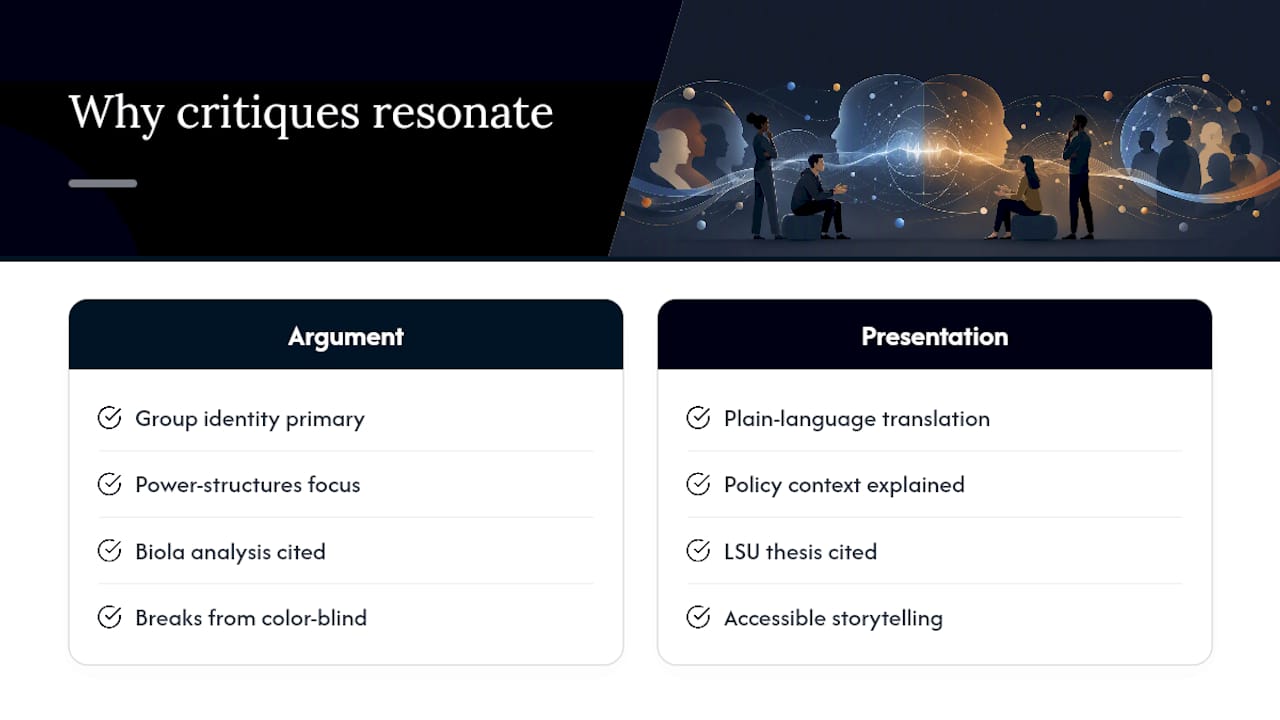
Most conservative critiques of CRT lean on a specific intellectual argument: that the framework treats group identity and power structures as more fundamental than the color-blind ideals of the traditional civil rights movement. Biola University’s analysis of “critical, cynical theories” lays out that contrast clearly, framing CRT as materialist in a way that breaks from earlier civil rights philosophy.
Hosts who succeed with this material tend to do one thing well: they translate academic language into plain terms without flattening the argument. A graduate thesis from LSU examining anti-CRT rhetoric found that this translation work, turning dense theory into a story a general audience can follow, is what makes certain podcasters persuasive where others just sound angry. The Daily Signal’s panel episode on CRT is a workable model here: Heritage Foundation scholars breaking down policy implications in a format any listener can follow without a background in critical theory.
The Editorial Case for Curated Conservative Listening
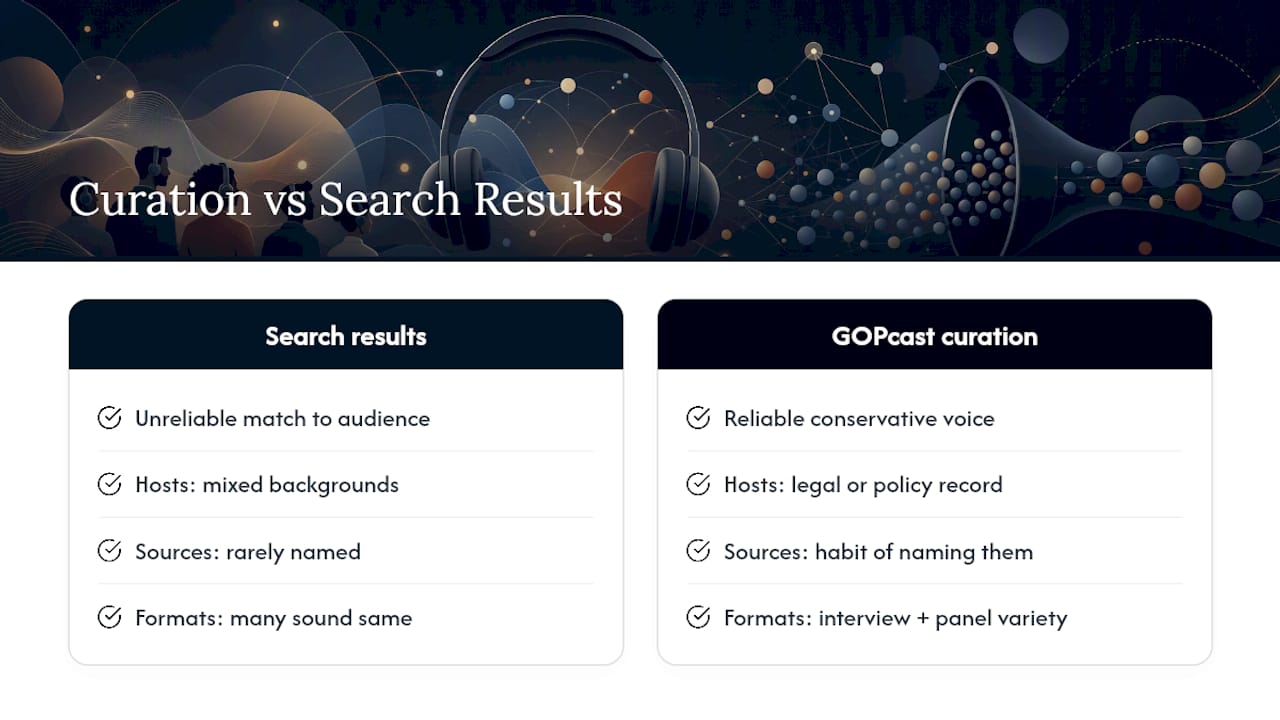
This platform exists because finding a reliable conservative voice on any given topic, CRT included, shouldn’t require scrolling through search results built for a completely different audience. Its curation leans toward hosts with a real record: legal backgrounds, policy experience, or a demonstrated habit of naming sources instead of gesturing at them.
It favors variety in format too. A single interview-heavy show and a single panel-heavy show will teach you more about CRT criticism than five shows that all sound the same. That’s the standard behind every category on this platform, and it’s one held for featured shows.
— GOPcast
Start Listening: Featured Shows on GOPcast
This platform is built to be a one stop for conservative critique of CRT, so you’re not juggling five apps to hear five different takes. Once you find a host whose sourcing checks out, following their show takes one tap, and new episodes show up automatically.

A few shows worth queuing up first:
- The Dan Bongino Show, for combative commentary backed by a law enforcement background.
- Ringside Politics, for debate-format episodes that put claims to a real test.
- Media Exposed with Adam Weiss, for document-driven media criticism.
- Louder with Crowder, for commentary with a sharper comedic edge.
Pick one, hit play, and see how it holds up against the checklist above. If it passes, follow it. If it doesn’t, GOPcast’s category pages make it easy to try the next one.
Sources
- Critical, cynical theories (Biola University blog)
- Podcast: What You Need to Know About Critical Race Theory (The Daily Signal)
- Graduate thesis on rhetoric and the anti-CRT movement (LSU repository)