Talk radio is live, scheduled audio broadcast over public airwaves for habitual mass audiences; podcasts are on-demand digital audio built for niche depth and listener control. For listeners: if you want company during a commute with no setup, radio wins. If you want a specific topic on your schedule, choose a podcast. For creators: radio gives you instant reach and live interaction; podcasting gives you editorial control, evergreen archives, and more precise audience targeting.
Edison Research’s Share of Ear data now shows podcasts at roughly 40% of daily spoken-word listening versus 39% for spoken-word radio. That one-point gap is historically significant. It means the two formats are genuinely competing for the same ears, and understanding the practical differences between talk radio vs podcasts matters more now than it did five years ago.
Key Takeaways
Podcasts have edged past talk radio in daily spoken-word listening share, but the two formats serve genuinely different listener needs and creator goals — understanding which job each medium does best is what determines the right choice.
| Point | Details |
|---|---|
| Live vs. on-demand | Radio is scheduled and live; podcasts are on-demand and time-shifted. |
| Reach vs. control | Radio delivers habitual mass reach; podcasts offer editorial control and niche targeting. |
| FCC constraints | Broadcast radio follows FCC indecency and format rules; podcasts have no equivalent regulatory limits. |
| Measurement | Radio uses ratings estimates; podcasts track downloads, unique listeners, and listen-through rates. |
| Monetization | Radio sells daypart ad spots; podcasts sell host-read CPM deals, subscriptions, and direct sponsorships. |
Table of Contents
- How radio and podcasts are structured differently
- How each medium reaches listeners
- What production actually looks like on each side
- U.S. regulatory constraints that shape what you can say and when
- Who actually listens, and in what context
- How creators and stations make money
- Where the formats blur: radio shows that become podcasts
- Which medium should you actually pick?
- How Gopcast uses both formats to reach conservative listeners
- The case for treating these as tools, not rivals
- Sources
How radio and podcasts are structured differently
Radio runs on a clock. Every segment fits a block, and those blocks are designed to accommodate listeners who tune in mid-show. A typical drive-time morning show cycles through news at the top of the hour, traffic and weather on the eights, commercial breaks every 8–12 minutes, and host commentary in between. The content is modular by necessity. Miss a segment? The next one starts fresh.
Podcast episodes work the other way. They assume you start at the beginning and stay until the end. That changes everything about structure.
Common podcast formats include:
- Solo commentary: One host, one topic, typically 15–45 minutes
- Interview: Host plus guest, usually 45–90 minutes, with a clear arc from intro to close
- Narrative/documentary series: Scripted, produced, often 20–40 minutes per episode with a season arc
- Roundtable or panel: Multiple voices, flexible length, often 60–90 minutes
Radio shows rarely exceed a 3–4 hour block, and individual segments run 4–12 minutes. Podcast episodes have no such ceiling. A political deep-dive can run three hours without a single mandatory break. Because podcast listeners start at episode one, hosts skip the “in case you just joined us” recap that radio hosts use constantly. Show notes, timestamps, and chapter markers replace that function.
How each medium reaches listeners
Terrestrial radio reaches listeners through AM/FM frequencies licensed by the FCC, plus HD Radio, satellite (SiriusXM), and station-run web streams. Your local station’s signal is its distribution. Schedule is its discovery mechanism: listeners tune in at 7 AM because that’s when the show airs, not because they searched for it.
Podcast distribution runs through RSS feeds picked up by directories. Apple Podcasts, Spotify, and Amazon Music are the dominant platforms, but a single RSS feed can populate dozens of apps simultaneously. Discovery works differently: a listener searches “conservative border policy podcast,” finds a show through a directory, or follows a social media link. Podcasts excel at niche, evergreen content and discoverability via apps and social referral, while radio excels at habitual mass reach.
Video podcasts add another layer. YouTube has become a major distribution point for long-form podcast content, and many weekly podcast listeners now watch rather than just listen. That shifts discovery toward YouTube’s recommendation algorithm, which rewards watch time and engagement differently than audio directories reward downloads.
Device context matters too. Radio dominates in-car listening through the factory-installed tuner. Podcasts travel via smartphone apps, smart speakers, and connected TVs. The listener who drives a 2010 pickup with no Bluetooth is a radio listener by default. The listener with AirPods and a Spotify subscription has a different set of habits entirely.
What production actually looks like on each side
Live radio and podcast production share almost no workflow steps.
Live radio workflow:
- Board operator manages the mixing console in real time
- Host follows a segment clock (rundown sheet) with hard breaks at fixed times
- Call-ins are screened, queued, and dropped live on air
- Mistakes go out unedited; the only fix is addressing them on air
- Content is ephemeral unless the station records and archives it
Podcast workflow:
- Record locally or remotely (Riverside, Zencastr, or similar)
- Edit multitrack audio in Adobe Audition, Descript, or GarageBand
- Master for loudness (typically targeting -16 LUFS for stereo)
- Write show notes, add chapter markers, and set episode metadata
- Upload to a podcast host (Buzzsprout, Libsyn, Podbean) for RSS distribution
Equipment costs reflect this gap. A radio station requires a licensed transmitter, a professional broadcast console, and a dedicated studio. A podcaster can start with a $100 USB microphone and free editing software. That’s not a small difference. It’s the reason live radio requires strict clock timing and live mixing while podcasts allow multitrack recording and post-production editing that shapes pacing and removes problematic content before anyone hears it.
Pro Tip: If you’re repurposing a live radio show as a podcast episode, don’t just upload the raw recording. Cut the segment breaks, remove station IDs and music beds (you likely don’t own the sync rights), re-edit pacing for on-demand listening, and add chapter markers so listeners can navigate the episode. A 3-hour show usually becomes two or three standalone 45-minute podcast episodes.
U.S. regulatory constraints that shape what you can say and when
Broadcast radio operates under FCC jurisdiction. That means indecency rules apply during safe-harbor hours (6 AM to 10 PM), stations must maintain public files and station logs, and content must fit within licensed format requirements. A political talk station can’t suddenly air explicit content at noon without regulatory consequences.
Podcasts are not broadcast media. The FCC has no authority over podcast content. A podcast host can use explicit language, skip commercial breaks entirely, or run a four-hour uninterrupted episode with no regulatory exposure. This is a structural freedom that talk radio simply cannot match.
Practical station constraints go beyond FCC rules. Most stations require mandatory news, traffic, and weather segments at fixed intervals. Ad clocks dictate how many commercial minutes air per hour (typically 12–18 minutes on commercial stations). Those requirements exist whether the content is compelling at that moment or not.
The numbers reflect this shift. Edison Research’s Share of Ear data shows podcasts now account for about 40% of daily spoken-word listening versus 39% for spoken-word radio — the first time podcasts have been reported to edge near or slightly past talk radio in that measure. The regulatory freedom podcasts enjoy is one reason creators are moving there.
Who actually listens, and in what context
Radio skews older. Drive-time listening (6–9 AM and 4–7 PM) is still radio’s strongest window, built around commuters who want background company and real-time news. As RadioWorld’s commentary notes, radio serves as real-time company and immediate information, while podcasts deliver on-demand intimacy and depth. Both behaviors are real. They just belong to different moments.
Podcast listeners tend to be more intentional. They search for a topic, subscribe to a show, and listen during workouts, household tasks, or focused commutes. The listening is chosen, not ambient.
| Dimension | Talk Radio | Podcasts |
|---|---|---|
| Availability | Live, scheduled broadcast | On-demand, any time |
| Typical length | 4–12 min segments / 3–4 hr shows | 15 min to 3+ hours per episode |
| Interactivity | Live call-ins, real-time feedback | Async comments, social media |
| Measurement | Nielsen ratings, time-spent estimates | Downloads, unique listeners, listen-through rate |
| Weekly U.S. reach | Large majority of U.S. adults weekly | a large weekly listener base |
Radio’s reach is still enormous in raw numbers. But podcast audiences are more measurable, more targetable, and growing faster among listeners under 45.
How creators and stations make money
Radio monetization:
- Live ad spots sold by daypart (morning drive commands the highest CPM)
- Station-level audience ratings (Nielsen/Arbitron) drive spot pricing
- Local sponsorships and promotional integrations
- Network syndication fees for nationally distributed shows
Podcast monetization:
- Host-read sponsorships (typically priced per thousand downloads, or CPM)
- Dynamic ad insertion (DAI) networks that swap ads based on listener data
- Listener subscriptions and memberships (Patreon, Apple Podcasts Subscriptions)
- Merchandise and live events
- Direct brand deals negotiated by the host or network
The measurement gap matters for advertisers. Radio buys are based on estimated reach and frequency, derived from diary-based or passive-meter ratings panels. Podcast buys are based on actual download counts, unique listener numbers, and listen-through rates. An advertiser who wants to know exactly how many people heard their ad to completion has a much cleaner answer from a podcast than from a radio spot.
For creators, the implication is straightforward: radio monetizes reach; podcasts monetize engagement. A show with 50,000 highly engaged podcast listeners can command better sponsor rates than a radio show with 200,000 passive listeners who tune out during breaks.
Where the formats blur: radio shows that become podcasts
The line between radio and podcasting has been blurring for years. Most major talk radio programs now upload episodes to podcast directories within hours of broadcast. Some simulcast live on both radio and streaming platforms simultaneously.
Common hybrid workflows include:
- Record-and-release: Station records the live show, strips station IDs and music beds, and uploads to Apple Podcasts and Spotify same day
- Segment extraction: A 3-hour show is cut into 3–5 standalone podcast episodes, each focused on a single topic
- Simulcast: The live show streams on the station’s website and app while airing on FM, reaching both audiences at once
- Podcast-first, radio-highlight: A podcast episode is produced first; a 5-minute highlight clip airs on a partner radio station for promotion
Radio stations that treat podcasting as a strategic channel — investing in production quality, promotion, and native podcast formats — capture more of the spoken-word audience than stations that simply dump raw recordings into a feed.
Pitfalls to avoid when repurposing content:
- Music rights: Songs cleared for broadcast are not cleared for podcast distribution. Strip them or replace with royalty-free alternatives.
- Pacing: Radio pacing is built around interruptions. Without commercial breaks, a 4-hour show can feel shapeless. Re-edit for flow.
- Metadata: A raw upload with no show notes, episode title, or chapter markers is nearly invisible in podcast directories.
- Station-specific references: “Coming up after the break on 98.7” means nothing to a podcast listener. Cut those lines.
For creators who want to maximize distribution from a single recording, a clip-first strategy can turn long-form episodes into short social clips that drive discovery back to the full show.
Which medium should you actually pick?
For listeners:
- Want background company while driving or working? Choose radio.
- Want a specific topic covered in depth, on your schedule? Choose a podcast.
- Want live, real-time news and local information? Radio.
- Want to binge a full season of a narrative series? Podcast.
- Want to call in and participate live? Radio.
For creators:
- Need instant local reach and live audience interaction? Radio is the faster path.
- Need editorial control, flexible length, and no FCC constraints? Podcast.
- Have a music-heavy format? Resolve sync rights before distributing as a podcast.
- Want evergreen content that compounds in search over time? Podcast.
- Have the budget for a licensed transmitter and studio? Radio. Starting with a USB mic and editing software? Podcast.
Five diagnostic questions before you choose:
- Where does your target audience actually spend listening time?
- What’s your production budget and technical capacity?
- How will you monetize: local ad sales or CPM-based sponsorships?
- Do you plan to use music? If yes, do you have podcast distribution rights?
- Does your content need to be timely and live, or is evergreen depth more valuable?
How Gopcast uses both formats to reach conservative listeners
Gopcast operates as a curated aggregation platform for conservative political audio, pulling together shows like The Dan Bongino Show and America’s Voice Live into a single streaming hub. The platform’s model lies at the intersection of radio-style live programming and podcast-style on-demand access.
Practically, Gopcast handles the two formats differently:
- Live shows get dedicated landing pages with broadcast schedules, so listeners know when to tune in, replicating the appointment-listening habit of radio
- Recorded episodes are organized with episode-level metadata, show notes, and category tags that support search-driven discovery, the way podcast directories work
- Curated categories (news, commentary, interviews, investigative content) let listeners browse by topic rather than by show, which mirrors how podcast apps surface content to new listeners
- Cross-promotion between shows on the platform functions like a radio network’s cross-daypart promotion, moving listeners from one program to another
The best conservative podcasts on the platform span both formats: some are repurposed radio programs with strong live-broadcast roots, others are native podcast productions built for on-demand listening from the start. Gopcast treats them differently in terms of metadata and presentation because the listener’s entry point differs. A listener who finds a show through a category search needs a strong episode description. A listener who tunes in live needs a schedule.
That distinction, live vs. on-demand presentation, is exactly the practical difference between radio and podcasting applied at the publisher level.
The case for treating these as tools, not rivals
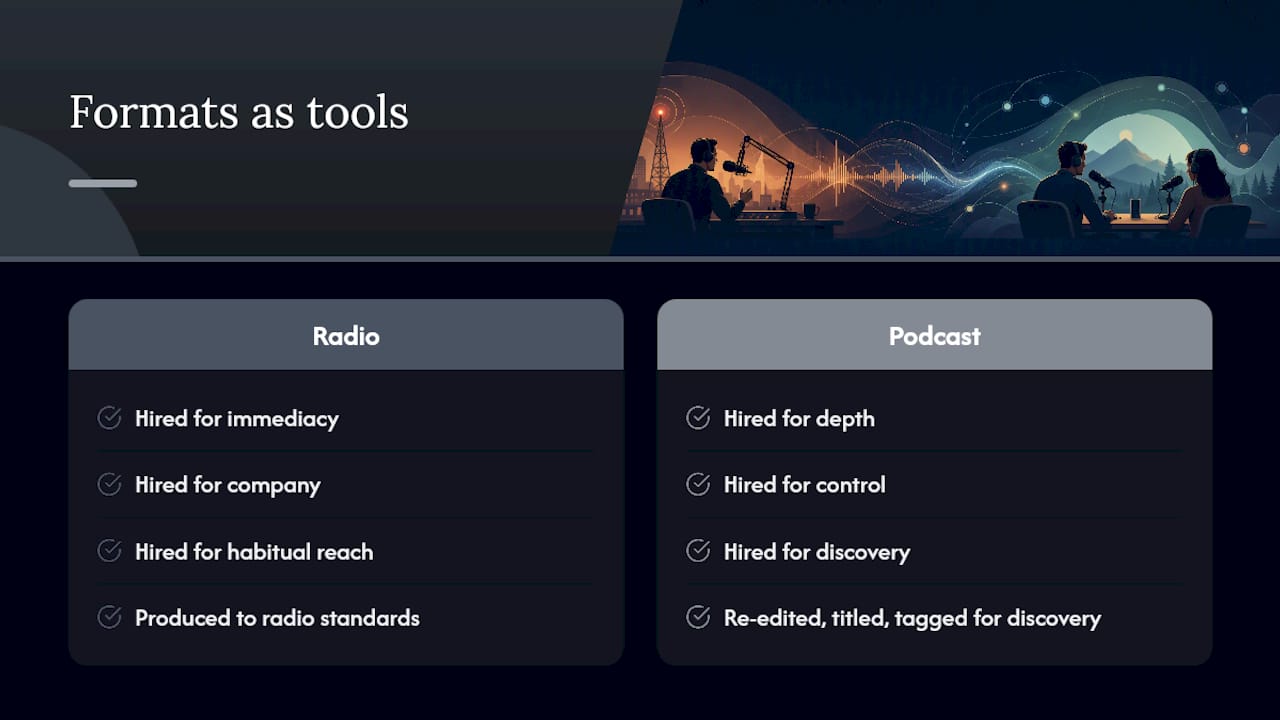
The conventional framing of talk radio vs podcasts as a competition misses the actual dynamic. Radio and podcasting are not fighting over the same job. Radio is hired for immediacy, company, and habitual reach. Podcasting is hired for depth, control, and discovery. The mistake most creators and publishers make is expecting one to perform the other’s function.
What the data actually shows is that the formats are converging at the distribution layer while diverging at the production layer. A show can air live on FM, stream simultaneously online, and release as a cleaned-up podcast episode by evening. That’s not a compromise. That’s a distribution strategy. The problem is that most stations and creators treat the podcast version as an afterthought — a raw dump of the live recording with no editing, no metadata, and no show notes. That approach wastes the format’s actual advantages.
The smarter move, and the one the content distribution data supports, is to treat each format as a first-class product with its own production standards. A live radio show should be produced to radio standards. The podcast version of that show should be re-edited, titled, and tagged for on-demand discovery. They are the same content serving two different listener behaviors, and both deserve the work.
For conservative political audio specifically, this matters because the audience spans both habits. Older listeners who grew up with AM talk radio still tune in live. Younger right-leaning listeners find shows through Spotify searches and YouTube recommendations. A platform that serves both without conflating them is the one that captures the full audience.
Sources
- Americans now listen to podcasts more often than talk radio, study shows | TechCrunch
- Mike McVay: Why radio needs to embrace podcasting | Radio Ink
- Exploring the differences between podcasts and radio | RadioWorld
- 5 Differences Between Live Radio Broadcasting and Podcasting | Live365