Federalism podcasts, in the way most conservative listeners search for them, means curated conservative political shows, and GOPcast is built to be the single place you find them. It aggregates news, commentary, and interview-driven programs like Bannon’s War Room and The Dan Bongino Show so you stop hunting across five apps for the voices you trust. This page names the top shows worth following, walks through how to start listening today, and gives advertisers a real vetting checklist before they buy a single spot.
TL;DR:
- Conservative podcasts are highly personality-driven, with trusted hosts like Dan Bongino and Steve Bannon shaping listener preferences and political narratives.
- The most effective shows focus on specific themes such as federal overreach, election integrity, and state versus federal power, recurring across many episodes.
- Curated platforms like GOPcast reduce discovery friction by grouping shows around shared audiences, enhancing trust and ad performance.
- Advertisers should vet podcasts through third-party measurement, audience data, host credibility, and episode-level controls before committing.
- Conservative podcast audiences trust this media more than other sources, making targeted, well-vetted advertising highly influential within this community.
Table of Contents
- What Are the Best Federalism Podcasts to Follow Right Now?
- Why Choose a Curated Conservative Podcast Platform?
- How Do You Start Listening to Conservative Podcasts?
- How Should Advertisers Vet Conservative Podcasts?
- What Is Federalism and Why Does It Shape Conservative Commentary?
- Do All Political Views Agree on Federalism?
- What Topics Come Up Again and Again on These Shows?
- Who Are the Voices Shaping This Conversation?
- How Do These Shows Shape Political Discourse?
- Where Else Can You Find Conservative Political Podcasts?
- GOPcast’s Perspective: How We Curate Shows and Why This Roster Fits
- Listen Now: Featured Shows and Advertiser Contact
- Sources
What Are the Best Federalism Podcasts to Follow Right Now?
If you want the shortest path to a reliable daily lineup, start here. These shows cover the range conservative listeners actually want: fast news recaps, long-form interviews, and unapologetic opinion. Each one earns its slot for a different reason, and knowing which is which saves you from subscribing to ten shows that all do the same thing.
- Bannon’s War Room runs multiple episodes a day and functions almost like a live newsroom for the populist right. Best for listeners who want real-time reaction to breaking political news, and advertisers get a highly engaged, frequent-listener audience.
- The Dan Bongino Show blends former Secret Service perspective with sharp media criticism and daily headlines. It suits listeners who want a consistent, opinionated read on the news cycle, and its name recognition makes it a strong test buy for new advertisers.
- Brian Kilmeade Show leans historical and conversational, often pulling in guests to unpack policy through a storytelling lens. Good fit for listeners who want context over outrage, and advertisers targeting an older, steady audience.
- Perino on Politics offers a calmer, more analytical tone from a familiar Fox News voice. Works well for listeners who want policy substance without the shouting, and for brands that want a lower-controversy placement.
- Louder with Crowder mixes comedy, culture commentary, and debate-style segments. Best for younger, culture-focused listeners, and advertisers chasing high engagement over pure reach.
- Lou Dobbs keeps a tight focus on economic nationalism and trade policy. Fits listeners who care about markets and manufacturing, a narrower but loyal niche for advertisers in finance or domestic goods.
- No Agenda Show takes a media-deconstruction, contrarian approach that doesn’t fit neatly into typical talk radio format. Appeals to skeptical, highly engaged listeners who want media literacy alongside commentary.
- Diamond and Silk bring an unfiltered, personality-driven style built on direct audience rapport. Strong for advertisers wanting host-read endorsements that feel personal rather than scripted.
- The Sentinel Report and National Update both specialize in tighter news-brief formats, good for listeners who want the headlines without an hour-long commitment, and for advertisers who want frequent, short ad slots.
- The Hope Report rounds out the roster with a more values-driven, faith-adjacent commentary style, appealing to listeners who want their news filtered through a specific moral lens.
Edison Research’s analysis of conservative-content podcasts confirms this pattern: the format that wins in this space is host-centered, not panel-driven. Listeners follow a person, not a network, which is exactly why a roster like this works better as a curated list than as an algorithmic feed.
Why Choose a Curated Conservative Podcast Platform?
Trust is the whole game here, and the numbers back it up. Pew Research Center found that A notable share of Republican-leaning adults who get news from podcasts trust that news more than what they get from other media, compared to just 15% of Democrats. That gap is not small, and it tells you something practical: conservative listeners aren’t casually sampling podcasts, they’re relying on them as a primary news source.
Trust gap: A substantial share of Republican-leaning podcast news consumers trust podcast news more than other sources, compared to a smaller share of Democrats, according to Pew Research.
Algorithmic platforms make discovery harder than it needs to be. You search for one show, get recommended three unrelated ones, and end up scrolling instead of listening. A curated hub removes that friction by grouping shows around a shared audience instead of a black-box recommendation engine, which tends to improve both retention and the sense of community listeners are actually looking for.
For advertisers, that same structure pays off differently. Host-driven trust means an endorsement lands closer to a friend’s recommendation than a commercial. A curated audience is also more predictable, so you know roughly who you’re reaching before the campaign runs. And loyal, habitual listeners tend to produce stronger ad recall than audiences assembled by a shuffle algorithm.
How Do You Start Listening to Conservative Podcasts?
Getting started takes less time than picking a show. Here’s the fastest path:
- Go to GOPcast and browse by category, news, commentary, interviews, or culture, depending on what you’re in the mood for.
- Open a show page for something like Perino on Politics or the Dan Bongino Show and hit play directly in the browser.
- Subscribe in your podcast app if you’d rather listen on the go. Most shows publish an RSS feed that Apple Podcasts, Spotify, or Overcast can pull in automatically once you search the show name.
- Turn on notifications for shows that publish daily, like Bannon’s War Room, so new episodes hit your phone the moment they drop.
- Download episodes for offline listening before a commute or flight, so you’re not burning data mid-episode.
Pro Tip: If a show publishes both live and recorded versions, the live feed usually includes rawer, unedited reaction, while the recorded version is tighter and easier to skim. Pick live for real-time news, recorded for commentary you want to actually finish.
How Should Advertisers Vet Conservative Podcasts?
Buying podcast ads without a checklist is how brands end up next to an episode they never should have touched. Run every show through this before committing spend:
- Confirm IAB certification or equivalent third-party measurement standards.
- Request written audience data, downloads, demographics, and geography, directly from the show or network, a step MillionPodcasts’ advertiser checklist calls a baseline requirement.
- Cross-check that data with an independent measurement provider rather than taking the show’s numbers at face value.
- Review sponsor history, who’s advertised there before, and whether they stuck around.
- Vet host credibility, tone, consistency, and how the host handles controversy on-air.
- Run a controversy search on recent episodes before you sign anything.
- Check creative fit, does your product make sense in this show’s world, or will it feel bolted on?
- Confirm episode-level controls exist so you can pull an ad from a single problematic episode instead of the whole show.
- Set up performance tracking from day one, promo codes, unique links, or listener surveys.
Two operational rules protect you further: negotiate a 3-episode test run before any long-term commitment, and insist on a 30-day cancellation clause so you’re never locked into a show that drifts. Standardizing mid-roll placement across shows also makes performance comparisons actually meaningful instead of apples-to-oranges.
That last checklist item matters more than most advertisers realize. Audience size shifts fast in this space. SSRS found that some right-leaning shows gained well over 100% in audience between Q4 2024 and Q2 2026 while others lost more than half theirs in the same window. A show that looked like a smart buy eighteen months ago might be a completely different audience today.
Pro Tip: Brand safety asks “is this content dangerous?” Brand suitability asks “does this content fit my brand’s voice?” A show can pass brand safety easily and still be a poor fit if its tone clashes with your product. Track suitability drift episode by episode, not show by show, so one off episode doesn’t cost you a placement that’s working everywhere else.
What Is Federalism and Why Does It Shape Conservative Commentary?
Federalism is the constitutional structure that divides power between the national government and the states, rather than concentrating it in one place. The Tenth Amendment reserves to the states, or to the people, any power the Constitution doesn’t explicitly hand to Washington. That single design choice shows up constantly in conservative political commentary, even when a host never uses the word “federalism” directly.
When a podcast host argues that a state shouldn’t have to follow a federal mandate on education, energy policy, or election administration, that argument is rooted in federalism. It’s the underlying logic behind states’ rights arguments on everything from gun laws to immigration enforcement. Conservative commentary tends to treat federalism as a check on federal overreach, a structural guardrail rather than an abstract legal theory.
Understanding that framework helps explain why so many conservative shows return again and again to governors clashing with federal agencies, state attorneys general filing lawsuits against Washington, or ballot measures that test how much authority a state actually has. It’s not a niche legal topic confined to law school seminars. It’s the operating assumption behind a huge share of the political arguments you’ll hear across conservative talk radio and podcasts.
Do All Political Views Agree on Federalism?
No, and pretending otherwise would flatten a genuinely interesting debate. Federalism isn’t owned by one side of the aisle, even though conservative media invokes it more consistently.
Progressive commentators have historically been more skeptical of state power, particularly when states have used it to resist federal civil rights enforcement or environmental regulation. From that view, a strong federal government is what protects individual rights against inconsistent or hostile state governments. Some liberal-leaning voices have flipped that argument in recent years, defending state authority when it comes to marijuana legalization, sanctuary policies, or climate rules that outpace federal standards.
Libertarian-leaning commentators often push federalism even further than mainstream conservatives, arguing for radical decentralization on nearly every issue, including some conservatives find uncomfortable. And plenty of legal scholars across the spectrum treat federalism as a pragmatic tool rather than an ideological commitment. States function as policy laboratories, testing approaches to healthcare, education, or criminal justice before ideas scale nationally.
Conservative political podcasts tend to apply federalism selectively, favoring state authority on issues like gun rights or education while sometimes favoring federal action on others like border enforcement. That inconsistency isn’t unique to the right. It shows up across the political spectrum, and recognizing it makes you a sharper listener no matter which shows you follow.
What Topics Come Up Again and Again on These Shows?
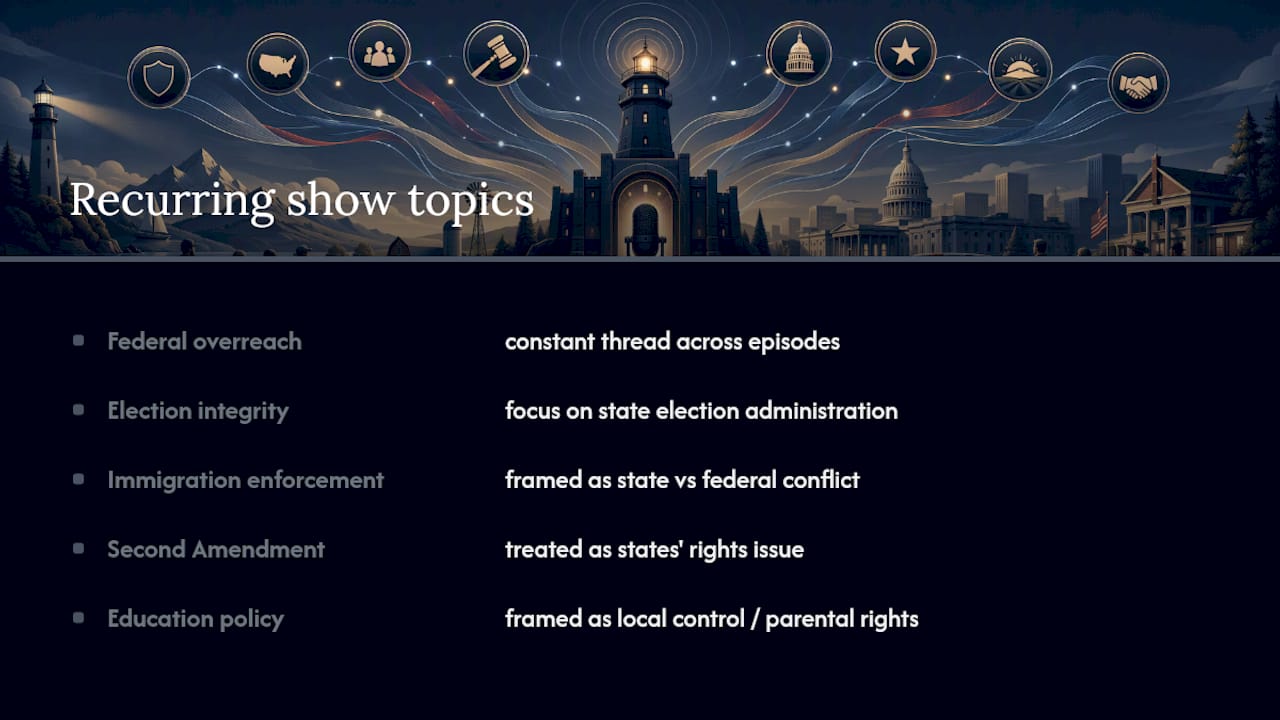
A handful of themes repeat across nearly every conservative political show, and recognizing the pattern helps you know what you’re signing up for before you hit play.
Federal overreach is the constant thread, whether the specific episode covers regulatory agencies, executive orders, or judicial rulings. Election integrity and state administration of elections comes up heavily during any election cycle, since election law sits mostly at the state level. Immigration enforcement gets discussed through a state versus federal lens constantly, especially when border states push back against federal policy. Second Amendment battles almost always play out as a states’ rights story, since gun law varies dramatically state to state.
Energy and environmental policy shows up as states resist federal mandates on emissions or drilling. Education policy, curriculum fights, school choice, parental rights, gets framed as a local control issue more often than a national one. Judicial appointments and constitutional interpretation are recurring long-form topics, particularly on interview-heavy shows like Perino on Politics or Brian Kilmeade Show.
Culture and media criticism round things out, with shows like Louder with Crowder treating mainstream media bias itself as a recurring subject rather than a one-off complaint. The through-line across nearly all of it: an argument about who should hold the power to decide, Washington or the states, and why that choice matters for the outcome.
Who Are the Voices Shaping This Conversation?
The strength of conservative podcasting comes from personality-driven hosts, not anonymous panels, and that’s true across the shows in this roundup. Steve Bannon built Bannon’s War Room into a multiple-times-daily political operation, with a tone that treats every episode like breaking news. Dan Bongino brings a law enforcement and Secret Service background to his commentary, which gives his media criticism a distinct edge compared to purely political hosts.
Dana Perino, hosting Perino on Politics, draws on her time as White House Press Secretary to offer a more measured, insider read on policy debates. Brian Kilmeade leans into historical parallels, often connecting current fights to founding-era arguments about federal power. Steven Crowder built Louder with Crowder around confrontational, culture-war-focused debate segments that draw a younger audience than most talk radio.
Diamond and Silk carved out space with a direct-to-camera, unscripted style that feels more like a conversation with friends than a broadcast. Lou Dobbs, a veteran of financial and political journalism, keeps his focus tight on trade and economic nationalism. Together, these hosts illustrate exactly what Edison Research found: conservative podcast audiences follow individuals whose credibility they trust episode after episode, not a rotating cast or a network brand.
How Do These Shows Shape Political Discourse?
Podcasts have moved from a supplementary media format to a genuine driver of political conversation, and research on the topic backs that up. A 2026 study in the Atlantic Journal of Communication found podcast consumption is linked to conservative identity politics and voter preference patterns, meaning these shows don’t just reflect existing views, they actively shape them.

That influence shows up in a few concrete ways. Long-form interview formats let candidates and officials make extended arguments without the interruption pattern common in cable news, which changes how those arguments land with listeners. Host-driven trust means a position argued by Dan Bongino or Steve Bannon carries weight that a generic news segment doesn’t, simply because the audience already trusts the messenger.
There’s also a feedback loop worth noting. Conservative podcasts have recently gained visibility on major platforms, partly fueled by high-profile guest appearances that pull new listeners in from outside the usual audience, according to reporting from The Straits Times. That crossover moment matters because it means these shows aren’t just talking to an existing base, they’re actively expanding it, one guest appearance and one algorithm-defying share at a time.
Where Else Can You Find Conservative Political Podcasts?
GOPcast isn’t the only place these conversations happen, and it’s worth knowing the broader landscape even if you land back on a curated hub for daily listening. Major streaming platforms like Spotify and Apple Podcasts host most of these shows directly, and Edison Research’s rankings of conservative-content podcasts track how titles like these perform against the biggest shows in the category.
Some hosts also maintain their own standalone apps or subscriber platforms outside any aggregator, particularly for premium or ad-free tiers. Talk radio networks that originally built these hosts’ audiences, before the podcast boom, still simulcast many shows live, which matters if you prefer a linear listening experience over on-demand.
What sets an aggregator model apart is the discovery layer sitting on top of all that fragmented distribution. Instead of remembering which app hosts which show, or missing a new voice because it launched on a platform you don’t use, a curated destination puts the whole category in one browsing experience. That’s less about replacing where shows technically live and more about solving the very real problem of finding them in the first place.
GOPcast’s Perspective: How We Curate Shows and Why This Roster Fits
We build this roster around three signals: host credibility, topical relevance to the news cycle, and actual listener engagement, not just download counts. A show earns a spot here because its host has a track record worth trusting, not because a network pushed it into the feed.
That’s why you’ll see hosts like Dan Bongino and Dana Perino sitting alongside newer voices like The Sentinel Report. Our roster reflects real listening patterns, not a static list frozen in time. As shifts happen, and SSRS’s data shows they happen fast, we adjust which shows get featured placement, because a curated hub is only useful if it stays current.
— GOPcast
Listen Now: Featured Shows and Advertiser Contact
GOPcast puts every show on this list, and dozens more, in one place, so you’re never juggling five apps to keep up with conservative political conversation. That’s the whole pitch: one destination, curated shows, no algorithm deciding what you see next.

Start on the GOPcast homepage and browse by category, or jump straight into a specific show like Brian Kilmeade Show or No Agenda Show if you already know what you’re after. Every show page streams directly in your browser, no extra app required to get started.
If you’re an advertiser evaluating where to place a campaign, the vetting checklist above is your starting point, but the fastest next step is reaching out directly. GOPcast works with brands running 3-episode tests and standardized mid-roll placements across its roster, so you can gauge fit before committing to anything longer. Reach out through the site to discuss available inventory and current audience data for the shows that match your campaign.
Sources
- Podcasts and News Fact Sheet | Pew Research Center
- Top podcasts with conservative or liberal content | Edison Research
- Right Wing Podcast Power Shift | SSRS
- How to Buy Podcast Advertising 2026: A Vetting Checklist - MillionPodcasts Blog