
Start here: the Library of Congress’s Our Constitution is the best pick for non-lawyers who want archival depth; the National Constitution Center’s We the People is the go-to for weekly constitutional debates with multiple perspectives; Akhil Reed Amar’s Amarica’s Constitution goes deepest on case analysis for law-curious listeners; the Washington Post’s Constitutional is the strongest narrative history option; and the Heritage Foundation’s Case in Point is the most accessible conservative legal commentary available. For curated conservative constitutional shows in one place, Gopcast aggregates the right-leaning commentary you won’t find on institutional feeds.
- Our Constitution (Library of Congress): Best for non-lawyers who want primary-source audio and documentary-style history.
- We the People (National Constitution Center): Best for balanced debate and weekly constitutional analysis.
- Amarica’s Constitution (Akhil Reed Amar): Best for scholarly deep dives and case-by-case legal theory.
- Constitutional (Washington Post): Best for narrative history and founding-era storytelling.
- Case in Point (Heritage Foundation): Best for conservative legal commentary on cases affecting politics and culture.
- Gopcast: Best single hub for curated conservative constitutional and political commentary.
Key Takeaways
The strongest constitution podcasts combine institutional backing, named host credentials, and transparent sourcing — those three signals together are the clearest indicator of a show worth your time.
| Point | Details |
|---|---|
| Best for history | Our Constitution (Library of Congress) uses archival audio and primary sources, ideal for non-lawyers. |
| Best for debate | We the People (National Constitution Center) presents multiple legal perspectives weekly. |
| Best for scholarly depth | Amarica’s Constitution by Akhil Reed Amar offers case-by-case legal analysis at the deepest level. |
| Where to subscribe | All shows are free on Apple Podcasts, Spotify, and their publisher pages; RSS feeds available for most. |
| Conservative commentary | Gopcast aggregates right-leaning constitutional and legal shows in one free streaming hub. |
Table of Contents
- Why constitution podcasts are worth your time
- The best constitution podcasts: detailed show cards
- How to pick the right constitutional law podcast for your needs
- Where to find and subscribe to these shows
- Why these shows made the list: trust signals to look for
- Gopcast’s place in the constitutional commentary space
- Conservative constitutional commentary is one click away on Gopcast
- Sources
Why constitution podcasts are worth your time
Audio is genuinely one of the better formats for learning constitutional law. You can follow a 45-minute debate on the First Amendment during a commute in a way you simply cannot with a law review article. The format also forces hosts to explain things clearly, which means even dense doctrinal questions get unpacked for a general audience.
The shows in this space break into four recognizable types. Documentary/archival shows (the Library of Congress model) weave in primary-source recordings, historical speeches, and expert narration. They run long, 30–60 minutes, and suit listeners who want historical grounding before they touch current debates. Interview/lecture shows feature a single scholar walking through a case or clause, often 45–90 minutes; Amarica’s Constitution is the clearest example. Debate/panel shows like We the People put two or more legal minds on opposite sides of a constitutional question, typically 45–60 minutes per episode. Think-tank commentary shows run shorter, 20–35 minutes, and present a specific ideological or policy lens on recent cases, which is where conservative legal podcasts tend to cluster.
Knowing which type you want before you subscribe saves you from abandoning a show after two episodes because the format doesn’t fit your schedule or learning style.
The best constitution podcasts: detailed show cards
1. Our Constitution (Library of Congress)
Host/Institution: Library of Congress scholars and archivists. Format: Documentary, archival audio. Episode length: 30–50 minutes. Frequency: Series-based, not weekly.
The Library of Congress’s Our Constitution draws on archival recordings and primary-source excerpts to walk through the Constitution’s text and its interpretation over time. It is explicitly designed for non-lawyers, which means the language stays accessible without sacrificing accuracy. Episodes are structured around specific clauses or historical moments, and the use of actual archival audio sets it apart from shows that rely entirely on talking heads.
Start with: The episode on the First Amendment’s history, and the episode covering the Fourteenth Amendment’s Reconstruction-era origins. Both give you the historical scaffolding that makes current debates make sense.
Where to listen: loc.gov/podcasts/our-constitution and major podcast apps. Free.
2. We the People (National Constitution Center)
Host/Institution: National Constitution Center, hosted by Jeffrey Rosen. Format: Debate/panel. Episode length: 45–60 minutes. Frequency: Weekly.
We the People is the most consistent source of structured constitutional debate available in podcast form. Jeffrey Rosen brings two or three legal scholars onto each episode to argue opposing sides of a live constitutional question, and the National Constitution Center publishes companion resources alongside each episode. The show’s institutional backing means guests are credentialed and the framing is genuinely balanced rather than performatively so.

Start with: Any episode on the Second Amendment’s post-Heller landscape, or the episode on presidential immunity. Both are high-stakes, well-argued, and immediately relevant.
Where to listen: constitutioncenter.org, Apple Podcasts, Spotify. Free.
3. Amarica’s Constitution (Akhil Reed Amar)
Host/Institution: Akhil Reed Amar, Yale and Columbia law professor. Format: Scholar lecture/case analysis. Episode length: 45–90 minutes. Frequency: Irregular.
Amar is one of the most cited constitutional scholars in the country, and Amarica’s Constitution reflects that depth. Episodes go clause by clause through major cases, often with a level of textual and historical detail that goes well beyond what you’d find in a newspaper. The show has noted continuing legal education relevance for legal professionals, though it rewards any serious listener willing to sit with a long episode.
Start with: The episode on the original meaning of the Commerce Clause, or the episode on the Reconstruction Amendments. Both show Amar’s method at its clearest.
Where to listen: amaricasconstitution.podbean.com, Apple Podcasts. Free.
4. Constitutional (Washington Post)
Host/Institution: Washington Post, hosted by Lillian Cunningham. Format: Narrative/journalistic. Episode length: 25–40 minutes. Frequency: Series-based.
Constitutional is a nine-episode narrative series that profiles the figures who shaped the Constitution, from the founders through later justices and reformers. Cunningham’s journalistic approach makes it the most story-driven option on this list. It won’t give you doctrinal depth, but it gives you character, context, and a sense of why the document’s history is genuinely dramatic.
Start with: The episode on James Madison and the episode on Thurgood Marshall. Together they span the Constitution’s founding logic and its civil rights evolution.
Where to listen: washingtonpost.com/podcasts/constitutional, Apple Podcasts, Spotify. Free.
5. Case in Point (Heritage Foundation)
Host/Institution: Heritage Foundation legal team. Format: Think-tank commentary. Episode length: 20–35 minutes. Frequency: Regular.
Case in Point packages legal-political case discussions into short, accessible episodes aimed at both lawyers and non-lawyers. The Heritage Foundation’s conservative perspective is transparent, which is actually useful: you know exactly what lens you’re getting. Episodes focus on cases affecting politics, culture, and public life, and the shorter runtime makes it easy to fit into a lunch break.
Start with: Any episode on administrative law or Second Amendment cases. These are where the show’s analytical strengths are most evident.
Where to listen: heritage.org/caseinpoint, Apple Podcasts, Spotify. Free.
6. Montpelier Podcasts (James Madison’s Montpelier)
Host/Institution: Montpelier Foundation historians. Format: Documentary/interview. Episode length: 20–40 minutes. Frequency: Series-based.
Montpelier’s podcast and video library focuses on James Madison, the Constitutional Convention, and the founding era. If you want to understand the original intent debates from a historically grounded perspective, this is the most founder-specific resource available in audio form.
Start with: Any episode on Madison’s notes from the Constitutional Convention. The primary-source detail is unusually rich.
Where to listen: montpelier.org/videos-podcasts. Free.
Quick comparison
| Primary focus | Host credentials / institution | Format | Episode length | Best for | Where to listen |
|---|---|---|---|---|---|
| History and text | Library of Congress archivists | Documentary/archival | 30–50 min | Non-lawyers, students | loc.gov, podcast apps |
| Constitutional debate | National Constitution Center / Jeffrey Rosen | Debate/panel | 45–60 min | General civic audience | constitutioncenter.org, Spotify |
| Case analysis | Akhil Reed Amar, Yale/Columbia | Scholar lecture | 45–90 min | Law students, legal professionals | podbean.com, Apple Podcasts |
| Narrative history | Washington Post / Lillian Cunningham | Journalistic narrative | 25–40 min | General listeners, history fans | washingtonpost.com, Spotify |
| Conservative legal commentary | Heritage Foundation legal team | Think-tank commentary | 20–35 min | Conservative listeners, policy-focused | heritage.org, podcast apps |
| Founder-era history | Montpelier Foundation historians | Documentary/interview | 20–40 min | History enthusiasts, students | montpelier.org |
How to pick the right constitutional law podcast for your needs
Match format to your learning goal first. Everything else follows from that.
- Decide how much time you have per episode. If you have 20–35 minutes, start with Case in Point or Constitutional. If you can commit 45–90 minutes, We the People or Amarica’s Constitution will reward you more.
- Check host credentials. A law professor, a constitutional historian, or an institutional affiliation (Library of Congress, National Constitution Center) signals that the content has been vetted. A show with no stated host credentials or institutional backing deserves more skepticism.
- Look for show notes and source links. Shows that publish episode transcripts, source citations, or companion reading are easier to learn from and easier to verify. The Constitution Annotated essays on Congress.gov are one resource several educational shows draw on for factual grounding.
- Know the angle. Think-tank shows like Case in Point are transparent about their perspective. Institutional shows like We the People present multiple sides. Neither is wrong, but knowing which you’re listening to changes how you weigh what you hear. Shows connected to policy organizations often have additional resources like white papers or event recordings on their sponsor’s site, which is worth checking.
- Match depth to your goal. If you want to pass a civics exam or understand a news story, Our Constitution or Constitutional is enough. If you’re preparing for law school or want to argue constitutional interpretation seriously, Amarica’s Constitution is the right level.
Pro Tip: Pair one archival or documentary episode (for historical framing and primary sources) with one debate or case-discussion episode (for contemporary implications). That combination gives you both the “what happened” and the “why it still matters” in a single listening session.
Where to find and subscribe to these shows
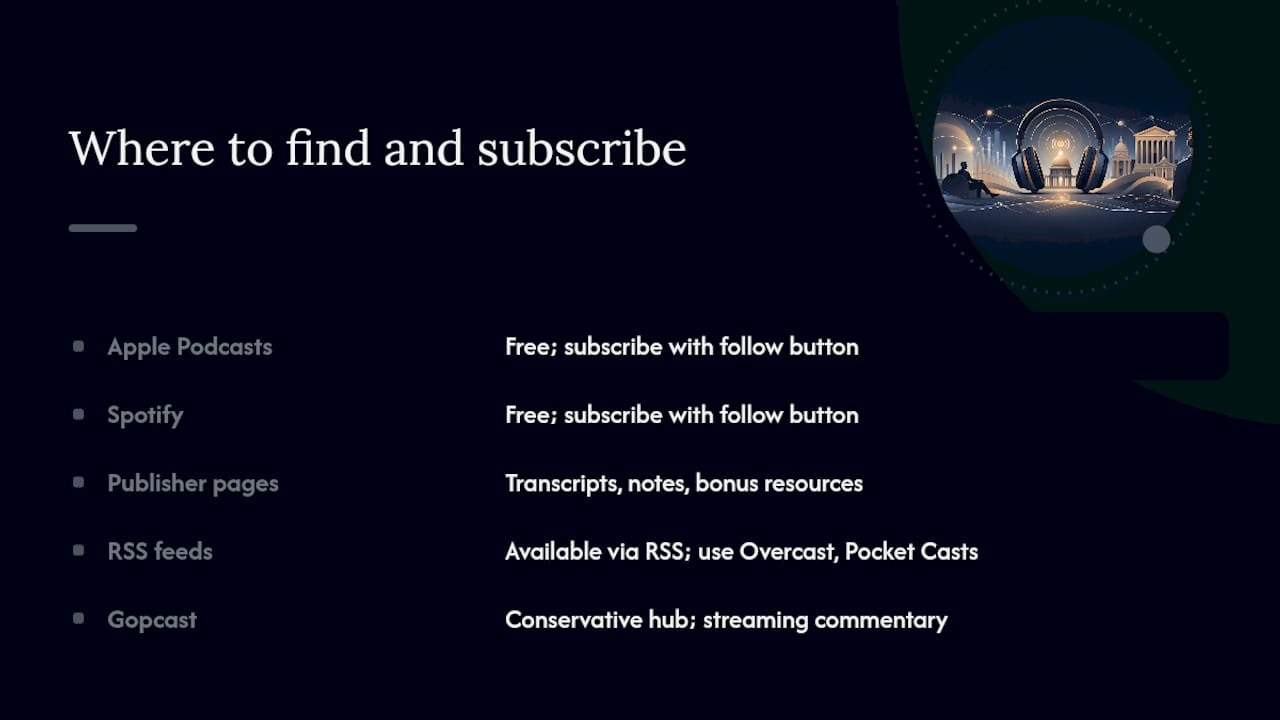
Every show on this list is free and available on Apple Podcasts and Spotify. Publisher pages are worth bookmarking separately because they often carry transcripts, show notes, and bonus resources that don’t appear in podcast apps. Apple Podcasts and Spotify handle subscriptions through their standard follow/subscribe buttons; RSS feeds are available for most shows if you prefer a dedicated podcast app like Overcast or Pocket Casts.
For conservative constitutional commentary specifically, Gopcast aggregates right-leaning political and legal shows into a single hub. Rather than hunting across individual publisher pages, you can browse Gopcast’s curated conservative news and commentary podcasts to find shows that cover constitutional issues from a conservative perspective. The experience differs from institutional feeds: Gopcast is a streaming portal, not a debate-format publisher, so the content skews toward commentary, talk shows, and political analysis rather than archival documentary.
Why these shows made the list: trust signals to look for
The single most important trust signal is institutional affiliation combined with named host credentials. A show produced by the Library of Congress or the National Constitution Center carries editorial accountability that an anonymous podcast does not.
Beyond that, here are the concrete signals worth checking before you commit to a show:
- Archival audio and primary-source excerpts. The Library of Congress’s Our Constitution uses actual historical recordings, which is a high bar most shows can’t match.
- Named hosts with verifiable credentials. Akhil Reed Amar’s Yale and Columbia affiliations are publicly verifiable. Jeffrey Rosen’s role at the National Constitution Center is documented. Anonymous or credential-free hosts are a yellow flag.
- Published show notes and source links. Shows that cite their sources in episode notes make it possible to verify claims and follow up on primary documents.
- Transparent editorial perspective. Think-tank shows that disclose their funding and ideological orientation (as the Heritage Foundation does) are more trustworthy than shows that present a single perspective as neutral.
- Institutional review or editorial oversight. Library and museum publishers typically have editorial review processes that individual podcasters do not.
Gopcast’s place in the constitutional commentary space
Gopcast is a hub that aggregates conservative political and legal commentary podcasts into a single streaming platform. It is not an institutional publisher of constitutional scholarship, and it doesn’t claim to be. What it does well is surface conservative voices on constitutional issues, from legal commentary to political analysis, that are harder to find on institutional feeds.
Readers who want archival history and balanced debate should start with the Library of Congress and National Constitution Center shows listed above. Readers who also want to hear how conservative legal thinkers and commentators are framing constitutional questions in real time will find that content on Gopcast. The editorial perspective here is conservative, and that’s stated plainly. Gopcast curates for a right-leaning audience and makes no pretense of ideological neutrality.
Conservative constitutional commentary is one click away on Gopcast
If you want conservative commentary on constitutional issues without hunting across a dozen separate feeds, Gopcast puts it in one place. The platform streams shows from hosts with legal and political backgrounds, including Trey Gowdy, a former federal prosecutor and congressman who covers legal and constitutional topics regularly.

Browse Gopcast’s best conservative podcasts to find shows that match your interest in constitutional law, civil rights debates, and legal theory from a conservative perspective. No subscription required. Stream directly from the site or follow individual show pages to stay current with new episodes.
Sources
The most useful official starting points are the Library of Congress podcast page and the National Constitution Center’s show archive, both of which link to transcripts, episode notes, and companion reading.
- Our Constitution | Podcasts | Library of Congress
- Podcasts from the National Constitution Center | Constitution Center
- Intro.10.1 About the Our Constitution Podcast
- Amarica’s Constitution | Akhil Reed Amar
- Constitutional
- Case in Point | The Heritage Foundation