Gopcast is the single destination for conservative podcasts, pulling together the most prominent right-leaning audio shows into one streaming hub. No algorithm-driven rabbit holes, no digging through app charts.
- What you get: aggregated shows across news, opinion, interview, culture, and policy categories, with editorial curation and streaming available on web
- Next step: head to Gopcast, browse by category, and start listening to shows like The Dan Bongino Show or Bannon’s War Room in minutes
Third-party rankers like Triton Digital, Edison Research, and Ad Fontes Media all track the conservative podcast space closely. Gopcast uses their signals to surface shows that are both popular and editorially reliable.
Key Takeaways
Gopcast is the single curated hub for conservative podcasts, giving listeners and advertisers direct access to the top right-leaning audio shows without relying on platform algorithms.
| Point | Details |
|---|---|
| Where to start | Go to Gopcast and browse by category — news, opinion, interview, or culture — to find shows that match your format preference. |
| Audience value | Political podcast listeners skew college-educated (36%) and affluent (a notable share earn over $100,000), making conservative audio a strong advertising buy. |
| Ad format match | Pair short pre-rolls with daily news shows and host-read integrations with long-form interview formats for the best recall. |
| Credibility check | Use the Ad Fontes Media Podcast Bias Chart and sample three to five recent episodes before committing to any show as a listener or advertiser. |
| Gopcast’s role | Gopcast aggregates and curates top conservative podcasts in one streaming hub, backed by Triton Digital, Signal Hill, and Ad Fontes Media signals. |
Table of Contents
- What are the best conservative blogs and podcasts by category?
- Why do listeners and advertisers use a curated conservative podcast hub?
- How does Gopcast curate and assess conservative shows?
- How do you find and listen to shows on Gopcast?
- Audience insights and advertising on conservative podcasts
- How do you choose the right conservative podcast?
- Conservative blogs as a written medium
- Key topics covered in conservative writing and audio
- Influential voices in conservative media
- How blogs and podcasts work together in conservative media
- How to evaluate credibility and bias in conservative media
- Why curation matters more than you might think
- Gopcast: one place for conservative podcasts
- Sources
What are the best conservative blogs and podcasts by category?
Conservative audio has spread across several distinct formats. Here is a quick map of what is available on Gopcast, organized by how you actually listen.
News and daily briefings
- The Dan Bongino Show — daily monologue, roughly 60 minutes, blending breaking news with sharp political commentary; one of the top conservative podcasts by audience size
- Brian Kilmeade Show — news-focused panel format, daily, covering national headlines with a Fox News sensibility; listen free on Gopcast
- Sean Hannity — daily opinion-driven news recap, long-form monologue style, consistent cadence for listeners who want a nightly anchor
Opinion and daily monologue
- The Ben Shapiro Show — fast-paced daily monologue, typically 60–90 minutes, policy-heavy with cultural commentary woven in
- The Matt Walsh Show — culture-war focused daily show, shorter episodes, combative tone aimed at social-conservative listeners
- Louder with Crowder — entertainment-leaning opinion format, longer episodes, available on Gopcast with a mix of comedy and political debate
Long-form interview and deep dive
- The Tucker Carlson Show — long-form interview format, weekly or multiple times weekly, known for unconventional guests and extended conversations
- The Megyn Kelly Show — interview-driven, typically 60–90 minutes, covering media criticism and national politics
- Trey Gowdy — policy deep-dive interview format, measured tone, strong on legal and governmental topics; show page on Gopcast
Activist and policy
- Bannon’s War Room — multiple episodes daily, panel format, activist-oriented with a focus on electoral and legislative strategy
- Candace Owens / Candace — culture and policy commentary, solo and interview episodes, aimed at younger conservative listeners
Signal Hill’s research confirms that conservative news and commentary shows now rank among the top programs in the Triton Digital Top 200, reflecting real audience momentum rather than niche appeal.
Why do listeners and advertisers use a curated conservative podcast hub?
Listeners benefit from not having to trust a platform algorithm. Streaming apps surface what is popular, not what is reliable or ideologically consistent with what you actually want. A curated hub like Gopcast solves that by doing the editorial work upfront.
For advertisers, the case is demographic. Triton Digital data shows that a majority of political podcast listeners hold college degrees and a notable share report household incomes above $100,000. That is not a casual audience.
Statistic: Pew Research found that 36% of conservative Republicans report hearing political opinions extremely or fairly often through podcasts, compared with 22% of moderate/liberal Republicans. These listeners are not passive — they are engaged and opinion-receptive.
Listener benefits:
- Single access point for dozens of shows without switching apps
- Category filters that match format to listening habit (commute, workout, background)
- Editorial signals about tone, cadence, and reliability before you commit to a show
Advertiser benefits:
- Aggregated reach across multiple high-profile conservative shows in one buy
- Clearer demographic targeting (age, income, education) versus broad-market buys
- Streamlined ad placement across formats from pre-roll to host-read integrations
Pro Tip: Match your ad format to the show’s structure. A 15-second pre-roll works on a fast-paced daily news show like The Dan Bongino Show. A 60-second host-read integration lands better on a long-form interview show like The Tucker Carlson Show, where listeners are already primed for extended listening.
How does Gopcast curate and assess conservative shows?
Curation at Gopcast is not just a playlist. Selection runs through several filters before a show appears on the platform.
Selection criteria:
- Format and cadence (daily, weekly, or multiple-times-daily)
- Host credentials and track record in conservative media
- Audience engagement signals from Triton Digital and Edison Research rankings
- Editorial reliability checks using episode-level analysis
Editorial review process:
- Episode sampling across recent releases, not just the pilot
- Bias and reliability cross-reference using the Ad Fontes Media Podcast/Audio Media Bias Chart, which rated 47 shows in May 2026 and placed 11 in its green box for minimal bias and strong factual reliability
- Audience-fit mapping to confirm the show aligns with the conservative listener profile Gopcast serves
Ad Fontes also cautions against assuming every show from a single outlet shares the same bias — episode-level analysis is the only accurate method. Gopcast applies that logic directly.
Pod Radar’s discovery guide makes the same point from the listener side: platform algorithms favor established popularity over actual quality, which is exactly why a curated hub adds value that no app chart can replicate.
How do you find and listen to shows on Gopcast?
- Select a show and play any episode directly in the browser — no app download required
- Follow or subscribe to a show to get notified when new episodes drop
- Enable notifications in your browser settings to receive real-time alerts for shows with daily or multiple-times-daily cadences like Bannon’s War Room
- Use the curated playlists or category pages (for example, conservative news podcasts or border security podcasts) to discover shows beyond your usual rotation
Platform features worth using:
- Category filters for matching format to your listening context
- Show pages with episode-level metadata and host background
- Ad format indicators that help advertisers assess placement options before booking
Quick tips:
- On mobile, use your browser’s “Add to Home Screen” option for one-tap access without a separate app
- For offline listening, check whether individual show pages link to the show’s native RSS feed for download via a podcast app
- Desktop listeners get the best experience for longer episodes; mobile works well for daily news briefings under 30 minutes
Audience insights and advertising on conservative podcasts
| Metric | Figure | Source |
|---|---|---|
| College-educated listeners | 36% | Triton Digital via Radio Ink |
| Household income over $100,000 | a notable share | Triton Digital via Radio Ink |
| Republican-leaning podcast share | rose notably | Triton Digital via Radio Ink |
| Conservative Republicans hearing political opinions often | 36% | Pew Research |
Edison Research has tracked several conservative talk shows moving up in the top 50 podcast ranks in recent quarters, and Inside Radio notes that conservative listener growth is directly reshaping ad recall metrics — affluent, engaged listeners remember ads at higher rates.
Common ad formats on conservative shows:
- Pre-roll (15–30 seconds): high completion rate on daily news shows; best for brand awareness
- Mid-roll (60 seconds): strong recall on longer interview formats; suits direct-response offers
- Host-read integration: the highest-trust format; the host delivers the message in their own voice, which resonates strongly with loyal audiences
- Sponsorship segments: full segment ownership, ideal for brands wanting extended association with a specific show or host
Pro Tip: Conservative podcast audiences respond well to messaging that respects their intelligence and avoids condescension. Lead with a concrete benefit in the first five seconds of any pre-roll — this audience skips fast if the opener sounds like a generic ad read. Host-read integrations work best when the host has genuine familiarity with the product category.
How do you choose the right conservative podcast?
For listeners:
- Identify your format preference — daily news briefing, long-form interview, or opinion monologue
- Check the episode length against your typical listening window (commute, gym, evening)
- Sample two or three recent episodes before committing to a subscription
- Verify the host’s track record: are they consistent, do they correct errors, and is the cadence reliable?
For advertisers:
- Match the show’s audience demographics to your customer profile using Triton and Pew data
- Confirm which ad formats the show supports before negotiating placement
- Review recent episode topics to check brand-safety alignment
- Ask for audience engagement metrics, not just download counts
Red flags to watch for:
- No transparency about sponsorships or undisclosed paid segments
- Inconsistent release cadence with no explanation (signals production instability)
- No publicly available audience metrics or third-party ranking presence
- Episode content that shifts dramatically in tone or topic without editorial rationale
Conservative blogs as a written medium
Conservative blogs occupy a different space than podcasts. Where audio shows build audience through voice, personality, and listening routine, written conservative blogs work through search discovery, shareable articles, and comment communities. A reader finds a blog post through Google; a listener finds a podcast through a recommendation or a platform browse.
The written format allows for longer citations, embedded documents, and detailed policy analysis that audio cannot replicate at the same pace. Blogs also archive more cleanly — a post from 2019 is still findable and linkable, while a podcast episode from the same year requires deliberate archiving to stay accessible.
Key topics covered in conservative writing and audio
Conservative media, whether written or audio, tends to cluster around a consistent set of themes: immigration and border policy, Second Amendment rights, fiscal conservatism and tax policy, social issues including abortion and religious liberty, foreign policy with a focus on national sovereignty, and media criticism aimed at mainstream outlets. Election integrity and judicial appointments have grown as recurring topics since 2020.

Culture-war content, covering education policy, gender debates, and corporate activism, has expanded significantly across both formats. Shows like The Matt Walsh Show and Candace Owens built substantial audiences almost entirely on cultural commentary rather than traditional political news.
Influential voices in conservative media
The Ben Shapiro Show built its audience on rapid-fire policy analysis and campus debate culture. Tucker Carlson shifted from cable news anchor to independent long-form interviewer after 2023, and his podcast format attracted a different listener profile than his Fox News audience. Megyn Kelly moved from NBC back to independent media and built a loyal podcast audience through media criticism and political interviews.
Bannon’s War Room operates at a different register, functioning more as an activist organizing tool than a traditional news show. Dan Bongino’s show sits between those poles: opinion-heavy but news-anchored, with a daily cadence that rewards habitual listeners. Brian Kilmeade brings a Fox News broadcast sensibility to the podcast format, appealing to listeners who want structured news coverage rather than extended monologue.
How blogs and podcasts work together in conservative media
The relationship is symbiotic. A blog post breaks a story or publishes a transcript; the podcast host picks it up and drives audio traffic back to the written piece. Many conservative shows maintain companion websites that publish show notes, source links, and extended commentary, blurring the line between the two formats.
For advertisers, this cross-format presence matters. A listener who hears a host mention a topic on a podcast may search for the written version, creating a second touchpoint. Gopcast’s aggregation model captures the audio side of that loop, while companion blog content handles the written discovery layer.
How to evaluate credibility and bias in conservative media
Ad Fontes Media’s May 2026 Podcast/Audio Media Bias Chart is the most systematic public tool for this. It rated 47 shows and placed 11 in its green box for minimal bias and strong factual reliability. The chart scores shows on two axes: political lean and factual/analytical quality.
The key discipline is episode-level evaluation. Ad Fontes explicitly warns against assuming a single outlet’s shows all share the same bias profile. A network that produces one reliable news show may also produce a highly partisan opinion show — they are not interchangeable. Sample three to five recent episodes, check whether claims are sourced, and note whether the host corrects errors on air. Those three habits will tell you more than any single bias rating.
Why curation matters more than you might think
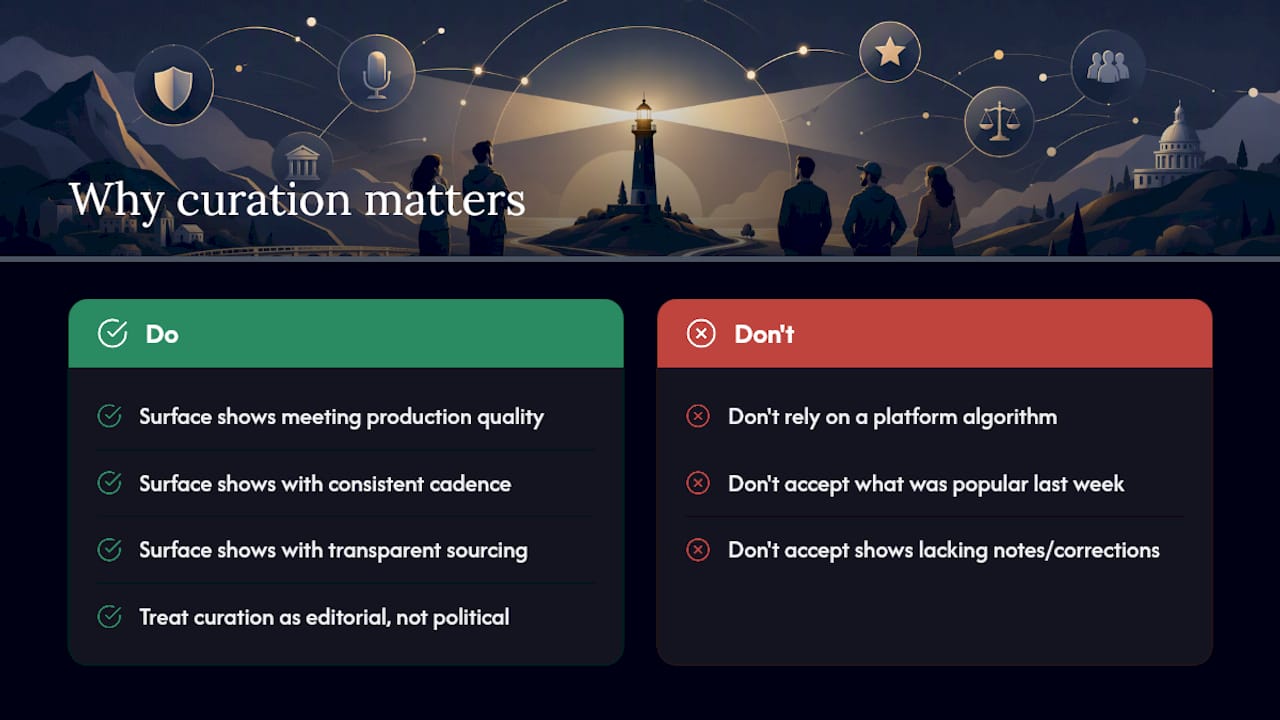
The conventional wisdom is that listeners are smart enough to filter bias on their own. That is partly true, but it misses the structural problem: when you rely on a platform algorithm to surface shows, you are not filtering bias — you are accepting whatever the algorithm decided was popular last week.
Gopcast’s position is that curation is not a political act. It is an editorial one. The goal is not to exclude challenging voices but to surface shows that meet a minimum standard of production quality, consistent cadence, and transparent sourcing. A show that publishes three times a day with no episode notes and no corrections policy is a different product than one that maintains a consistent format and cites its sources. That distinction matters for listeners who want to stay informed, and it matters even more for advertisers who need brand-safe placements.
The Atlantic Journal of Communication research linking podcast consumption to political identity and electoral information use in 2024 confirms what experienced media buyers already know: podcast listeners are not passive consumers. They are using audio to form and reinforce political views. That makes the quality of curation a substantive issue, not a marketing one.
Gopcast: one place for conservative podcasts
Gopcast is the fastest route from “I want conservative podcasts” to actually listening. Rather than hunting across multiple apps and charts, you get a single hub where shows like The Dan Bongino Show, Sean Hannity, and Louder with Crowder are already aggregated, categorized, and streaming.

For advertisers, Gopcast offers aggregated reach across a high-income, highly educated conservative audience with clear ad format options from pre-roll to host-read integrations. The platform’s editorial curation means brand-safety checks are built into the selection process, not an afterthought.
What Gopcast gives you:
- Curated conservative shows across news, opinion, interview, and culture categories
- Web streaming with no app required
- Editorial reliability signals backed by Triton Digital, Ad Fontes Media, and Signal Hill data
- Ad inventory across multiple high-profile shows in a single buy
Start listening or explore advertising opportunities at Gopcast.
Sources
- Americans’ podcasts & radio chart — May 2026 (Ad Fontes Media)
- How Republicans and Democrats engage with podcasts (Pew Research Center)
- The news podcast audience hits a new high (Signal Hill Insights)
- Political podcast listeners are older, educated, and affluent (Radio Ink, citing Triton)
- How to find news & politics podcasts — Discovery Guide 2025 (The Pod Radar)