The fastest way to hear conservative takes on cancel culture is GOPcast, which pulls the shows already doing this work, including the CCL leadership podcast and framing referenced in Harvard’s cancel culture research, into one hub instead of six separate apps.
- Start here: visit the GOPcast landing page and browse by show or category.
- Then: pick two or three programs from the starter list below and follow them directly.
- Next: use the critical-listening checklist further down before you take any host’s framing at face value.
Key Takeaways
Conservative podcasts frame cancel culture as coordinated institutional bias, and GOPcast is the fastest way to follow that coverage across multiple shows at once.
| Point | Details |
|---|---|
| Dominant framing | Conservative hosts describe cancel culture through weaponized bias, lawfare, and ideological gatekeeping. |
| Evidence is contested | Harvard research found no single, uniform cancel culture effect, so treat sweeping claims skeptically. |
| Start with structure, end with combat | Try The Ben Shapiro Show first, then Louder with Crowder or Bannon’s War Room for the sharper edge. |
| Verify before accepting | Cross-check quotes, timelines, and “lawfare” claims against primary sources before trusting a host’s framing. |
| Follow it all on GOPcast | GOPcast centralizes shows like The Dan Bongino Show and The Dana Show so you can follow and get alerts in one place. |
Table of Contents
- How Do Conservative Podcasts Frame Cancel Culture?
- Which Conservative Podcasts Cover Cancel Culture Best?
- What Should You Watch For When Listening?
- How Do You Follow These Shows on GOPcast?
- Start Listening to These Shows on GOPcast Today
- Sources
How Do Conservative Podcasts Frame Cancel Culture?
Conservative hosts overwhelmingly frame cancel culture as an organized campaign, not a series of isolated incidents. That framing shows up in three recurring shapes: weaponized institutional bias, what hosts often call “lawfare,” and ideological gatekeeping inside media, academia, and entertainment.
The Gina Carano case gets cited constantly in this world. After she was dropped from The Mandalorian, she landed a producing deal with The Daily Wire, a move conservative commentators point to as proof that mainstream studios purge dissenting voices while alternative platforms absorb them. Hosts treat that sequence, dismissal followed by a second-platform landing spot, as a repeatable pattern worth tracking across entertainment, publishing, and academia.
Not every show treats the topic the same way. Nuance exists even inside conservative media, and it’s worth hearing before you assume the genre speaks with one voice.
The debate over cancel culture often splits along a single fault line: is this accountability, or is it social punishment dressed up as justice? Leadership-focused conversations tend to land closer to the accountability side, weighing impact against intent rather than assuming bad faith.
That framing comes from Freedom Forum’s cancel culture commentary, and it’s a useful filter for judging how combative or measured a given host actually is.
Common framing patterns you’ll hear across the genre:
- Weaponized bias: institutions applying rules selectively to punish conservative speech.
- Lawfare: using lawsuits, regulatory pressure, or HR complaints as a substitute for open debate.
- Ideological gatekeeping: hiring, publishing, and platform decisions that quietly filter out dissenting voices.
- Accountability reframed as persecution: the point where legitimate criticism gets recast as an attack.
Academic research complicates the picture. A Harvard analysis on cancel culture found that evidence for a single, uniform “cancel culture” effect is contested, meaning the sweeping narrative some hosts lean on doesn’t always hold up against the data. That doesn’t make the concern illegitimate. It means listeners benefit from treating each case on its own terms rather than assuming every controversy fits the same mold.
Which Conservative Podcasts Cover Cancel Culture Best?
Start with a show built for context, move to one built for analysis, then finish with something combative. That order keeps you from mistaking outrage for insight.
- The Ben Shapiro Show breaks down media controversies line by line, often dissecting the original quote or clip before delivering his verdict. His episodes on campus speech codes are a good entry point if you want the argument laid out methodically.
- The Dana Show with Dana Loesch leans into Second Amendment and free speech intersections, frequently covering platform bans and deplatforming cases with a legal lens.
- The Tony Kinnett Cast focuses heavily on education and youth culture, tracking how cancel-style pressure plays out in schools and universities specifically.
- Louder with Crowder takes a more combative, debate-format approach, often bringing on guests who disagree to argue cancel culture claims live on air.
- Bannon’s War Room treats cancel culture as one front in a broader cultural conflict, with a rapid-fire news format covering multiple flashpoints per episode.
- The Dan Bongino Show connects cancel culture to law enforcement and free speech law, often walking through specific legal mechanisms behind deplatforming.
Pro Tip: If you only have time for one episode this week, pick something recent rather than an older “greatest hits” clip. Cancel culture cases move fast, and a six-month-old episode may already be missing context from how the story resolved.
Recommended listening order:
- The Ben Shapiro Show for structured background on a specific case.
- The Dana Show with Dana Loesch or The Tony Kinnett Cast for a legal or institutional deep dive.
- Louder with Crowder or Bannon’s War Room if you want the more combative, debate-driven version of the same argument.
Selection here favors shows with a consistent track record covering these controversies, not one-off mentions. The fuller reasoning behind that call sits later in this piece.
What Should You Watch For When Listening?
Three filters matter most: whether a host names their source, whether they distinguish evidence from assertion, and whether the framing itself is doing the persuading instead of the facts. Apply all three before you accept a host’s conclusion.
Practical checks worth running on any episode:
- Verify the original quote or clip the host is reacting to, not just their summary of it.
- Check whether “lawfare” claims actually involve a filed lawsuit or regulatory action, or whether it’s a looser accusation.
- Cross-check the timeline. Controversies often get compressed or reordered to sound more coordinated than they were.
- Notice when emotional language substitutes for a specific example.
Red flags to take seriously:
- Repeated victimhood framing with no specific incident attached.
- Anecdotes presented as documented fact with no named source.
- Arguments that lean on audience anger as if it were evidence.
Pro Tip: Give yourself two minutes before accepting a claim. Search the person’s name plus the specific incident, check a primary transcript or original reporting, and see if the “lawfare” claim matches an actual court filing. Most claims either hold up fast or fall apart fast.
A quick sequence for any episode:
- Note the specific claim being made.
- Search for the primary source, court filing, or original statement.
- Decide whether the host’s framing matches what actually happened.
Independent commentary has also pointed out that some media figures monetize victim narratives to grow audience share, a claim worth keeping in mind as a qualitative caution rather than a proven pattern for any specific host.
How Do You Follow These Shows on GOPcast?
GOPcast is the single easiest way to follow every show mentioned above without juggling five different podcast apps. It aggregates conservative programming into one platform organized by category, host, and topic.
- Visit the GOPcast landing page and browse shows by category or search by host name.
- Open a show page, like The Dan Bongino Show or Louder with Crowder, and follow it directly from that page.
- Bookmark or enable notifications so new episodes covering cancel culture and related controversies show up automatically.
- Use category browsing, similar to GOPcast’s border security podcasts page, to find adjacent shows covering related political and cultural topics.
What that gets you:
- One centralized destination instead of scattered subscriptions across multiple apps.
- Simple follow and bookmark controls on every show page.
- Category browsing that surfaces shows you didn’t know to search for.
RSS feeds and native podcast apps still work if you’d rather manage subscriptions that way, but GOPcast’s category structure makes cross-show discovery considerably easier when you’re tracking a fast-moving topic like this one.
Why These Shows and Episodes Made the List
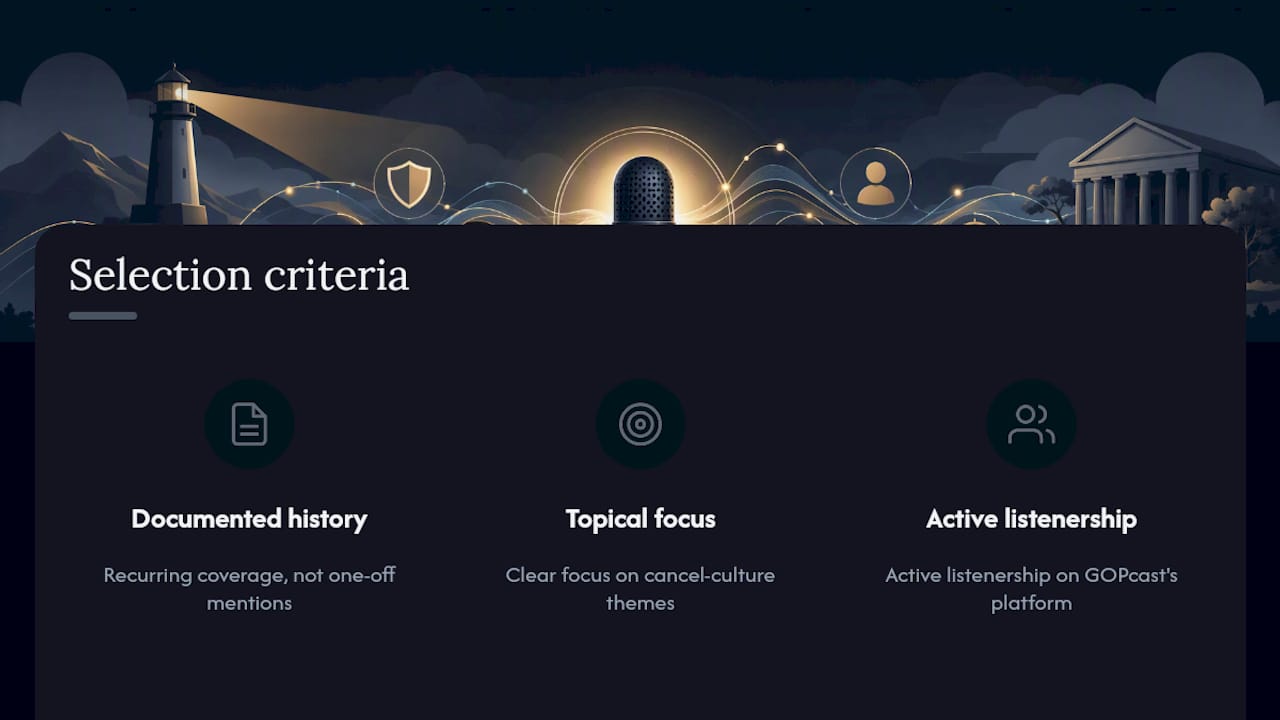
Selection here prioritized shows with a repeated, documented history of covering cancel culture, not a single mention buried in an unrelated episode. Every show listed has clear topical focus and active listenership on GOPcast’s platform.
Reference points like the Aporia Magazine debate on right-leaning cancel tactics and the CCL leadership episode helped anchor the framing section in real, citable commentary rather than assumption. Shows without public, listenable archives were left off this list.
GOPcast’s Editorial Take on This Coverage
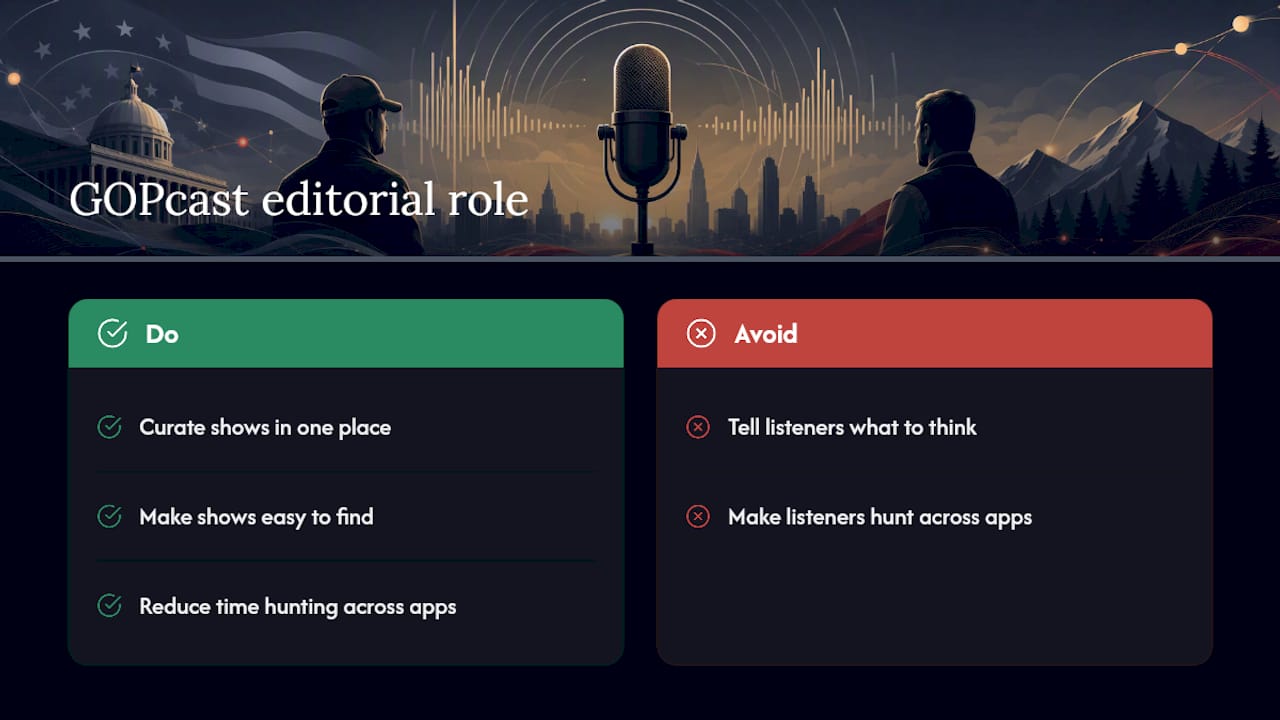
Our aim with GOPcast has never been to tell listeners what to think about cancel culture. It’s to make sure the shows already having that conversation, from legal analysis to combative debate, are easy to find in one place.
That curation role is the whole point of the platform: less time hunting across apps, more time actually listening.
Start Listening to These Shows on GOPcast Today
GOPcast solves a specific problem: conservative commentary is scattered across a dozen apps, and finding a specific host’s take on a specific controversy usually means searching several platforms before you find the right episode. GOPcast puts them in one hub instead.

Three steps to get moving:
- Visit GOPcast and browse the full show directory.
- Follow a show page directly, like The Dan Bongino Show or Brian Kilmeade Show.
- Enable notifications so new episodes on cancel culture and related controversies land in your feed the day they publish.
If faith-driven commentary is also part of your regular rotation, Spirit Of His Mouth’s Bible study podcast guide is worth a look alongside your political shows. Either way, the fastest next step is the same: pick a show above and follow it on GOPcast right now.
Sources
- Cancel culture: Myth or reality?
- Cancel culture — Freedom Forum
- Lead With That: What cancel culture can teach us about impact and accountability — CCL podcast
- Podcast: Should the right engage in cancel culture? — Aporia Magazine