If you want legal analysis, historical grounding, and honest advocacy on the Second Amendment, start with a curated hub like Gopcast and a short list of shows that actually cite their sources: a reasoned-debate program, an investigative deep dive, and a pro-gun-rights advocacy show. Between the National Constitution Center’s moderated debates, WNYC’s “The Gun Show,” and daily commentary aggregated on Gopcast, you get history, Supreme Court analysis, and current debate without digging through a hundred low-quality feeds.
A quick verdict before the details:
- Best for legal analysis: The National Constitution Center podcast, for moderated, citation-heavy debate.
- Best for historical context: WNYC’s “The Gun Show” (from the More Perfect series), for narrative reporting on how the Supreme Court reshaped the issue.
- Best for pro-2A advocacy: Shows aggregated on Gopcast, plus independent programs like “State of the Second.”
- Best for news and daily updates: Fast-turnaround shows like Cam & Co. at Bearing Arms.
- Best one-stop hub: Gopcast, for centralized access to conservative-leaning commentary alongside Second Amendment coverage.
Pro Tip: Before subscribing to anything, check the show notes for one episode. If they cite a case name, a statute, or a law review article, that’s a strong signal the host does real homework rather than just riffing.
Key Takeaways
Serious Second Amendment podcast coverage requires matching listener goals (legal doctrine, history, advocacy, or news) to the right show type and verifying sourcing before trusting any claim.
| Point | Details |
|---|---|
| Match show type to goal | Use academic/legal shows for doctrine, advocacy shows for policy positioning, and daily news shows for breaking updates. |
| Verify before you trust | Check show notes for cited cases, statutes, or law review articles before accepting a claim as fact. |
| Test new shows for a week | Listen to one episode daily and cross-check one factual claim per episode against a primary source. |
| Watch for red flags | Avoid shows that blend opinion and reporting without distinction or cite unverifiable anonymous experts. |
| Use a hub for convenience | Gopcast centralizes conservative-leaning commentary on gun rights and related political topics in one browsable platform. |
Table of Contents
- Second Amendment Podcasts Worth Your Subscription
- How Second Amendment Podcasts Differ From One Another
- How Do You Choose the Right Second Amendment Podcast?
- Where to Listen and How to Subscribe
- Starter Episodes That Give You Immediate Value
- Why Is the Second Amendment Still Contested Today?
- How to Spot a Trustworthy Legal or Political Podcast
- A Note From Gopcast on Curating This Coverage
- Start Listening to Conservative Second Amendment Coverage Today
- Sources
Second Amendment Podcasts Worth Your Subscription
Not every show covers the same ground, and that’s the point. Some hosts specialize in oral argument breakdowns. Others focus on militia history or grassroots organizing. Here’s a working list that spans the spectrum readers actually search for.
- Gopcast (aggregator hub). Rather than a single show, Gopcast centralizes a catalog of conservative political programs, including commentary that regularly touches gun rights, Second Amendment litigation, and constitutional debate. It’s built for listeners who want one destination instead of five separate apps. Start with the conservative news podcasts category to see how coverage is organized.
- National Constitution Center podcast. This is the closest thing to a courtroom seminar in podcast form. Episodes bring in law professors and litigators for moderated debate on Second Amendment history and doctrine, typically running 45 to 60 minutes with new episodes released roughly weekly. Start with the flagship reasoned-debate episode on the amendment’s text and history.
- The Gun Show (WNYC’s More Perfect). Produced by WNYC Studios, this episode traces how the Supreme Court transformed the modern understanding of the Second Amendment through archival tape and historian interviews. It runs about 30 minutes and functions as a standalone documentary rather than an ongoing series, making it a strong single-episode starting point.
- No Compromise (NPR). NPR’s reporting on gun politics blends investigative journalism with policy analysis, often featuring named correspondents and verified sourcing. Episodes run 20 to 40 minutes depending on the story, with availability through NPR’s own platforms and major podcast apps.
- GunGuyTV. This show leans firmly pro-gun-rights, mixing product commentary with advocacy-oriented takes on legislation and litigation. Episodes tend to run shorter, in the 20 to 30 minute range, and post frequently, which suits listeners who want quick, opinionated hits rather than long-form analysis.
- Decoding the Second Amendment (Brady). Produced by the gun-violence-prevention group Brady, this series walks through the amendment’s Latin and Roman militia roots and how that history shapes modern law. It’s explicitly advocacy content from the public-safety side, useful as a counterweight if you want both perspectives represented in your feed.
- State of the Second. This program focuses on the infrastructure behind the gun-rights movement, covering industry players, grassroots organizing, and legislative strategy from a firmly pro-Second-Amendment vantage point. It’s a good pick if you care less about courtroom doctrine and more about who’s funding and running the advocacy machine.
- Gun Lawyer Podcast. Hosted by a practicing attorney, this show mixes casework anecdotes with practical legal analysis aimed at gun owners navigating state and federal statutes. It’s less academic than the Constitution Center’s offering, but the host’s courtroom experience gives episodes a grounded, practitioner’s edge.
- Cam & Co. (Bearing Arms). For readers who want daily or near-daily reaction to court rulings and legislative votes, this show delivers rapid news commentary from a pro-gun-rights editorial stance, usually in shorter 20 to 30 minute episodes.
- Saint Louis University Law’s Second Amendment episode. Law schools occasionally produce standalone episodes tackling state-specific legal questions. Episode 17 covers Missouri’s Second Amendment landscape in an academic, single-topic format, a solid model for state-level legal deep dives.
- The 2nd Best Gun Podcast. An independent show with a regular release schedule visible on its Apple Podcasts listing, useful for listeners who want a mix of news, culture, and rights-focused commentary in a casual format.
How Second Amendment Podcasts Differ From One Another
Five things separate a serious legal podcast from a talk-radio-style advocacy show, and knowing them saves you from subscribing to five shows that all say the same thing.
Best for is the first filter. Are you chasing courtroom doctrine, historical context, breaking news, or a specific ideological read on policy? A show built for one rarely does the others well.
Tone and stance matters just as much. Some programs stay neutral and let opposing views argue it out. Others openly advocate, whether pro-gun-rights or pro-regulation, and there’s nothing wrong with that as long as the show is transparent about it rather than presenting opinion as neutral reporting.
Host credentials separate a law professor moderating a panel from a commentator riffing off headlines. Neither is inherently better, but they serve different needs: one gives you doctrine, the other gives you a read on the political mood.
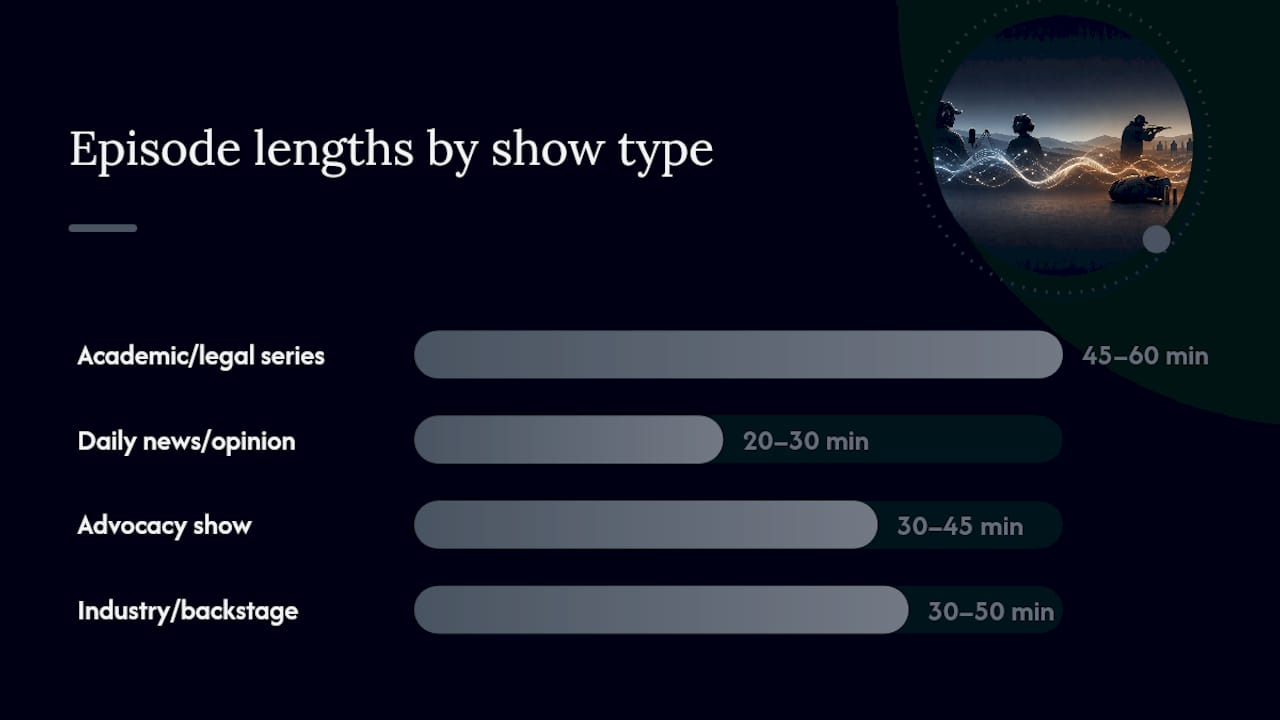
Episode length and frequency shape how a show fits your day. A 60-minute academic debate suits a long commute or dedicated study time. A 20-minute daily update fits a coffee break.
Where to listen varies by publisher. Some shows live exclusively on NPR’s platforms, others on Apple Podcasts or Spotify, and aggregator hubs like Gopcast pull conservative-leaning commentary into a single interface so you’re not juggling four apps.
| Show Type | Best For | Tone / Stance | Host Credentials | Episode Length & Frequency |
|---|---|---|---|---|
| Academic/legal series | SCOTUS doctrine, constitutional history | Neutral, moderated debate | Law professors, litigators | 45–60 min, weekly |
| Daily news/opinion | Breaking rulings, legislative votes | Advocacy-leaning, fast turnaround | Journalists, commentators | 20–30 min, near-daily |
| Advocacy show | Policy positioning, grassroots strategy | Explicitly pro-2A or pro-regulation | Advocacy leaders, organizers | 30–45 min, weekly or biweekly |
| Industry/backstage | Movement infrastructure, funding, culture | Pro-2A, insider perspective | Industry insiders, activists | 30–50 min, weekly |
Format matters too, as detailed in how talk radio shapes opinion, influencing the way listeners perceive political and legal debates. Interview-style episodes work well for commuting because the back-and-forth keeps attention without requiring notes. Solo commentary suits quick catch-up listening. Panel discussions, common on the academic and moderated-debate shows, reward focused listening because multiple viewpoints get layered fast, and it’s easy to lose the thread if you’re distracted.
How Do You Choose the Right Second Amendment Podcast?
Start by answering one question honestly: are you researching Supreme Court precedent, tracking advocacy and policy updates, or trying to understand the historical “well-regulated militia” debate? Your answer narrows the field fast.
Run through this checklist before committing to a subscription:
- Does the show name specific cases, statutes, or law review articles in its episode notes?
- Is the host’s professional background verifiable, either through a university page, a bar listing, or a newsroom bio?
- Does the show distinguish between opinion segments and sourced reporting, or does it blend them without warning?
- How often does the show release new episodes, and does that match your listening habits?
- Are episode lengths compatible with how you actually listen (commute, workout, dedicated study time)?
- Does the publisher have an institutional reputation (NPR, a university law center, an established advocacy organization) or is it a solo operation with no track record?
- Are guest experts named with checkable affiliations, or are claims attributed to vague “experts”?
- Does the show offer transcripts or searchable notes for pulling exact quotes later?
Watch for red flags: repeated factual errors that never get corrected, guests presented anonymously with unverifiable credentials, or hyperpartisan claims stated as settled fact with no citation. A show that never distinguishes “here’s my opinion” from “here’s what the court ruled” is one to listen to critically, if at all.
Test any new show over one week. Listen to one episode a day, jot down any factual claim that surprises you, and spend five minutes verifying it against the show’s own notes or a primary source like a court opinion. If the claims hold up across five episodes, the show earns a permanent spot in your feed.
A few technical preferences worth weighing:
- Episode length under 45 minutes fits most commutes; longer format suits dedicated listening blocks.
- Weekly release cadence keeps you current without overwhelming your queue.
- Searchable show notes save time when you need to find a specific case reference months later.
- Transcript availability matters if you’re citing the episode in writing or research.
Where to Listen and How to Subscribe
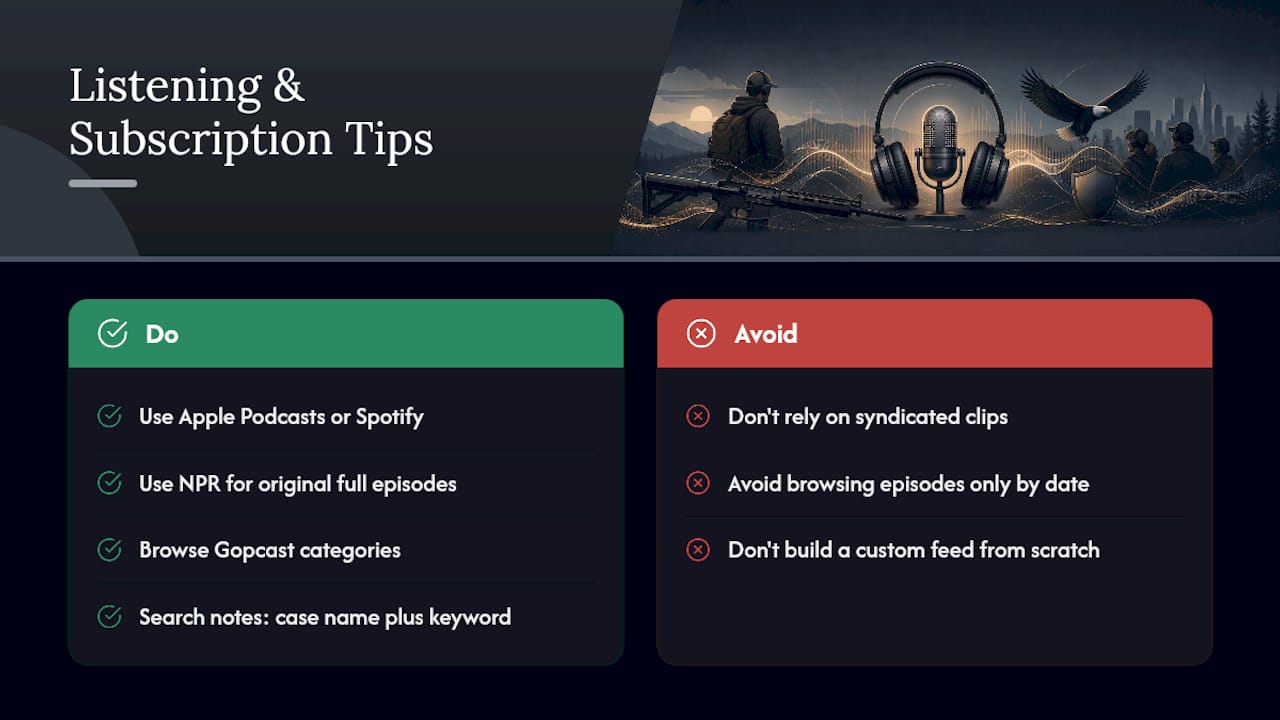
Apple Podcasts and Spotify remain the default apps for most listeners, and both index show notes well enough to search by case name. NPR hosts its own reporting directly through its site and app, which is useful when you want the original, unedited episode rather than a syndicated clip. Aggregator hubs like Gopcast serve a different function: instead of searching show by show, you browse by category, which speeds up discovery if your interest in the Second Amendment sits alongside broader conservative political commentary.
Subscribing is straightforward across platforms: search the show name, tap follow or subscribe, and most apps will auto-download new episodes. The more useful skill is searching within episode notes. If you’re trying to find how a show covered a specific ruling, search the case name directly, for example “Bruen” or “Heller,” rather than scrolling through a full episode list by date.
Pro Tip: Combine a case name with a keyword like “oral argument” or “ruling” when searching podcast apps. You’ll surface the exact episode faster than browsing chronologically, especially on shows with years of back catalog.
Gopcast simplifies this discovery problem for listeners who lean conservative and want Second Amendment commentary without hunting across five separate apps. Instead of building a custom feed from scratch, you can browse curated conservative podcast categories and follow shows that regularly weigh in on gun rights alongside broader political coverage.
Starter Episodes That Give You Immediate Value
You don’t need to binge a show’s full archive to get value. These entry points cover the major angles readers look for.
- National Constitution Center’s flagship reasoned-debate episode on the amendment’s text and history. Roughly 50 minutes, moderated format, available directly through the Center’s site and major podcast apps.
- WNYC’s “The Gun Show”, a 30-minute documentary-style episode tracing how the Supreme Court reshaped modern gun law. Find it on WNYC Studios or any major podcast platform.
- Saint Louis University Law’s Episode 17, covering Missouri-specific legal developments in a compact academic format, useful if you’re researching state-by-state variation.
- Brady’s Decoding the Second Amendment, tracing Roman militia roots through to modern policy from the advocacy side of the debate.
- A “State of the Second” episode on grassroots organizing, for listeners who want the movement’s infrastructure rather than courtroom doctrine.
- A Gun Lawyer Podcast episode covering state carry-permit changes, blending casework anecdotes with practical statute analysis.
- Cam & Co.'s coverage of a recent circuit court ruling, for listeners who want same-week reaction rather than retrospective analysis.
- A curated Gopcast commentary episode touching on gun rights within a broader political news cycle, good for listeners who want Second Amendment content alongside general conservative coverage.
If a show’s built-in search function comes up empty for an older episode, try searching the episode title plus “transcript” in a general search engine. Many publishers, especially NPR and university-hosted shows, post full transcripts separately from the audio feed. Whatever episode you land on, check the show notes for cited cases or law review articles and spend a few minutes confirming those sources actually say what the host claims.
Why Is the Second Amendment Still Contested Today?
The debate traces back to the amendment’s own language: “a well-regulated militia, being necessary to the security of a free state, the right of the people to keep and bear arms, shall not be infringed.” Historians and legal scholars disagree over whether “well-regulated militia” limits the right to organized militia service or is prefatory language explaining, but not restricting, an individual right, a disagreement that law review scholarship on the amendment’s original meaning has examined at length.
The legal landscape shifted substantially with a pair of landmark Supreme Court decisions establishing an individual right to keep firearms for self-defense, followed by a more recent ruling that reshaped how lower courts evaluate gun regulations by requiring them to align with historical tradition rather than modern policy justifications alone. University press scholarship on the amendment’s historical development remains a common citation point across both academic and advocacy podcasts trying to explain how we got here.
Modern flashpoints keep the debate active on every podcast feed:
- Assault-weapon bans and how courts assess “common use” for self-defense.
- Concealed and open carry laws that vary sharply by state.
- Age restrictions on firearm purchases and their constitutional footing.
- Militia doctrine and whether it still has legal relevance outside historical analysis.
- The “common use” test itself, which determines which weapons fall under constitutional protection.
How to Spot a Trustworthy Legal or Political Podcast
Four trust signals separate a show worth your time from one that’s just noise dressed up as analysis.
Host credentials come first. A law professor, a practicing attorney, or an investigative reporter brings a different kind of authority than a commentator with no verifiable background. Check this in under two minutes by searching the host’s name alongside their claimed institution.
Publisher reputation matters almost as much. Shows from established news organizations, university law centers, or long-running advocacy groups carry institutional accountability that a solo podcast simply doesn’t have.
Episode sourcing is the fastest tell. Open the show notes. If you see citations to specific court opinions, statutes, or law review articles, that’s a real signal the host is doing the work rather than reciting talking points.
Guest expertise rounds it out. When a show brings in outside voices, verify their claimed affiliation with a quick search. A “constitutional expert” with no findable credentials is a red flag, not a credibility booster.
Here’s a two-minute test you can run on any new episode: open the show notes, look for at least one named source or citation, search the host’s or guest’s professional background, and note whether opinion segments are clearly separated from sourced reporting. If a show passes all four checks consistently across a handful of episodes, it’s earned a spot in your rotation.
A Note From Gopcast on Curating This Coverage
We built Gopcast because finding reliable conservative-leaning commentary, including serious Second Amendment coverage, meant hunting across a dozen scattered apps and feeds. Our platform brings together shows like The Trey Gowdy Podcast and other established conservative voices into categorized hubs, so listeners spend less time searching and more time actually listening.
We don’t claim every episode we host meets the academic rigor of a law school seminar, and we won’t pretend advocacy content and legal scholarship are the same thing. What we do is make it easier to find commentary that aligns with a conservative perspective on gun rights, organized in one place instead of scattered across platforms with inconsistent search tools. That curation role, connecting listeners to voices they already trust, is what we built this platform to do.
Start Listening to Conservative Second Amendment Coverage Today
Gopcast brings together conservative political commentary, including regular coverage of gun rights and constitutional debate, into one browsable hub instead of a dozen separate podcast feeds. If you’ve been juggling apps to keep up with different hosts, this consolidates that into a single search-and-browse experience.

Getting started takes about 30 seconds. Head to the Gopcast homepage, browse the curated conservative categories, and follow a show that matches the angle you want, whether that’s daily commentary or deeper political analysis. If you want a strong starting point, The Dan Bongino Show is one of the platform’s most-followed programs and regularly touches on constitutional rights and gun policy alongside broader news. Search “Second Amendment” once you’re in, follow what resonates, and build your feed from there.
Sources
- Fordham Law Review article (Second Amendment scholarship)
- Episode 17: The Second Amendment in Missouri and Beyond
- Decoding the Second Amendment (Brady)
- University of Virginia Press listing (related to Second Amendment scholarship)
This article is general information, not a substitute for advice from a qualified lawyer. Consult a qualified legal professional about your own circumstances before acting on anything here.