The strongest rural politics podcasts right now are Rural Remix’s Backroad Ballots, Brookings’ Reimagine Rural, The Daily Yonder’s The Rural Impact, Rural Matters, The Heart of Rural America, and Everywhere Radio. Each takes a different angle on rural policy, culture, and organizing. Below you’ll find short profiles of each show, the three themes they circle back to again and again, and a quick framework for matching a show to what you actually want to hear.
TL;DR:
- Most rural politics podcasts focus on either narrative storytelling or policy analysis, so choosing the right show depends on your specific interests.
- Shows backed by institutions like Brookings tend to emphasize data and federal investment, while independent shows often highlight local voices and organizing efforts.
- Episode lengths, release frequency, and availability of transcripts are key factors for rural listeners with limited broadband or data plans.
- Building a diverse podcast rotation on both narrative and policy-driven shows provides a more comprehensive understanding of rural political issues.
- Curated platforms like GOPcast help find conservative rural-focused podcasts more efficiently than relying solely on general rankings.
Table of Contents
- The Best Rural Politics Podcasts Worth Your Feed
- The Three Main Beats You’ll Hear Across These Shows
- How to Choose the Right Rural Politics Podcast for Your Interests
- How GOPcast Helps You Find Rural-Political Coverage
- Where Rural Politics Podcasting Actually Came From
- Who’s Actually Making These Shows
- Getting These Shows to Rural Listeners
- What Actually Matters When You’re Picking a Show
- Start Listening: GOPcast Shows Worth Your Rural Politics Feed
- Sources
The Best Rural Politics Podcasts Worth Your Feed
Rural politics podcasts split into three rough camps: narrative shows that follow specific people and towns, policy shows that lean on data and interviews with researchers, and hybrid shows that mix both. Knowing which camp a show belongs to before you press play saves you from bailing three minutes in.
-
Rural Remix / Backroad Ballots. Produced by The Daily Yonder, this show pairs on-the-ground narrative with local organizing coverage. Backroad Ballots follows how small towns build political power outside the usual party machinery, and episodes typically run 30 to 45 minutes. Good fit for listeners who want voices from the town hall over voices from Capitol Hill. Show notes and full episode archives live on the Daily Yonder site.
-
Reimagine Rural. Backed by the Brookings Institution, this podcast travels to specific U.S. towns to examine how public investment reshapes rural prosperity. Episodes lean heavily on policy analysis, federal broadband money, and infrastructure spending. It’s the closest thing in this space to a think-tank briefing you can listen to on a drive, and the institutional backing gives it credibility with listeners who want numbers, not just anecdotes.
-
The Rural Impact. This one centers economic development and the practical mechanics of rural policy: workforce programs, small-business lending, and federal grant cycles. It fits listeners who care less about drama and more about what actually moves the needle in a county budget meeting.
-
Rural Matters. A community-politics show built around local leadership and organizing stories. Episodes tend to spotlight county commissioners, school board fights, and the kind of hyperlocal politics that never makes national news but decides whether a town keeps its hospital or its main street.
-
The Heart of Rural America. This show digs into property rights, agricultural policy, and the fights breaking out over data centers and AI infrastructure landing in rural states. Its episode catalog covers water use, energy demand, and the local zoning battles that come with a tech company buying up farmland. Strong pick for listeners tracking how rural land use collides with national tech policy.
-
Everywhere Radio. A broader cultural and civic show that treats rural America as more than a voting bloc, mixing interviews with everyday organizers, artists, and local business owners. It leans narrative over wonky, and works well as a counterweight if you’re already deep into the policy-heavy shows on this list.
None of these shows compete with each other for your ear the way two news apps might. They cover different beats, so most rural-politics listeners end up subscribing to two or three rather than picking just one.
The Three Main Beats You’ll Hear Across These Shows
Almost every rural politics podcast returns to the same three pillars, whether the format is narrative or policy-driven.
- Economic development and policy. This covers federal investment, broadband expansion, agricultural subsidies, and the fights over new industry moving into rural counties. A recurring example: episodes on data centers landing in small towns and the local water and energy strain that follows, a topic The Heart of Rural America returns to often.
- Social and cultural narratives. These episodes follow how demographic change, immigration, or population loss is reshaping specific towns, often through the eyes of one family or one main street business rather than a national trend line.
- Local leadership and organizing. This pillar tracks how rural communities build political power from the ground up, county commission races, hospital board fights, and grassroots campaigns that rarely reach a national audience.
Healthcare access is a theme that cuts across all three pillars, and it’s not a small one. Rural areas frequently vote in ways that seem to run against their own material interests, a dynamic the Niskanen Center has examined in depth, tying voting behavior to worse health outcomes and hospital access. Multiple shows in this space treat rural hospital closures as a recurring episode topic, not a one-off story, because the closures keep happening.
How to Choose the Right Rural Politics Podcast for Your Interests
Picking the right show comes down to matching format to what you’re actually trying to learn, not just picking whatever ranks highest on a list.
- Decide what perspective you want first. Are you after narrative storytelling, hard policy analysis, or partisan commentary? Backroad Ballots leans narrative and organizing. Reimagine Rural leans policy. Neither is wrong, they just answer different questions.
- Check who’s behind the mic. A show backed by a research institution, like Brookings, signals a different rigor than an independent producer working solo. Look at whether episodes rely on local reporting or national framing dropped onto a rural setting, since the two produce very different listening experiences.
- Weigh the practical listening factors. Episode length, release frequency, and whether transcripts exist all matter more than people expect. A weekly 20-minute show fits a commute; a biweekly 50-minute deep dive does not.
Shows that mix narrative interviews with shorter policy segments tend to hold listeners longer than shows that pick one lane and stay there, according to Rural Remix’s own production approach.
Pro Tip: Most podcast apps let you search within a show’s episode archive. If you only care about one topic, say rural broadband or hospital closures, search the show’s back catalog by keyword instead of scrolling chronologically. It’s faster than it sounds and surfaces episodes you’d otherwise miss.
How GOPcast Helps You Find Rural-Political Coverage
Several platforms aggregate conservative political shows into categories spanning news, commentary, interviews, and activism, so you’re not hunting across multiple apps to find rural-relevant coverage. Browsing by category can surface shows discussing agricultural policy, rural voting trends, and local organizing without wading through unrelated national commentary.
- Browse GOPcast’s category pages to filter by topic rather than searching show by show.
- Follow individual show pages to catch new episodes the moment they post.
- Use each show’s episode archive to jump straight to topics like agricultural policy or rural voting behavior.
If you want a curated starting point built for a conservative-leaning audience, show pages on podcast platforms can be a faster route than piecing together multiple separate podcast feeds.
Where Rural Politics Podcasting Actually Came From
Rural political coverage didn’t start as podcasts. It started as beat reporting at small-town newspapers and regional radio, the kind of coverage that shrank hard as local newsrooms closed through the 2000s and 2010s. Podcasting filled part of that gap, but slowly. Early rural-focused shows were mostly agricultural extension broadcasts, county fair recordings, and farm-radio holdovers, not political commentary.
The shift toward rural politics as its own podcast genre tracks closely with the 2016 and 2020 election cycles, when national media suddenly needed to explain rural voting patterns to urban audiences and often got it wrong. That created an opening for shows produced by outlets already embedded in rural reporting, like The Daily Yonder, to build audio programming grounded in actual local sourcing rather than parachute journalism. Institutional players followed. Brookings launching Reimagine Rural reflects a broader pattern of policy institutions recognizing that rural economic and political dynamics deserved dedicated coverage instead of a chapter in a national trends report.
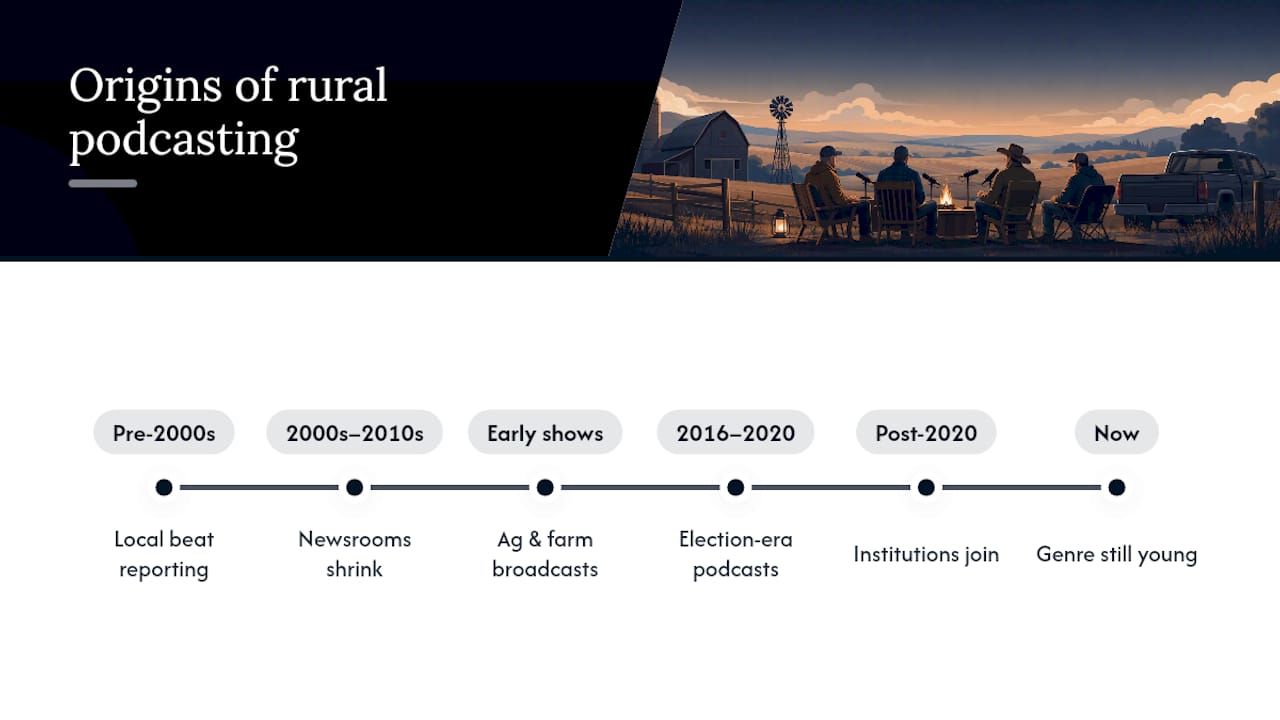
The genre is still young compared to political podcasting broadly, and it’s still figuring out its own conventions around length, tone, and how much data versus how much storytelling belongs in a single episode.
Who’s Actually Making These Shows
Rural politics podcasting is smaller and more personal than national political media, which means the people behind the microphone often are the reporting. Producers at outlets like The Daily Yonder build episodes around relationships they’ve spent years cultivating with local organizers, elected officials, and business owners, rather than booking whoever’s available for a quick national hit.
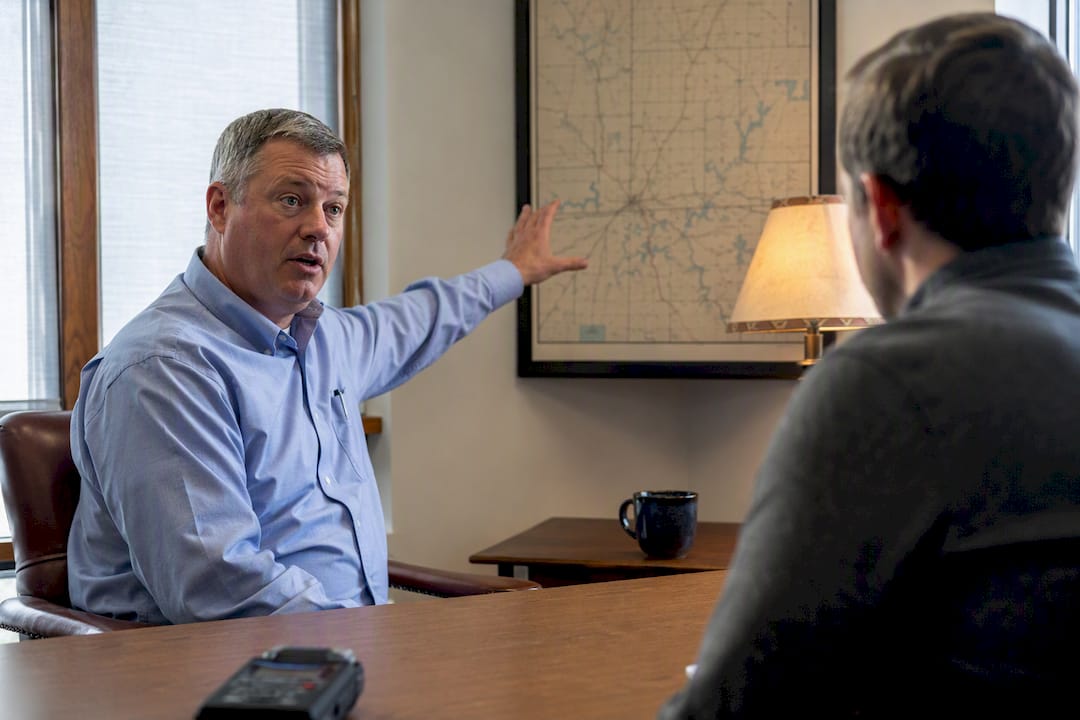
That approach shows up in the finished product. Shows built on deep local sourcing tend to publish searchable show notes that list location, policy area, and guest affiliation, which makes it far easier to find the one episode about, say, a specific state’s data center fight instead of scrolling through a hundred titles.
Scholars studying rural political identity have pushed back on the lazy media shorthand that reduces rural voters to a single emotion or grievance. Coverage that centers actual local voices, organizers, farmers, small-business owners, county officials, tends to hold up better than coverage built around a preset narrative looking for confirmation. The strongest producers in this space seem to understand that distinction instinctively: they book the county commissioner, not just the pundit talking about the county commissioner.
Getting These Shows to Rural Listeners
Distribution is its own problem in rural politics podcasting, separate from content quality. Broadband gaps still shape who can stream reliably, which means download-first listening (grabbing an episode over Wi-Fi at a library or a coffee shop, then listening offline) still matters more in rural counties than it does in cities. Shows that publish full transcripts also serve listeners with limited data plans who’d rather read an episode than stream it.
Standard podcast apps handle the mechanics fine once an episode is downloaded, but discoverability is the harder piece. Most mainstream podcast charts are built around urban listening patterns, so rural-focused shows rarely break into general “top politics” rankings even when they’re doing strong work. That pushes rural politics podcasts toward roundup lists, institutional backing, and word of mouth within farm and small-town networks rather than algorithmic discovery.
Curated hubs solve part of this by grouping shows by category instead of relying on a single ranking algorithm. If you’re specifically hunting for conservative-leaning commentary that touches rural policy, browsing by topic on a platform built around that lens beats scrolling a general politics chart hoping something rural surfaces.
What Actually Matters When You’re Picking a Show
Most “best rural podcasts” lists rank shows by production polish or host name recognition. That’s the wrong metric. The shows that hold up over a full season are the ones that keep showing up in the same county, talking to the same organizers, tracking the same hospital closure or data center fight over months instead of parachuting in for one dramatic episode and moving on.
The conventional advice, “just subscribe to whatever’s trending,” misses that rural politics podcasts aren’t interchangeable the way news podcasts often are. A show built on policy analysis and one built on narrative storytelling are answering different questions, and treating them as competitors for the same slot in your feed means you’ll drop one out of boredom instead of realizing you actually needed both.
If you’re new to this space, start with one narrative show and one policy show, not five shows in the same lane. That combination covers more ground than five shows all doing variations on the same format. And if what you’re really after is conservative-leaning commentary that touches rural economic and cultural fights without pretending to be neutral, a curated hub like GOPcast is a faster way to find that voice than hoping a general politics chart surfaces it for you.
— GOPcast
Start Listening: GOPcast Shows Worth Your Rural Politics Feed
Building your own rural-politics rotation from scratch can mean checking several different apps and guessing which conservative hosts actually touch agricultural policy, local organizing, or rural economic fights. Some platforms simplify that step by putting shows in one place, already sorted by category.

A few starting points worth a follow: Ringside Politics covers national policy fights with the kind of commentary that regularly touches rural economic issues. The Brian Kilmeade Show mixes news and interviews at a pace that fits a daily commute. The Heart of Rural America’s direct focus on agricultural policy and data-center fights makes it a natural companion to broader conservative commentary shows like America’s Voice Live. Following a show on GOPcast takes one click from its show page, and new episodes land in your feed automatically. Browse the full show lineup and start following the ones that match how you actually want to hear rural politics covered.