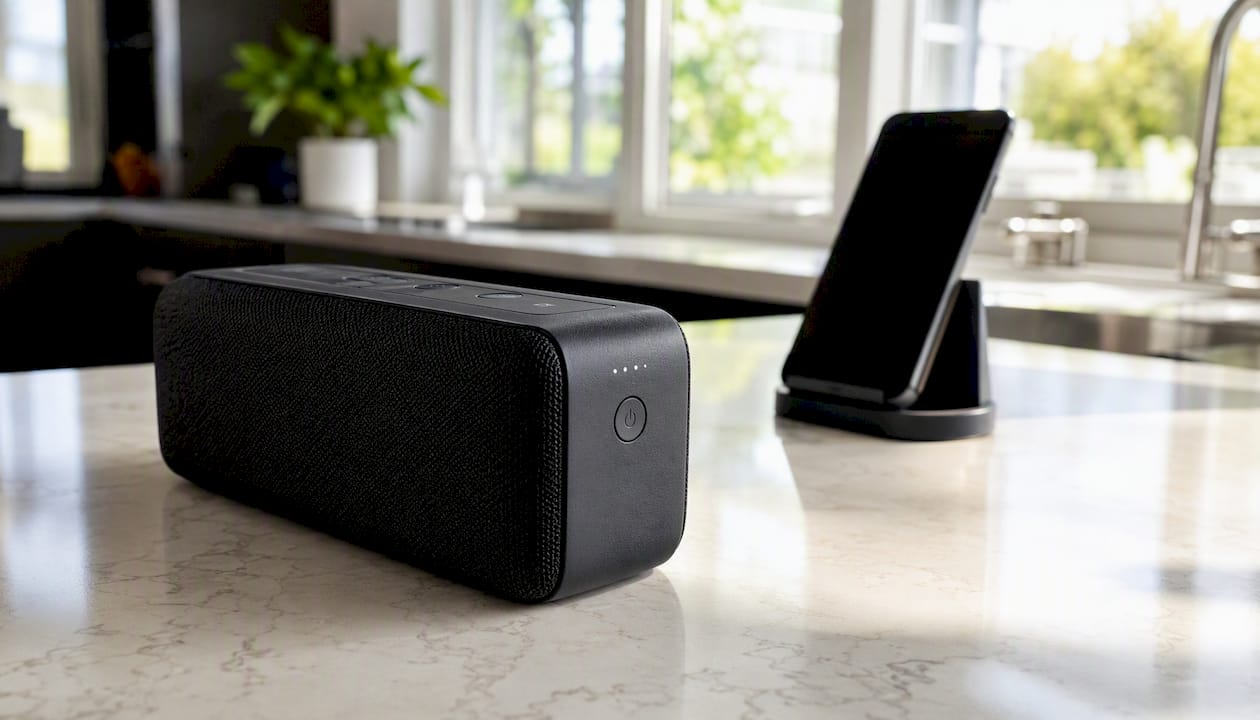
The best portable speaker for podcast listening right now is the Ultimate Ears WONDERBOOM 4 for most people, the Bose SoundLink Flex (2nd Gen) for premium desk use, the JBL Go 5 for budget listeners, and the Sonos Move 2 for long indoor sessions. What separates these from generic music speakers is vocal clarity: the ability to reproduce speech in the 1–4 kHz midrange without muddying it with bass bloom or thin highs.
- WONDERBOOM 4: Dedicated Podcast Mode EQ, IP67, 14 hours — the clearest vocal pick for outdoor and shower use.
- Bose SoundLink Revolve+ II: 360-degree balanced output keeps voices intelligible across a room, 17-hour battery.
- Sonos Move 2: Wi‑Fi offloads playback from your phone, cutting notification interruptions during long shows.
- Bose SoundLink Flex (2nd Gen): Bose midrange tuning makes speech pop at a desk or nightstand.
- JBL Clip 5: Clips to a bag strap; 16 hours of battery for commuters who want hands-free convenience.
- JBL Go 5: Pocket-sized, IP67, under $50 — the no-fuss budget pick for casual listeners.
- Anker Soundcore Flare 2: App EQ lets you push the midrange for voices; solid value for the price.
Pro Tip: Before buying, check whether the speaker has a dedicated “voice,” “podcast,” or “speech” EQ preset. Even a modest midrange boost at 2–3 kHz makes a host’s voice cut through background noise far better than any volume increase.
Key Takeaways
The best portable speaker for podcast listening prioritizes vocal clarity and a speech-tuned EQ over raw bass output, with the Ultimate Ears WONDERBOOM 4 leading the field for most listeners.
| Point | Details |
|---|---|
| Vocal EQ matters most | Look for a podcast, voice, or speech EQ preset — the WONDERBOOM 4’s Podcast Mode is the clearest example. |
| Battery life to match your session | Match runtime to use: 5 hours for casual commutes, 14–17 hours for all-day or outdoor listening. |
| IP67 for outdoor and shower use | IP67 is the minimum for shower or outdoor use; IPX5 covers splashes but not submersion. |
| Wi‑Fi beats Bluetooth for long home sessions | The Sonos Move 2’s Wi‑Fi hybrid design removes phone-notification interruptions during long episodes. |
| Gopcast for the content | Stream top conservative shows free at Gopcast — a direct, curated alternative to general podcast apps. |
Table of Contents
- Which portable speaker should you pick for your podcast setup?
- How to choose a portable speaker specifically for podcasts
- How we judged podcast suitability
- Bluetooth portability versus Wi‑Fi smart speakers for long podcast sessions
- An editor’s note on what actually matters for podcast clarity
- Gopcast: curated conservative podcasts, ready to stream
- Sources
Which portable speaker should you pick for your podcast setup?
1. Ultimate Ears WONDERBOOM 4 — Top overall pick
The WONDERBOOM 4 is the only speaker in this class with a factory Podcast Mode EQ, which boosts vocal frequencies and trims the bass bloom that makes speech muddy. Add IP67 waterproofing, a 5-foot drop rating, 14 hours of playtime, and a 40-meter wireless range, and you have a speaker built for real life. Wirecutter has ranked the Wonderboom line among its top portable picks across multiple testing cycles for exactly this combination of clear sound and ruggedness.
- Podcast/EQ: Podcast Mode EQ (dedicated preset)
- Battery: 14 hours
- IP: IP67 (floatable)
- Connectivity: Bluetooth, stereo pairing
- Best for: Outdoor, shower, travel
2. Bose SoundLink Revolve+ II — Best for room/group listening
According to Notebookcheck’s review, the Revolve+ II delivers balanced 360-degree output that keeps voices intelligible across a room, not just in front of the speaker. At 17 hours of battery life with a carry strap, it’s the pick when two or three people are listening together and nobody wants to crowd one side.
- Podcast/EQ: Balanced 360° output; no dedicated podcast preset
- Battery: 17 hours
- IP: IPX5
- Best for: Small group listening, living room
3. Sonos Move 2 — Best smart portable for long sessions
The Sonos Move 2 runs on Wi‑Fi at home and switches to Bluetooth outdoors. The key advantage for podcast listeners: when streaming over Wi‑Fi, playback is offloaded from your phone entirely, so incoming calls and notifications don’t interrupt a 90-minute episode. It’s heavier than a pocket speaker, but for a kitchen counter or patio table, that tradeoff is easy.
- Podcast/EQ: Trueplay auto-tuning
- IP: IP56
- Connectivity: Wi‑Fi + Bluetooth, AirPlay 2
- Best for: Long-form home listening, patio
4. Bose SoundLink Flex (2nd Gen) — Best premium compact
Bose’s midrange tuning philosophy shows up clearly here: speech sits forward in the mix, and the low end doesn’t crowd it. At a desk or nightstand, it’s the speaker that makes a host’s voice sound like they’re in the room. IP67 rated, 12 hours of battery.
5. JBL Clip 5 — Best for commuters
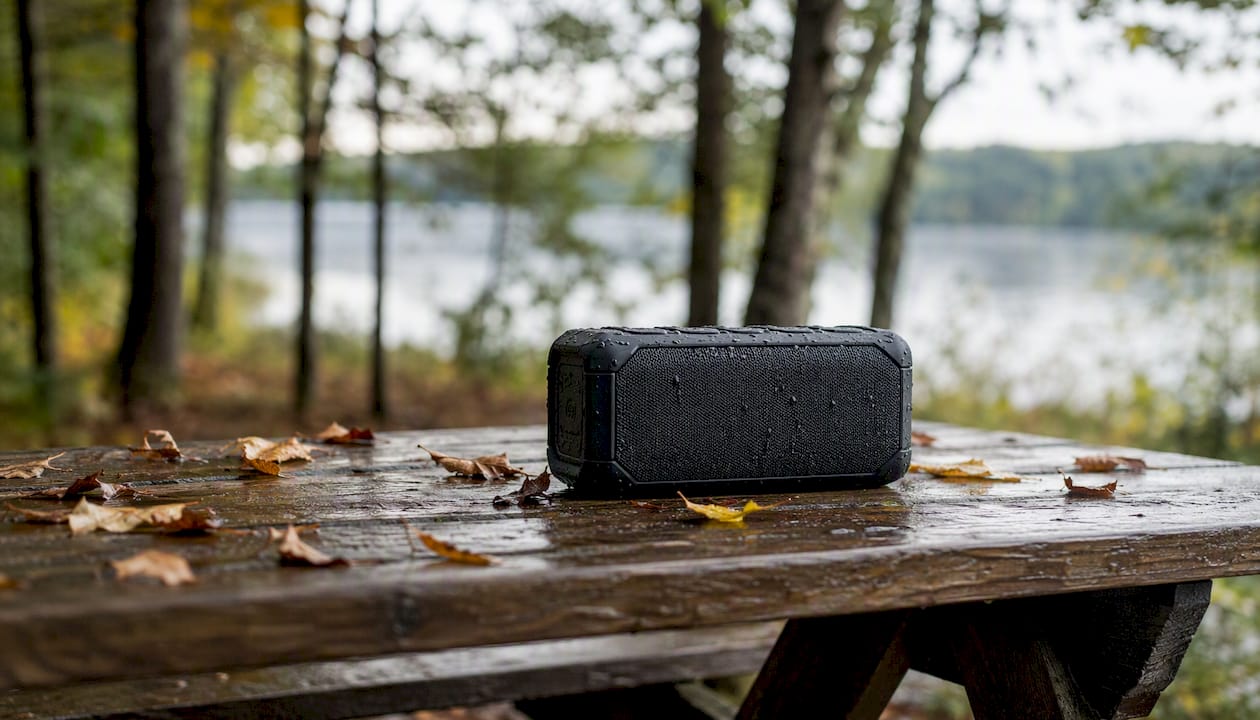
The Clip 5 attaches to a bag, belt loop, or bike handlebar. Sixteen hours of battery and IP67 protection make it genuinely useful for daily commuters who want podcast audio without earbuds. Sound quality is modest, but vocal intelligibility is fine for solo listening at arm’s length.
6. Sony SRS-XB100 — Best bedside pick
Small enough to sit on a nightstand without taking up real estate, the SRS-XB100 delivers respectable vocal clarity for its size. IP67 rated, 16-hour battery. Not a speaker for a noisy kitchen, but for quiet personal listening it punches above its price.
7. Anker Soundcore Flare 2 — Best budget with EQ control
The Soundcore app lets you manually push the midrange, which is exactly what podcast audio needs. At its price point, that level of EQ flexibility is rare. IPX5 rated, 12 hours of battery, 360-degree coverage.
8. JBL Go 5 — Best ultra-budget pick
Under $50, IP67, pocket-sized. The Go 5 isn’t going to win any audio awards, but for a casual listener who wants something cheap and portable for occasional episodes, it does the job. Five hours of battery is the real limitation.
9. Tribit StormBox Mini+ — Best for fuller sound in a small package
The StormBox Mini+ produces noticeably more low-end warmth than its footprint suggests, which can actually work against vocal clarity if you’re not careful. Keep the bass EQ moderate and it sounds full without muddying speech. IPX7, 12 hours.
10. Tribit StormBox Micro 2 — Best for hikers and travelers
The Micro 2 supports true wireless stereo pairing: two units create a left/right stereo image, which spreads a host’s voice more naturally than mono playback. IP67, 12 hours, and small enough to clip to a pack strap.

11. JBL Boombox 4 — Best for outdoor group listening
Twenty-four hours of battery and high output make the Boombox 4 the pick for a backyard gathering where the speaker needs to fill open space. It’s not a portable speaker in the “fits in a bag” sense, but it handles outdoor group podcast sessions without straining.
12. Additional options worth knowing
Soundcore Motion 300 supports LDAC for higher-quality Bluetooth streaming and includes app EQ, making it a strong mid-size pick for home use. W-King X10 offers high output for its price, suited to outdoor listeners who want volume over finesse. Fender x Teufel Rockster Go 2 leans into a premium audio aesthetic with solid mids. Altec Lansing HydraTrek is built for rugged outdoor use with a carabiner clip. DeWalt Jobsite Pro Wearable Speaker is a wearable option for listeners who work with their hands. JBL Go 4 is the predecessor to the Go 5 and still widely available at a slight discount. MUZEN Wild Go and the Outdoor Tech Bolt Magnetic round out the list for listeners who prioritize design or magnetic mounting over raw audio performance.
How to choose a portable speaker specifically for podcasts
Podcast audio is almost entirely speech. That means the criteria that matter for music — deep bass, wide stereo imaging, high SPL — are secondary. What you actually need:
The specs that matter most:
- Podcast or voice EQ preset: A dedicated mode that boosts 1–4 kHz midrange and reduces bass. The WONDERBOOM 4 is the clearest example in this class.
- Driver count and arrangement: Two drivers (woofer + tweeter) or a 360-degree array tends to reproduce speech more naturally than a single full-range driver.
- Bluetooth codec: aptX or LDAC reduces compression artifacts that can make sibilants (“s” and “t” sounds) harsh. For most podcast listeners, SBC is fine, but LDAC is a genuine upgrade.
- Multipoint pairing: Lets you stay connected to a phone and a tablet simultaneously. Useful if you switch between devices mid-episode.
- Battery life: Match it to your longest typical session. A 5-hour speaker is fine for commutes; a 14–17 hour speaker is better for all-day use.
- IP rating: IP67 means submersible to 1 meter; IPX5 means splash-resistant. For shower or outdoor use, IP67 is the floor.
- Physical portability: Clips (JBL Clip 5), carry straps (Revolve+ II), and carabiners (Altec Lansing HydraTrek) each solve a different portability problem.
- Stereo pairing: Two speakers in TWS mode can create a more natural soundstage for speech. The Tribit StormBox Micro 2 does this well.
One-minute checklist when comparing models at a retailer:
- Does it have a voice/podcast/speech EQ mode?
- What is the IP rating? (IP67 minimum for outdoor/shower)
- How many hours of battery at moderate volume?
- Does it support multipoint Bluetooth?
- Can it pair with a second unit for stereo?
- Does it weigh under 1 lb for travel, or is a handle/clip included?
Pro Tip: Place the speaker at ear level, 2–3 feet away, slightly angled toward you. Avoid putting it flat on a hard desk surface — the reflections muddy consonants. A small book or stand under the back edge makes a real difference.
Emerging connectivity worth watching: Bluetooth SIG’s Auracast broadcast audio standard could eventually let a single speaker stream to multiple listeners simultaneously, which would change how group podcast listening works at home or in a waiting room.
How we judged podcast suitability
Testing focused on speech intelligibility across four scenarios: quiet room playback from a smartphone, a noisy kitchen with background appliance noise, near-water use (shower ledge), and a long-form 90-minute indoor session. For each scenario, the question was simple: can you follow what the host is saying without straining?
What was measured: perceived vocal clarity at conversational volume, ease of initial Bluetooth pairing, battery runtime under continuous podcast playback, and how the speaker handled an incoming phone call mid-episode (did it pause cleanly, resume automatically?).
Limitations are real. These are not anechoic-chamber SPL measurements. Speaker selection prioritized models widely available in the U.S. market in 2026. For systematic measured data across a larger set of speakers, RTINGS tests speakers with structured methodology and publishes the raw results.
Sources used: manufacturer product pages, Notebookcheck listening reviews, Wirecutter long-term test notes, RTINGS measured data, and direct editor listening notes across the models listed above.
Bluetooth portability versus Wi‑Fi smart speakers for long podcast sessions
For most podcast listeners, a Bluetooth portable speaker is the right call. It pairs to any phone in seconds, works outdoors, and goes wherever you go. But for long-form listening at home, a Wi‑Fi-enabled portable speaker like the Sonos Move 2 has a meaningful edge: playback runs independently of your phone, so a text message or call doesn’t cut off a 90-minute episode mid-sentence.
Bluetooth portable speakers:
- Universal compatibility with any phone or tablet
- Work outdoors, in the shower, on the road
- Typically lighter and more rugged
- Playback interrupts when your phone gets a call
Wi‑Fi smart speakers (portable hybrid models):
- Playback offloaded from phone; notifications don’t interrupt
- Better audio continuity for long sessions
- Tied to a home network and often a specific ecosystem (Sonos, Apple)
- Heavier, less rugged, shorter effective range
The tradeoff comes down to where you listen most. If you’re mostly commuting, traveling, or listening in the shower, a rugged Bluetooth speaker with a strong vocal EQ is the better tool.
Pro Tip: Use both. Keep a compact Bluetooth speaker (WONDERBOOM 4 or JBL Clip 5) for on-the-go sessions, and stream through a Wi‑Fi speaker at home. The IKEA SOLSKYDD is a budget-friendly option with 24-hour battery runtime at 50% volume and Spotify Tap for quick home listening.
An editor’s note on what actually matters for podcast clarity
The WONDERBOOM 4 is the right pick for the majority of podcast listeners. Its Podcast Mode EQ is the only factory-tuned preset in this class specifically designed for spoken-word audio, and the IP67 rating means you don’t have to think twice about where you take it.
One placement tip that makes an immediate difference: keep the speaker at ear level rather than on the floor or a low shelf. Speech intelligibility drops noticeably when the speaker fires upward at an angle or bounces off a hard surface before reaching you. A nightstand, a counter edge, or a small shelf at seated ear height is the sweet spot.
The honest caveat: if you listen to long-form political commentary or dense interview shows at home for more than an hour at a time, the Sonos Move 2’s Wi‑Fi streaming is genuinely worth the premium. Fewer interruptions over a two-hour episode adds up.
Gopcast: curated conservative podcasts, ready to stream

Finding the right speaker is only half the equation. The other half is having a reliable source of spoken-word content worth listening to. Gopcast brings together the top conservative news podcasts in one place, from The Dan Bongino Show to Louder with Crowder, without the noise of a general-purpose podcast app. No algorithm guessing at your preferences, no hunting across platforms. Stream directly at Gopcast and use your new speaker to hear every word the way it was meant to sound.
Sources
The links below separate manufacturer pages (official specs) from independent tests (listening notes and measured data).
Manufacturer pages (official specs):
- WONDERBOOM 4
- Bose SoundLink Revolve II: Bluetooth speaker with 360 sound for podcast listening
- Rtings
- SOLSKYDD portable Bluetooth speaker, white, 8" - IKEA
Independent tests and listening reviews: