
For conservative listeners and the advertisers targeting them, the most effective YouTube alternative is a dedicated conservative podcast aggregation hub, and Gopcast is the clearest example of that format done right. Listeners: start browsing shows like Bannon’s War Room and The Dan Bongino Show today. Advertisers: request a media kit and ask about show-level sponsorship inventory. A significant portion of Americans listen to at least one podcast weekly, and a curated hub captures that audience far more efficiently than a general-purpose video feed.
Table of Contents
- What “YouTube alternatives” means in this guide
- Why a dedicated conservative podcast hub beats browsing YouTube for political content
- What should listeners and advertisers look for in a conservative podcast hub?
- Gopcast spotlight: how the platform meets listener and advertiser criteria
- How advertisers and sponsors can reach conservative podcast listeners on Gopcast
- How listeners subscribe, follow, and discover shows on Gopcast
- What other video-sharing platforms look like beyond conservative podcast hubs
- How YouTube compares to dedicated podcast hub platforms
- Content diversity and content policies on alternative platforms
- Interface, content discovery, and community features on alternative platforms
- Monetization options for content creators on alternative platforms
- Potential drawbacks of dedicated hubs compared to YouTube
- Key Takeaways
- Why the discovery gap is the real story here
- Start listening or advertising on Gopcast today
What “YouTube alternatives” means in this guide
This article uses “YouTube alternatives” to mean dedicated conservative-leaning podcast aggregation and streaming hubs, specifically platforms that centralize right-leaning political shows, live and recorded, into a single browsable destination for U.S. listeners and advertisers.
The scope covers talk, news, interviews, commentary, conservative health programming, and true crime. General-purpose video-hosting sites are a different product solving a different problem for a different audience, so they sit outside this guide entirely.
Why a dedicated conservative podcast hub beats browsing YouTube for political content
Conservative media consumption is concentrated across four platforms: Facebook (84%), YouTube (74%), AM/FM radio (69%), and network/cable television (56%). Those environments surface content through algorithms, not intent. A listener who wants Dan Bongino gets whatever the feed decides to show alongside him.
A curated hub flips that dynamic. Podcasting requires active seek-and-subscribe behavior, which means the audience arriving at a conservative hub is already self-selected. They came looking for this content. That distinction matters for advertisers more than almost anything else in a media plan.

Podcasts also build audience intimacy that video feeds rarely replicate. A host speaking directly into earbuds for an hour creates a trust relationship that a 90-second clip on a social feed cannot match. For political messaging, that trust transfers to the sponsor.
Audio advertising strengthens multi-channel political media plans by connecting audiences through trusted voices and consistent exposure, increasing message credibility in ways that display and pre-roll video rarely achieve alone.
Pro Tip: Repurpose 60-second audio clips from sponsored segments as social video cards with captions. Conservative podcast listeners who discover a show on social often convert to full-episode listeners within two weeks, giving advertisers a second touchpoint at no additional media cost.
What should listeners and advertisers look for in a conservative podcast hub?
For listeners
- Show roster depth. Does the hub carry the hosts you already follow, plus enough adjacent shows to surface new ones?
- Discovery mechanics. Can you browse by category (news, commentary, health, true crime) rather than relying on a search bar?
- Platform availability. Web streaming is the baseline; smart TV and mobile access extend habitual listening into more dayparts.
- Follow and subscribe options. One-click follow mechanics reduce the friction that causes listeners to drift back to YouTube.
- Content policy clarity. Conservative listeners have been burned by deplatforming. A hub with a clear, stable content policy is worth more than one with a larger but unstable catalog.
Pro Tip: When you find a show you like, check the hub’s “related shows” or category page immediately. That first session is when most listeners lock in their subscription habits.
For advertisers
Ask these questions before signing any insertion order:
- What are the verified monthly unique listeners and average completed-listen rates by show?
- Which ad formats are available: pre-roll, mid-roll, host-read sponsorship, display, or campaign landing pages?
- How is targeting structured: show-level, category-level, or behavioral?
- What measurement outputs does the platform provide: reach, frequency, UTM-compatible landing pages, pixel support?
- What is the brand-safety policy, and how are political ads reviewed for compliance?
- Is there a minimum spend, and what does a test campaign look like?
Gopcast spotlight: how the platform meets listener and advertiser criteria
Gopcast aggregates prominent conservative shows into a single ad-supported hub, with curated category browsing, individual show pages, and web streaming available across the United States.
The show roster covers the full range of conservative political listening. Bannon’s War Room and The Dan Bongino Show anchor the hard-news commentary tier. Louder with Crowder, The Clay Travis & Buck Sexton Show, and Hang Out with Sean Hannity cover opinion and culture. The Trey Gowdy Podcast and The Sentinel Report add investigative depth. America’s Voice Live, Brian Kilmeade Show, and Stinchfield Tonight round out the live and nightly formats. Health and lifestyle listeners have America’s Doctor: The Dr. Oz Podcast and The Hope Report. True crime sits alongside politics with the Fox True Crime Podcast. Rounding out the catalog: No Agenda Show, National Update, The Secretary Kennedy Podcast, and My Mornings.
That breadth matters for advertisers. Conservative podcast audiences split into distinct segments: younger, digitally fluent listeners and older, broadcast-rooted conservatives. A hub carrying both Bannon and Kilmeade reaches both cohorts from a single buy.
| Dimension | Watching political clips on a video platform | Listening via a conservative podcast hub |
|---|---|---|
| Listener intent | Passive, algorithm-surfaced | Active, seek-and-subscribe |
| Content format | Short clips, variable length | Full episodes, structured formats |
| Ad environment | Pre-roll alongside unrelated content | Show-integrated, host-adjacent placements |
| Audience signal | Broad, interest-inferred | Self-selected, ideologically aligned |
| Discovery mechanism | Recommendation feed | Category browse and show pages |
| U.S. advertiser targeting | Platform-level demographic | Show-level and category-level inventory |
Video consumption of podcasts on living-room devices is rising sharply, which means smart TV availability is no longer optional for a hub that wants to capture the full conservative audience.
How advertisers and sponsors can reach conservative podcast listeners on Gopcast
Ad formats and when to use each
- Host-read mid-roll sponsorships: highest trust transfer; use for persuasion goals and brand introduction to new audiences.
- Pre-roll audio: best for frequency and awareness; pair with a landing page for direct response.
- Site display placements: retargeting and awareness for listeners browsing show pages; lower CPM, useful for budget extension.
- Campaign landing pages: dedicated URLs tied to a show or host; track conversions cleanly with UTM parameters.
Creative best practices for conservative audio audiences
Keep spots between 30 and 60 seconds. Conservative podcast listeners skew toward longer-form attention, but ad fatigue still kicks in past 90 seconds. Use a conversational tone that mirrors the host’s register. Hard-sell copy lands poorly in a trust-based audio environment. For political advertisers, maintain a complete record of all ad creative and placements per FEC and state-level disclosure requirements.
Measurement structure
Set baseline KPIs before the campaign launches: reach, frequency, and completed-listen rate. Add UTM parameters to every landing page URL. Structure an incrementality test by running audio alone in one market and audio plus digital in another, then compare conversion lift. Publishers and platforms are moving toward unified ad delivery across audio and video formats, so ask Gopcast about any cross-format reporting tools available.
Pro Tip: Sequence creative across dayparts. Morning shows like My Mornings attract habitual commuter listeners; nightly programs like Stinchfield Tonight reach a different attention state. A two-spot campaign using distinct creative for each daypart outperforms a single spot run across both.
How listeners subscribe, follow, and discover shows on Gopcast
- Visit gopcast.com on any web browser.
- Browse the featured shows on the homepage or use the category navigation to filter by news, commentary, health, or true crime.
- Click any show page to access full episodes and live streams.
- Use the follow or subscribe option on the show page to get notified of new episodes.
- For smart TV listening, access Gopcast through your device’s browser or check the platform’s app availability page.
- Return to the homepage regularly; featured show rotations surface new programs you may not have searched for directly.
For power users: check the category pages weekly rather than relying only on shows you already follow. The conservative podcast space moves fast, and new programs from established hosts appear without much advance notice. Also, sharing a show page link directly is the fastest way to bring a friend into the hub without requiring them to navigate from scratch.
What other video-sharing platforms look like beyond conservative podcast hubs
For listeners who want broader context, the general video-sharing space includes platforms built around user-uploaded video, live streaming, and creator monetization. These range from large ad-supported networks to smaller creator-owned communities. Some emphasize long-form content; others prioritize short clips and social sharing. Most rely on algorithmic recommendation rather than curated category browsing, which is exactly the friction a dedicated hub eliminates for conservative political listeners.
How YouTube compares to dedicated podcast hub platforms
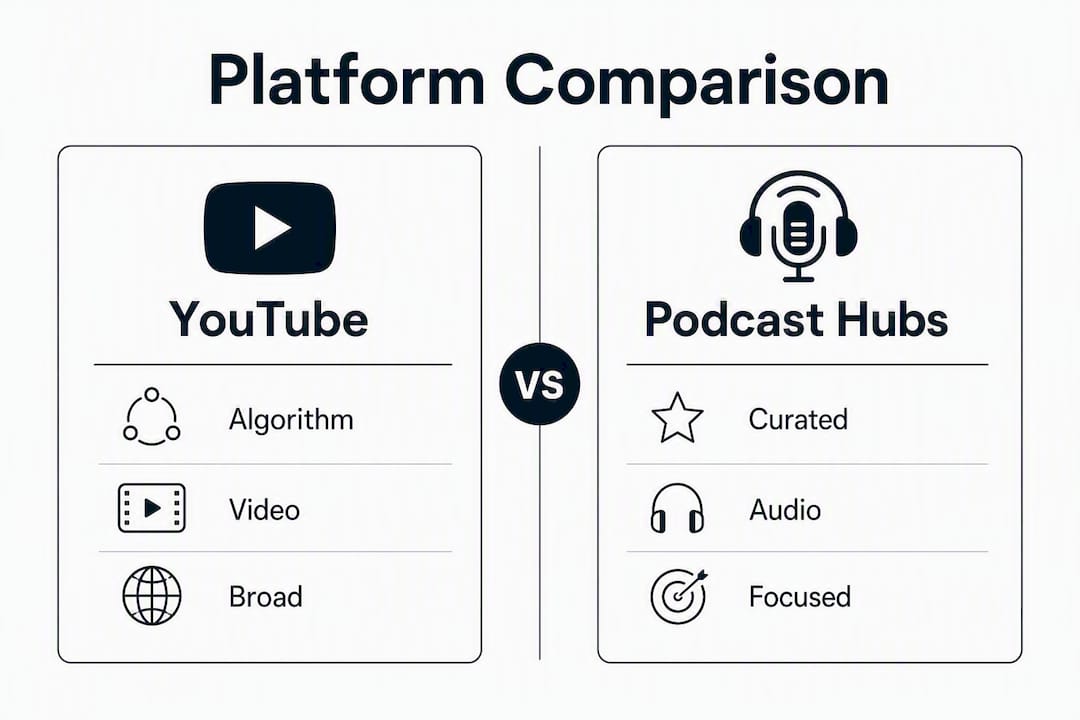
| Feature | General video platform | Dedicated podcast hub |
|---|---|---|
| Content curation | Algorithm-driven | Editorial and category-curated |
| Creator monetization | Ad revenue share, memberships | Sponsorship, host-read ads, display |
| Audience intent | Mixed (entertainment, news, tutorials) | Focused (political talk, commentary) |
| Ad targeting | Broad demographic | Show-level, ideologically aligned |
| Content policy | Centralized, frequently updated | Platform-specific, often more stable |
Content diversity and content policies on alternative platforms
Conservative podcast hubs carry a wider range of right-leaning content types than most listeners expect: hard political commentary, investigative reporting, health and wellness, true crime, morning lifestyle programming, and faith-adjacent content all coexist. Content policies on dedicated hubs tend to be more transparent about what they will and will not carry, which reduces the deplatforming anxiety that drives conservative listeners away from larger general platforms.
Interface, content discovery, and community features on alternative platforms
Dedicated hubs prioritize browse-first discovery over search-first. Category pages, featured show rotations, and show-level pages make it easy to find something new without knowing exactly what you want. Community features vary by platform; some offer comment sections or listener forums tied to individual shows, while others keep the experience purely audio-focused. The cleaner the interface, the lower the drop-off rate among listeners who are less digitally fluent, which matters for reaching the older broadcast-rooted conservative segment.
Monetization options for content creators on alternative platforms
Creators on dedicated conservative hubs typically monetize through host-read sponsorships negotiated directly with advertisers, platform-level ad revenue sharing, and affiliate partnerships with shows or networks. Some platforms are moving toward premium subscription tiers for ad-free or exclusive content. The industry is actively experimenting with paid content and multi-modal formats as a way to diversify revenue beyond ad-supported models.
Potential drawbacks of dedicated hubs compared to YouTube
The honest limitations: a dedicated hub carries fewer total shows than a general platform, which means niche or emerging conservative voices may not yet be included. Discovery outside the hub is limited; a show that lives only on a curated platform misses the organic search traffic that YouTube’s recommendation engine generates. YouTube is now the primary podcast platform for many weekly listeners, so a hub that does not integrate with broader discovery channels risks missing first-time listeners. Measurement tools on smaller platforms can also lag behind the reporting depth available on large ad networks.
Key Takeaways
Gopcast is the most direct YouTube alternative for conservative podcast listeners and advertisers because it centralizes curated show inventory, self-selected audiences, and show-level ad formats into a single U.S.-available hub.
| Point | Details |
|---|---|
| Listener intent matters | Conservative podcast hubs attract active, self-selected listeners rather than algorithm-surfaced viewers. |
| Show roster signals reach | Gopcast carries 17+ prominent shows spanning commentary, health, true crime, and live formats. |
| Audio builds advertiser trust | Host-read sponsorships drive persuasion; platform display extends reach and supports retargeting. |
| Measurement starts before launch | Set reach, frequency, and completed-listen KPIs before the campaign runs, then add UTM tracking. |
| Gopcast as the recommended hub | Gopcast aggregates top conservative shows in one place, with ad-supported inventory for U.S. advertisers. |
Why the discovery gap is the real story here
The conventional framing treats “YouTube alternatives” as a question about video technology. It is not. For conservative political listeners, the real problem has always been discovery: how do you find and follow the shows that match your worldview when the dominant platforms are optimized for engagement across every possible interest, not yours specifically?
A curated hub does not just aggregate content. It removes the cognitive load of filtering. When a listener lands on Gopcast and sees Bannon, Bongino, Gowdy, Kilmeade, and Hannity on the same page, they do not need to evaluate whether the platform is for them. The roster answers that question immediately. That is a fundamentally different value proposition than a general video platform, regardless of how good its recommendation engine is.
For advertisers, the same logic applies in reverse. You are not buying impressions on a platform. You are buying access to an audience that has already declared its preferences by showing up. That self-selection is worth more than any demographic overlay a general platform can offer.
Start listening or advertising on Gopcast today
Gopcast gives conservative listeners one place to follow every major right-leaning show, from Bannon’s War Room to The Brian Kilmeade Show, without hunting across multiple apps or fighting an algorithm that does not know what you want. No subscriptions, no paywalls, just the shows you already trust in a single browsable hub.

For advertisers, Gopcast offers show-level sponsorship inventory, host-adjacent audio placements, and a self-selected conservative audience that general video platforms cannot replicate. The show roster spans commentary, health, true crime, and live programming, giving media buyers multiple inventory options within a single, brand-safe environment. Contact Gopcast to request audience demographics, available formats, and campaign examples. Visit gopcast.com to browse the full show catalog and take the first step toward reaching the conservative podcast audience where it actually listens.