
The most reliable faith and politics podcasts share three traits: a host who names their theological framework upfront, guests who disagree without shouting, and show notes you can actually check. Start with an interview episode and a breaking-news episode from the same show; if both hold up, subscribe. GOPcast’s Faith & Freedom with Shemane Nugent is a solid first stop for listeners who want that faith-informed lens without hunting across five different apps.
TL;DR:
- Many faith and politics podcasts improve credibility by clearly stating their theological perspective and sourcing their claims in show notes.
- Shows with diverse guests and balanced viewpoints help listeners critically evaluate information rather than falling into echo chambers.
- The genre has expanded through independent production, making it essential for listeners to check sources and avoid shows with uniform perspectives.
- Formats vary from interviews and debates to short reflections, with tone differences emphasizing either civil discourse or provocative commentary.
- Accessibility is supported through grouping on main podcast apps, with most shows releasing weekly or biweekly to accommodate guest availability.
Table of Contents
- The Best Faith and Politics Podcasts to Subscribe To
- What to Expect: Formats, Tones, and Episode Types
- How to Pick the Right Podcast for Your Perspective
- Where to Listen and How Often New Episodes Drop
- How Faith and Politics Ended Up on the Same Microphone
- The Range of Views Inside Faith and Politics Podcasts
- Who Keeps Showing Up: Hosts and Guests Worth Knowing
- What to Do After You Finish an Episode
- Where These Podcasts Can Mislead You
- Why Faith and Politics Podcasts Actually Matter
- Start Listening Without the App-Hopping
- Sources
- FAQ
The Best Faith and Politics Podcasts to Subscribe To
Faith-based discussions about government and culture range from academic seminars to campfire-style conversations. The shows below cover that range, and each one earns its spot for a specific kind of listener.
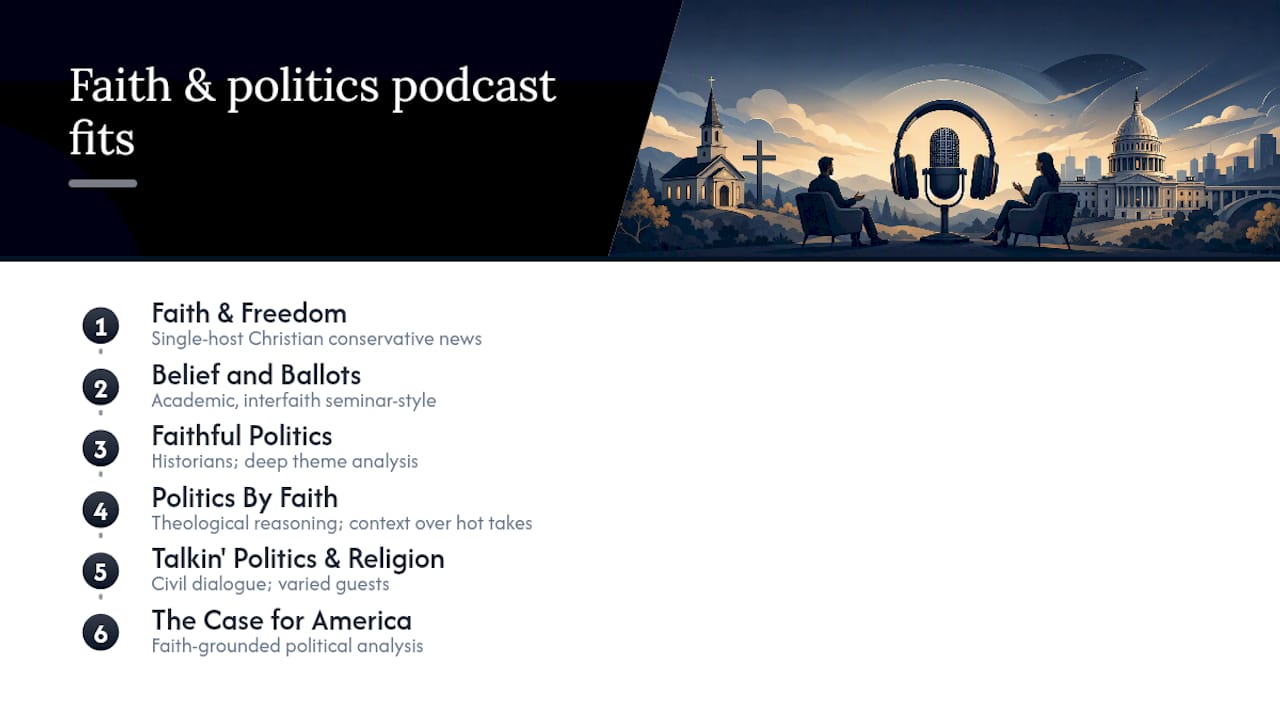
1. Faith & Freedom with Shemane Nugent. Hosted on GOPcast, this show pairs current events with a Christian conservative worldview, often bringing on guests from ministry, media, and politics. It fits listeners who want a single host’s steady perspective rather than a rotating panel. Start with a recent episode covering a headline news story to gauge the tone before committing to the back catalog.
2. Belief and Ballots. Produced through Saint Anselm College’s Center for the Study of Religion and Public Life, this series brings on scholars and religious leaders from multiple traditions. It’s built for listeners who want the seminar-room version of faith and politics, complete with academic sourcing and interfaith framing. The institutional backing is the trust cue here.
3. Faithful Politics. This show regularly hosts historians and public scholars to dig into topics like Christian nationalism and the roots of political movements. Best for listeners who want depth on a single theme rather than a news roundup. Check the episode archive on Apple Podcasts for guest lists before diving in.
4. Politics By Faith with Mike Slater. The show’s own framing is explicit: help Christians reason through political choices theologically, not tell them how to vote. Good fit for listeners anxious about the news cycle who want historical and biblical context rather than hot takes. Sample an episode built around a current controversy to see the calming, framework-first approach in action.
5. Talkin’ Politics & Religion Without Killin’ Each Other. Featured on The Democracy Group network, this podcast is built entirely around resisting the loudest voices and modeling civil exchange between people who disagree. It’s the pick for listeners exhausted by combative commentary who still want substance. Because the entire premise is dialogue, the guest mix tends to be genuinely varied.
6. The Case for America. Available on GOPcast, this program frames contentious political issues through a faith-informed lens, tackling topics that many mainstream shows avoid. It suits listeners who want political analysis explicitly grounded in Christian conviction rather than secular framing with a faith aside. Sample an episode on a divisive current issue to see how the host builds the theological case.
Two more worth a mention in passing: shows in the broader “faith and politics” category on platforms like Untangled Faith often serve listeners who feel politically homeless in either major party, critiquing both from a theological angle rather than defending one side.
What to Expect: Formats, Tones, and Episode Types
Faith and politics podcasts generally fall into a handful of recognizable formats, and knowing them ahead of time saves you from wasting an hour on the wrong show.
- Interview shows: one host, rotating guests, usually scholars, pastors, or political figures.
- News-plus-theology: a current event paired with biblical or historical commentary, similar in pacing to a daily news-analysis podcast like the NPR Politics Podcast, but with a scripture-informed layer added.
- Short reflections: five to fifteen minutes, often devotional in tone, touching politics only lightly.
- Panel discussions: multiple voices across the political spectrum, built specifically for the dialogue-over-debate format.
The tone split matters more than the format. Some shows aim for civil dialogue and openly say so; others lean into combative commentary designed to provoke a reaction. Look for guest diversity, clear sourcing in the show notes, and academic or institutional sponsorship as three quick signals of a show built for substance over outrage.
Pro Tip: Skim the show notes before pressing play. A podcast that links its sources and names its guests’ credentials is almost always more careful with its claims than one that just drops a title and a run time.
How to Pick the Right Podcast for Your Perspective
Choosing among faith and politics podcasts gets easier with a short framework instead of trial and error across a dozen shows.
- Check the theological framing first. Does the host name a denomination, tradition, or set of convictions? Vague framing usually means vague analysis later.
- Listen for evidence of civil dialogue. A single test works well here: play the show’s most recent news episode plus one long-form interview. If both include sourcing, context, and respectful disagreement, the show is likely consistent across its catalog.
- Match production style to your schedule. Daily or weekly commentary shows suit a regular commute; monthly long-form interviews suit a weekend deep dive.
Watch for red flags while you sample: echo-chamber language that never engages an opposing view, a total absence of sourcing, or a format built entirely around outrage rather than argument. Any of those should push a show to the bottom of your list, not the top.
Where to Listen and How Often New Episodes Drop
Most faith and politics podcasts publish through standard apps, but where you listen changes how easy it is to track claims and follow up on sources.
- Standard podcast apps work fine for casual listening but make it harder to jump between a show’s episodes and its cited sources.
- Individual show pages, including ones on GOPcast, often link directly to notes and related episodes.
- Aggregator hubs group multiple shows by category, which helps if you’re building a weekly rotation instead of following one podcast alone.
- Use playlists and variable playback speed to work through longer interview episodes without losing the thread of a theological argument.
News and commentary shows typically post weekly; long-form interview and academic-style shows tend to run biweekly or monthly, since booking scholars and public figures takes longer.
How Faith and Politics Ended Up on the Same Microphone
Religious broadcasters and political commentary have shared airtime for close to a century, from Depression-era radio preachers to televangelists who built political followings in the 1980s. What changed with podcasting wasn’t the impulse to mix faith and politics. It was the barrier to entry.
Radio and cable required licenses, studios, and distribution deals. A podcast requires a microphone and an RSS feed. That shift let independent voices, campus programs, and small ministries publish faith-and-politics content that once would have needed a broadcast network behind it. Academic centers followed the same path: instead of a print journal or a lecture series, a research center can now put out a podcast and reach a general audience directly, which is exactly the model behind institutional shows like Belief and Ballots.
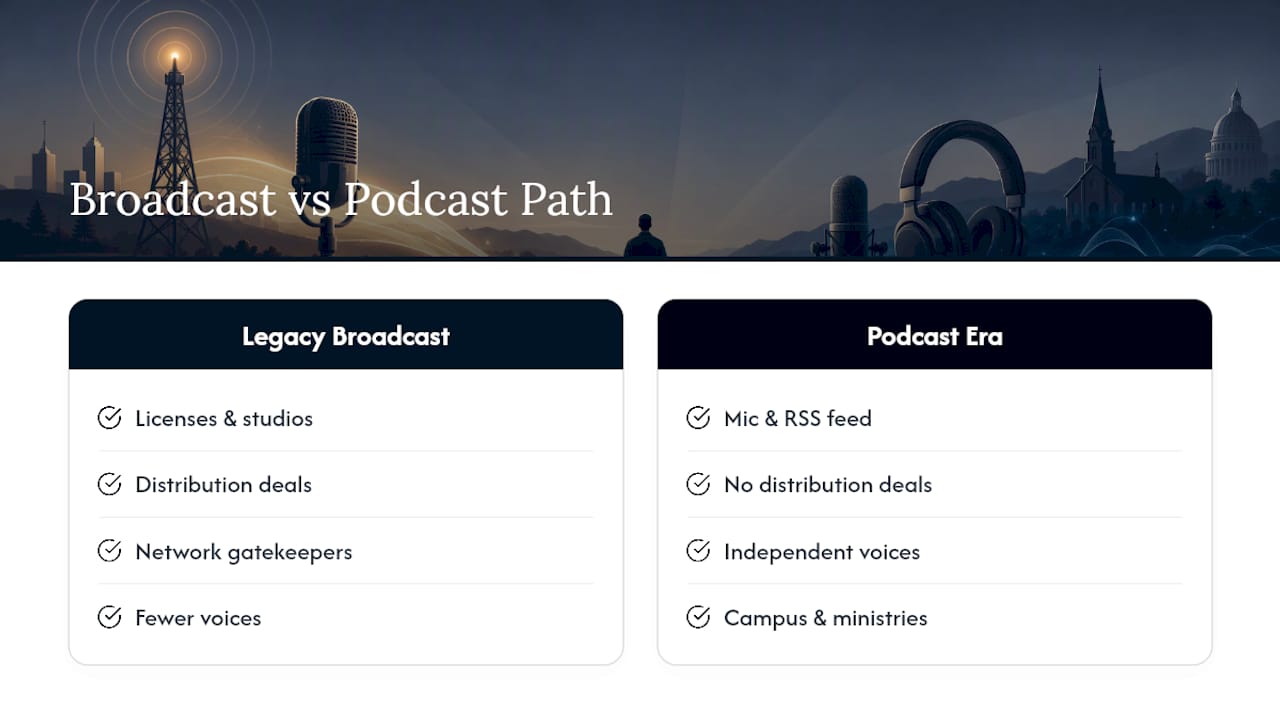
The result is a much wider spread of voices than the old media landscape allowed, but also a much wider spread of quality. There’s no editorial board vetting every episode the way a newspaper op-ed page once was. That makes the listener’s own filtering, checking sourcing, framing, and tone, more important than it used to be, not less.
The Range of Views Inside Faith and Politics Podcasts
Faith and politics podcasts don’t sit on one point of the political or theological map, and treating them as a single bloc misses most of what’s actually out there. Evangelical, Catholic, mainline Protestant, and interfaith shows each bring different starting assumptions about scripture, tradition, and public authority. Some hosts argue from a specific denominational stance; others, like the panel format behind Talkin’ Politics & Religion Without Killin’ Each Other, deliberately mix traditions in a single conversation.
Politically, the spread runs just as wide. Some shows lean conservative and say so plainly. Others aim for a genuinely mixed panel where disagreement is the point, not a bug. And a segment of listeners, as the “politically homeless” framing from outlets like Untangled Faith suggests, are actively looking for shows that critique both major parties from a theological standpoint rather than defending either one.
Knowing where a show sits before you commit to it saves frustration. A listener hoping for a conservative Christian framework will get little from a deliberately balanced interfaith panel, and vice versa. Neither approach is wrong. They’re just built for different listeners with different goals, and matching your own expectations to the show’s actual premise is most of the work.
Who Keeps Showing Up: Hosts and Guests Worth Knowing
A handful of recurring figures shape how faith and politics get discussed on podcasts today. Hosts of institutional shows, like the scholars and religious leaders featured on Belief and Ballots, bring formal academic credentials and tend to frame episodes around research rather than reaction. That academic grounding is one reason those shows are useful benchmarks, since producers who partner with a college tend to include transcripts and bibliographic show notes rather than just a title card.
Independent hosts, by contrast, often build a show around a personal conviction or ministry background. Shemane Nugent’s show on GOPcast fits that model, pairing a distinct personal voice with current events rather than a rotating academic panel.
Guests vary just as widely. Historians and public scholars are frequent guests on shows like Faithful Politics, brought in specifically to unpack movements like Christian nationalism with more context than a news segment allows. Pastors and denominational leaders show up on shows built around theological discernment rather than news analysis. Political figures and campaign staff appear more often on shows with an explicit ideological lean, since those hosts are usually building a specific audience rather than a balanced panel.
Watching who a show books over several episodes tells you almost as much as listening to the episodes themselves. A guest list that never varies in background or viewpoint is a pattern worth noticing.
What to Do After You Finish an Episode
A good faith and politics podcast should leave you with something to follow up on, not just an opinion to repeat. Start with the show notes. Shows with academic backing, like Belief and Ballots, typically link to the research, scripture, or historical events referenced in the episode, which turns a 45-minute listen into a reading list if you want to go further.
From there, a few directions are worth exploring:
- Local church small groups or campus ministry discussions, if a college near you hosts a religion-and-public-life center or similar program.
- Denominational or interfaith study groups built around current events, which exist in many communities and give you a live version of the podcast conversation.
- Direct engagement with the sources cited in an episode, whether that’s a historical document, a theologian’s book, or a specific piece of legislation.
- Other episodes from the same guest, since a scholar or pastor featured once usually has a broader body of work worth checking.
Following up matters more with this genre than most, since faith and politics podcasts are meant to inform discernment, not deliver a finished verdict.
Where These Podcasts Can Mislead You
Every faith and politics podcast has a point of view, and pretending otherwise is the first mistake a listener can make. A host’s denomination, political lean, or funding source shapes which stories get airtime and which get skipped, even on shows that genuinely try to be fair. That’s not a reason to avoid the genre. It’s a reason to listen with a checklist.
Watch for a few recurring limitations. Shows built around a single host’s personality can drift into echo-chamber territory over time, especially if the guest list rarely varies in viewpoint. Sourcing quality varies wildly. Some shows cite primary documents and academic research; others cite headlines secondhand without checking them. And a show’s definition of “civil dialogue” can be looser than it sounds. Producers who say they resist the loudest voices are making a real production choice, but the label alone doesn’t guarantee balance.
The fix isn’t cynicism. It’s diversification. Follow at least one show that leans toward your own convictions and one that deliberately mixes viewpoints, and compare how each handles the same news story. The gap between them tells you more about media literacy than either show alone ever will.
Why Faith and Politics Podcasts Actually Matter
Most credible shows in this space aren’t trying to hand listeners a ballot. Hosts on programs like Faithful Politics describe the goal as helping Christians think theologically about public life, not issuing voting instructions, and that distinction shapes everything from guest selection to episode structure.
Formats built around civil dialogue, like the panel model behind Talkin’ Politics & Religion Without Killin’ Each Other, do something media coverage rarely manages anymore: they let people disagree without treating disagreement as combat. That’s a genuine service in a polarized media environment, not just a pleasant style choice.
This platform functions as an accessible hub where listeners can find conservative faith-and-politics programming without hunting across a dozen apps and feeds.
— GOPcast
Start Listening Without the App-Hopping
Finding a faith-informed political podcast usually means bouncing between five apps, half a dozen show websites, and a lot of dead-end searches. GOPcast skips that by putting curated conservative shows, including faith-and-politics programming, in one place you can browse by category instead of by guesswork.

If you want a news-and-commentary show with a distinct personal voice, The Sentinel Report is a strong sample of what GOPcast’s newsroom-style programming looks like. Prefer a debate-style format? Ringside Politics pairs opposing viewpoints in the same conversation. And if you want political analysis built specifically around a Christian conviction, The Case for America tackles issues most mainstream shows avoid entirely. Pick one, press play on a recent episode, and see whether the framing fits before you commit to a weekly subscription.
Sources
- Belief and Ballots — Saint Anselm College
- Talkin’ Politics & Religion Without Killin’ Each Other | The Democracy Group
- NPR Politics Podcast
FAQ
What Are the Top Political Podcasts Right Now?
The top political podcasts span daily news shows like the NPR Politics Podcast and faith-informed programs like Faithful Politics and Politics By Faith with Mike Slater. For a curated conservative lineup that includes faith-and-politics programming, some platforms group shows like Faith & Freedom and The Case for America in one place.
Is There Such a Thing as an Unbiased Political Podcast?
Every host brings a perspective, so “unbiased” is the wrong bar to set. What you can find are shows that model civil dialogue and disclose their framing upfront, like Talkin’ Politics & Religion Without Killin’ Each Other, which is built specifically around resisting one-sided shouting matches.
What Is the Number One Religious Podcast?
There’s no single universally agreed “number one” religious podcast, since rankings vary by platform, tradition, and audience. Within the faith-and-politics niche specifically, shows like Faithful Politics and Belief and Ballots are frequently cited for their academic guest lists and sourcing.
How Do I Know if a Faith-and-Politics Podcast Is Trustworthy?
Check for named theological framing, sourced show notes, and a guest list that includes more than one viewpoint. Shows backed by academic centers, like Belief and Ballots, tend to include transcripts and citations that make claims easy to verify.
Which Faith Is Declining Fastest in the United States?
Christian affiliation broadly has declined in recent decades according to long-running surveys of American religious life, though the pace and pattern vary by denomination and region. Faith-and-politics podcasts, including academic ones like Belief and Ballots, often address this shift directly when discussing why religious voices matter in public debate.