
The best approach to China policy podcasts isn’t picking one show and sticking with it. It’s rotating through think-tank and university series that each cover a different layer: domestic party politics, foreign and security policy, and Sino-American relations, with historical context mixed in. Freshness matters most around summits and security news, and credentials on both host and guest are your fastest filter for quality.
TL;DR:
- Rotating through different types of China policy podcasts helps cover domestic politics, foreign policy, bilateral relations, and historical context effectively.
- Verify podcast quality by checking the host’s institutional background, episode sourcing, and episode structure; avoid relying on vague claims or unverified sources.
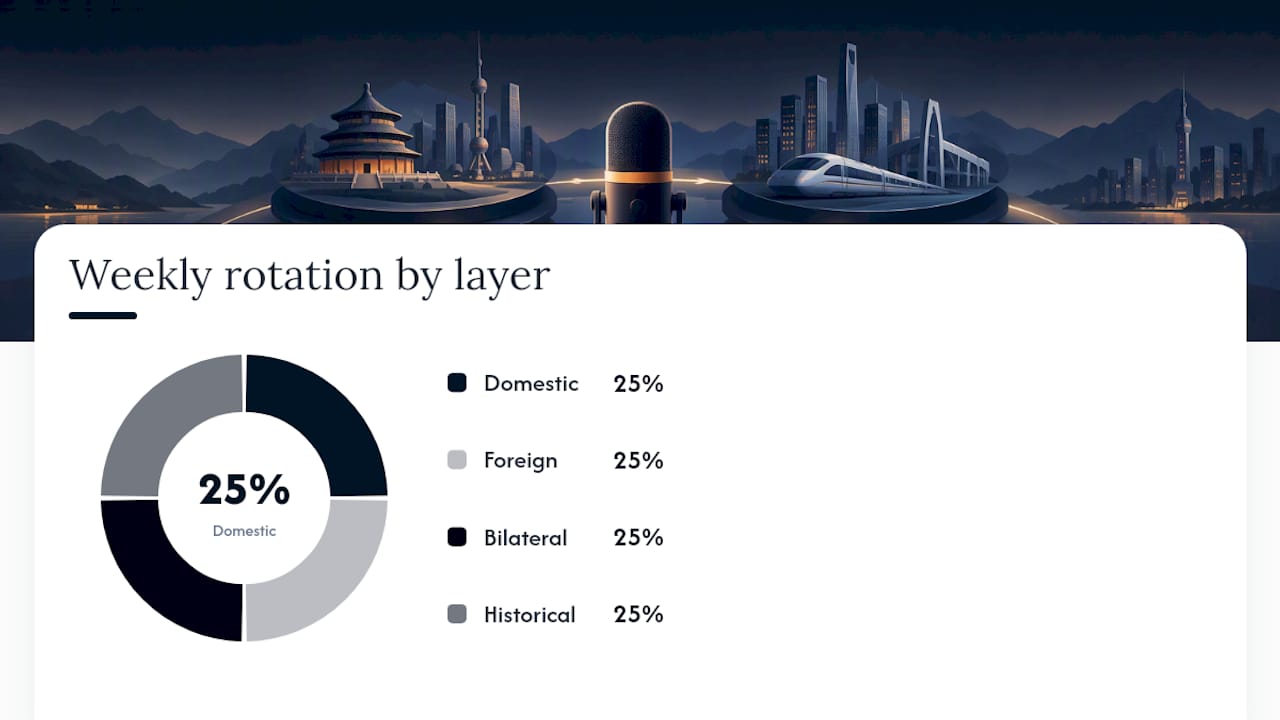
- Focus your listening routine on a balanced weekly mix: one domestic episode, one foreign or security episode, one on U.S.-China relations, and one historical or contextual.
- Use transcripts, linked research, and season topics to build a research-grade workflow and deepen understanding of complex issues.
- Prioritize fresh episodes during summits or security events, but revisit older long-term analysis for historical and structural topics to maintain perspective.
Table of Contents
- What Makes a Good China Policy Podcast (And How to Vet One)
- Building a Listening Rotation Across Four Policy Layers
- Turning Episodes Into a Research-Grade Workflow
- Keeping Up With New Episodes Without Losing the Thread
- Beyond Podcasts: Books, Reports, and Databases Worth Pairing With Your Queue
- GOPcast’s Take: Curation Without Blind Trust
- Where to Start Listening and Reading Further
- Sources
- FAQ
What Makes a Good China Policy Podcast (And How to Vet One)
Anyone can record a podcast and call it China analysis. The gap between a serious policy show and a commentary show pretending to be one shows up fast if you know where to look.
Start with the host. Is this person affiliated with a research institution, a university, or a former government post? Someone like Elizabeth Economy, who hosts China Considered at the Hoover Institution with a background spanning academia and government service, brings a different rigor than a generalist news commentator riffing on headlines. That doesn’t mean former officials or academics are always right. It means their claims come with a paper trail you can check.
Before you hit play, read the episode description and the guest’s bio. A five-minute scan tells you whether the guest is a regional specialist, a journalist, or someone with only tangential expertise dressed up as an authority. Programs that link source documents, prior research, or a transcript in the show notes are doing you a favor: you can verify a claim instead of taking it on faith.
Season and series structure matters too. Shows organized around themed seasons, the kind Georgetown’s U.S.-China Nexus Podcast uses, let you go deep on one subject, such as military affairs or global health engagement, rather than jumping between disconnected topics’ episode to episode.
A few production details are worth checking too:
- Format: Interview, roundtable, or monologue. Roundtables surface disagreement; solo monologues surface one person’s frame.
- Frequency and length: Weekly 30 to 45 minute episodes usually signal a sustainable, well-resourced production; sporadic 90 minute drops can mean less editorial discipline.
- Sourcing transparency: Does the host name specific documents, data, or reports, or just assert things?
- Opinion vs. analysis: Analysis explains mechanisms and cites evidence; opinion states conclusions and moves on.
Pro Tip: Before subscribing, listen to one full episode from the middle of a season, not the pilot. Pilot episodes are often looser and less representative of the show’s steady-state quality.
Watch for red flags: guests introduced with vague titles like “China expert” and no institutional anchor, claims about internal Communist Party deliberations with no sourcing offered, and hosts who treat speculation as settled fact. These aren’t automatically disqualifying, but they should lower your confidence in any single unverified claim.
Building a Listening Rotation Across Four Policy Layers
Ranking individual shows is less useful than understanding what each type of program is built to tell you. China policy splits cleanly into four layers, and a well-built rotation touches all four.
- Domestic and party politics. This layer covers Communist Party decision-making, leadership dynamics, and internal governance. Pekingology from CSIS sits squarely here, unpacking how party politics shapes both domestic and foreign policy, with 2026 episodes covering China strategy, Central Asia, and China-Russia ties. Evidence in this layer tends to come from party documents, leadership speeches, and personnel moves.
- Foreign and security policy. This layer tracks defense posture, technology competition, trade instruments, and maritime disputes. China Global from the German Marshall Fund focuses here, covering economic statecraft and China’s relations with Europe and the Global South. Expect evidence drawn from defense white papers, trade data, and regional case studies.
- Sino-American relations and diplomacy. This layer zeroes in on the bilateral relationship specifically: summits, trade negotiations, and diplomatic friction points. Episodes here often reference joint statements, congressional testimony, or State Department readouts.
- Historical and contextual episodes. This layer explains how China got here. Programs pairing history with current policy, the approach Elizabeth Economy takes on China Considered, help you understand why today’s disputes over Taiwan or trade didn’t appear out of nowhere.
One useful framing: separate shows analyzing party-level domestic governance from those built for strategic, country-level analysis, rather than lumping every China show into one undifferentiated bucket.
A minimal weekly rotation looks like this: one domestic-politics episode, one foreign or security-policy episode, one bilateral U.S. China episode, and one historical or contextual episode. During a summit, a Taiwan flashpoint, or a major trade announcement, increase the frequency of foreign-policy and bilateral episodes and let the historical layer slide to biweekly.
Mix formats within that rotation too. Long-form interviews, the 45 to 60 minute conversations typical of season-based series, give you depth and nuance on a single topic. Shorter topical episodes, often 20 to 30 minutes, are better for tracking a fast-moving story like a new export control announcement or a diplomatic exchange. Lean on long-form when you’re building foundational understanding of a topic; lean on short-form when you’re tracking something that changed this week.
Turning Episodes Into a Research-Grade Workflow
Listening passively is fine for general awareness. If you actually want to retain and cite what you hear, treat your podcast queue like a research pipeline instead of a playlist.
Start with search terms that filter for quality. When browsing an episode archive or search results, try keywords like “transcript,” “season,” “policy,” and the guest’s institutional affiliation. Episode pages that include these terms tend to belong to programs built for study rather than casual listening.
Save transcripts and linked research whenever they’re available. Think-tank and university podcast pages, unlike many commercial news shows, reliably post transcripts and linked citations alongside the audio. That means you can go back and quote a guest precisely instead of paraphrasing from memory.
A few workflow habits make a real difference:
- Subscribe via RSS instead of relying on app recommendations, so you never miss an episode from a smaller, more specialized show.
- Use season or topic-tag pages on program sites to pull every episode on a single subject (Taiwan, semiconductor policy, a particular leadership transition) into one study block.
- Bookmark episode pages rather than just downloading the audio; the page usually has the show notes, transcript link, and cited sources you’ll want later.
- Take notes in a claim/evidence/source format as you listen: what was claimed, what evidence backed it, and where that evidence originally came from.
Pro Tip: When a guest cites a specific report or data point, pause and note it immediately. Chasing down “that stat the guest mentioned around minute 20” after the episode ends almost never works.
Timeliness matters more for some topics than others. Episode freshness is especially important around summits, Taiwan developments, technology disputes, trade actions, and security incidents, where an episode recorded even two weeks earlier can already be outdated. For steady, structural topics like historical context or long-run economic trends, older episodes hold their value much longer.
Keeping Up With New Episodes Without Losing the Thread
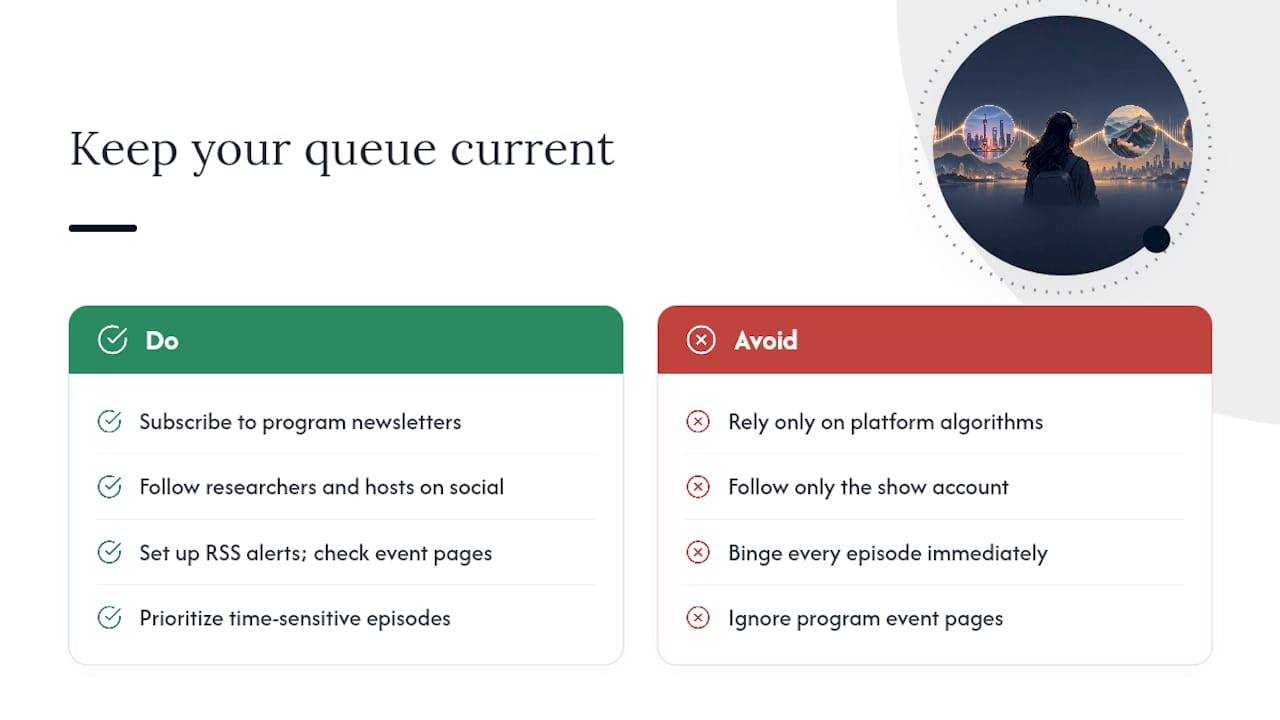
New China policy episodes drop constantly, and app algorithms are not built to prioritize the ones that matter most to a serious listener. A few habits keep your queue current without turning podcast tracking into a second job.
Subscribe directly to program newsletters when they’re offered. Think-tank podcasts are often tied to a broader research program, and the newsletter will flag not just new episodes but the reports and events those episodes are built around. That context is often more useful than the episode alone.
Follow the researchers and hosts on social platforms rather than just the show account. Individual scholars frequently post ahead of a recording or link supplementary material the episode itself doesn’t cover in full.
Set up RSS alerts through a podcast app that supports them, rather than relying purely on a platform’s algorithmic feed, which tends to surface popular shows over specialized ones. And check program event pages periodically. Many China-focused podcasts are recorded alongside public panels or briefings, and the event page often previews what an upcoming episode will cover before it’s published.
Finally, resist the urge to binge everything the moment it drops. A 45 minute episode on a fast-moving trade dispute deserves a same-week listen; a historical deep dive on Qing dynasty foreign relations can wait a month without losing relevance.
Beyond Podcasts: Books, Reports, and Databases Worth Pairing With Your Queue
Podcasts are a strong entry point, but they’re an audio summary of research that usually exists in fuller form elsewhere. Pairing your listening with written material closes the gaps that a 40 minute conversation can’t fill.
When a guest references a report during an episode, track down that report directly. Congressional testimony, think-tank policy briefs, and government white papers are usually the actual evidentiary base a podcast conversation is built on, and reading the source lets you check whether the host’s summary matched the underlying document.
Academic databases and institutional archives are worth building into your routine too, particularly when a podcast touches a historical event you don’t already understand well. A single footnote in an episode transcript can lead you to a far more detailed academic treatment of the same topic.
Books remain the best format for connecting the dots a podcast rotation naturally fragments. An episode on semiconductor export controls makes far more sense once you understand the broader arc of China’s industrial policy, and that kind of long-run narrative is still better served by a book than by any single 45 minute conversation.
GOPcast’s Take: Curation Without Blind Trust
GOPcast exists to make conservative political audio easy to find in one place, organizing shows by category, including our Newsroom Podcasts hub, so listeners aren’t hunting across a dozen apps for the programs they trust.
On a topic like China policy, that same instinct toward curation should extend to how you personally evaluate what you hear, regardless of the source. A guest’s ideological lean tells you something about their framing, but it tells you almost nothing about whether their underlying facts are correct. We’d rather listeners pair strong-opinion commentary with transcript-backed, credentialed policy shows than pick one and treat it as gospel. The strongest listeners aren’t the ones who found the “right” show. They’re the ones who built a rotation wide enough that no single host’s blind spot becomes their own.
— GOPcast
Where to Start Listening and Reading Further
A few program hubs are worth bookmarking directly:
- Pekingology (CSIS): domestic party politics and how internal decision-making shapes China’s foreign posture.
- China Global (German Marshall Fund): foreign and security policy, including defense, technology, and economic statecraft.
- U.S.-China Nexus Podcast (Georgetown): season-themed episodes covering military affairs, global health, and regional relationships.
- China Considered (Hoover Institution): long-form conversations pairing history with current policy.
Use each site’s season or topic filters to pull every relevant episode into a single study block instead of hunting one at a time. If you’re building your broader conservative political listening lineup alongside your policy research, GOPcast’s show pages organize commentary and interview programs the same way, by show and by category, so you can move between analysis and commentary without losing track of either.
Sources
Most of the strongest China policy programs are English-language and internationally oriented, produced by research institutions built around English-language scholarship. That’s not a knock on Chinese-language sources. It’s a practical reality: English-language shows dominate the transcript-and-citation ecosystem that makes verification possible.
When a Chinese-language source or a guest speaking from inside China enters the conversation, a few checks matter more than usual:
Cross-checking across multiple episodes before treating a claim as settled is a habit worth building regardless of language. If two independently produced shows, drawing on different guests, converge on the same interpretation of an event, that convergence is worth more than any single confident-sounding claim.
FAQ
What is the best podcast about Chinese history?
For history paired directly with current policy, China Considered with Elizabeth Economy is a strong fit, since it draws on academic and government experience to connect past events to present decisions. Pure history podcasts exist too, but pairing history with policy analysis tends to be more useful for understanding why current disputes look the way they do.
Are there good Chinese-language podcasts worth following?
Chinese-language sources can add valuable primary perspective, but check whether the episode includes a verified translation or transcript before treating claims as settled. English-language, internationally oriented policy programs remain the more consistently documented option for listeners who need citable, transcript-backed material.
What is the best documentary about Chinese history?
This article focuses on podcasts rather than film, so a specific documentary recommendation falls outside what’s covered here. For video treatments of Chinese history, look for productions tied to established academic institutions or major broadcasters, and apply the same credential check you’d use for a podcast host.
How often should I refresh my China policy podcast queue?
Weekly for foreign-policy and bilateral episodes, since freshness matters most around summits, trade actions, and security developments. Historical and domestic-politics episodes hold their value longer and can be refreshed every two weeks without losing relevance.